"...we should pass over all biographies of 'the good and the great,' while we search carefully the slight records of wretches who died in prison, in Bedlam, or upon the gallows."
~Edgar Allan Poe
Showing posts sorted by relevance for query judy smith. Sort by date Show all posts

Monday, January 28, 2019

Judy Smith's Final Destination: A Bizarre Murder Mystery


Judith "Judy" Eldridge did not have a particularly easy life. She was born in 1946 into a working-class family in Massachusetts. When she was just out of high school, she entered into a marriage which failed almost immediately. Her husband abandoned her when he fled to Sweden to avoid being drafted into the Vietnam War. Her second marriage, to a thoroughbred racetrack worker named Charles Bradford, produced a son and daughter, but this union also soon ended. Judy Bradford found herself divorced, without a job, and with two small children to raise alone.

Fortunately, she was more than equal to the challenge. She managed to care for her youngsters while simultaneously putting herself through nursing school. She worked hard, got herself out of welfare, advanced rapidly through her chosen profession, and brought up two fine children. She was the classic single-mother success story. Judy Bradford was a smart, assertive, take-charge sort of person who took pride in her street-smarts and ability to look after herself.

While working as a home-care nurse for a dying Boston man, Judy became acquainted with her patient's son, a successful lawyer named Jeffrey Smith. A romance soon developed between the two. After being together for ten years, the couple finally married in November 1986. The long wait for the wedding bells appears to have been Judy's idea. After so many years of independence (not to mention two failed marriages) she was understandably uneasy about a third trip down the altar. However, when she finally did take the plunge, it seemed like she had finally found domestic bliss. The pair had every reason to expect a long and prosperous life ahead.

Instead, what soon followed was deep tragedy and inexplicable mystery.

On April 9, 1997, only five months after their wedding, the Smiths headed for Logan International Airport. They were planning to attend a pharmaceutical conference in Center City, Pennsylvania, where Jeffrey, a expert in health-care law, was to moderate a panel. At the airport, Judy realized she had forgotten to bring her photo ID, so she was unable to get on their plane. The pair decided that Jeffrey would take their scheduled flight alone, while Judy would follow him on another flight that left later that day. She made it to their Philadelphia hotel at around 10 p.m. The couple shared a room service pizza and went to bed.

The next morning, Jeffrey left their room to grab some breakfast in the hotel restaurant. According to his later story, Judy was just about to step into the shower. Their plan was that she would spend the day sightseeing while he attended the conference. That evening, they would meet with friends for dinner.

When Judy failed to return to their hotel room during the day, her husband assumed she was merely touring the city. However, when nightfall arrived with no sign of her, Jeffrey became alarmed and contacted the police. A detective informed him that it was too soon to launch a search. Chances were that she merely stayed out later than she had planned. She would probably turn up alive and well at any moment.

The next morning, Judy was still missing. This time, Jeffrey and his friends not only phoned police, they contacted various media outlets and the city's mayor. This barrage of publicity had its effect. Six detectives were instantly assigned to track down this missing tourist. Judy Smith had been transformed into a high-profile case, and an intensive search was made for her throughout the city. Posters with her photo and description were plastered everywhere. Numerous "sightings" of the vanished woman were reported in and around Philadelphia, but police generally dismissed them as unreliable. Not the slightest trace of Judy was ever found in the metropolis. Police had no idea where Judy Smith could be. Indeed, despite the fact that her plane ticket to Philadelphia had been used, detectives began to wonder if Mrs. Smith had ever truly been in the city at all. In an article about the case in the August 31, 1997 "Philadelphia Inquirer," Detective Anthony Buchanico was quoted as saying, "I don't think she's in Philadelphia any longer, if she ever was. We had a lot of people searching; if she was here very long, we would have found her. Or if something happened to her, we would have found her body." Another investigator noted, "She was supposedly here one night, then went off by herself the next morning. But she had friends at the convention, and nobody saw her." Yet another detective mused, "There were so many strange coincidences you don't know what to think. She didn't get on the plane with him. They meet in the lobby. They go to breakfast separately. And she doesn't have much female stuff in the hotel room..."

From these quotes, you can probably guess the trend of the detectives' thinking. However, Judy's family and friends expressed outraged disbelief at the hint that Jeffrey could have been behind his wife's disappearance. They all described him as a gentle, honest, affectionate man who would never hurt anyone. Judy's daughter Amy told the "Inquirer," "If he says she was in Philadelphia, she was there. It makes me mad that there's any doubt at all about that." In any case, Jeffrey was a severely overweight man with a number of health problems. Even if he had been emotionally capable of disposing of his wife, he definitely was not physically able to do so.

Jeffrey himself was equally adamant that his wife would not have disappeared voluntarily. "She was happy," he insisted. "And even if she did want to run away, why would she go to Philadelphia to do that?" He could only theorize that while touring the city, Judy somehow became disoriented and wandered away somewhere outside of Philadelphia, perhaps to be put into some sort of institution without anyone knowing who she was.

Could she have been the victim of a street crime? In any large city, that's always a dangerous possibility. However, it seemed unlikely that someone so brave and feisty could have been harmed or kidnapped without anyone noticing. Judy Smith was never afraid to make a loud scene.

Did she go off to start a new life and career? Some of Judy's friends told investigators that she found marriage somewhat confining, and that Jeffrey wanted her to socialize more than she liked. They believed she genuinely cared for her husband, but giving up her independence was hard. However, no one who knew her believed she would abandon her children. Plus, Judy was an outspoken person, not one to keep her feelings to herself. Those who knew her believed that if she wanted out of her marriage, she simply would have said so. Her personality also ruled out suicide. "She's not the type to quit," said one friend.

Jeffrey Smith's suggestion that she had become mentally confused was also seen as improbable. Just two weeks before her disappearance, Judy had a physical, and was completely healthy.

In short, there was no obvious reason for Judy Smith's disappearance. Amy Bradford sighed, "Rationally, I know something must have happened to her. But I try to think that she left on her own and she's OK, even though I know she wouldn't do that. But I try to think she did, because that helps my peace of mind."

Sadly, Judy Smith was not "OK." Just one week after Amy's hopeful words were published in the "Inquirer," a couple of hunters in a remote, isolated area in North Carolina's Pisgah National Forest came across something horrifying: human remains. A woman's corpse had been wrapped in a blanket and buried in a shallow grave. Animals had later dug up parts of the body, scattering them around the scene. Some personal effects, including a backpack and shirt containing nearly $200 in cash, were found there as well. Dental records were able to establish that these bones were all that was left of Judy Smith. Holes in her bra and cut marks on the bones led investigators to suspect she had been stabbed, although the cause of her death could not be positively determined.

This grim discovery transformed Judy's disappearance from merely mysterious to bafflingly bizarre. How did the dead woman travel 600 miles from where she was last seen? No evidence could be found of her taking a plane, bus, or rental car. And why North Carolina, considering that she had no ties to the area, and had never expressed a desire to visit that region of the country? Adding to the puzzle was the fact that when she died, she was wearing hiking clothes that were completely different from the ones she had on when she vanished.  The personal items found by the body were not known to belong to Judy, and her distinctive red backpack, which she always carried with her in lieu of a purse, has never been found.

Several people reported seeing a woman matching Judy's description in the Asheville area. A clerk at a local store believed she had talked to her in April. The woman seemed pleasant and completely normal, saying that her husband was a Boston attorney, attending a conference in Philadelphia, and "during that time she had just decided to go to the Asheville area." An employee at the Biltmore Estate, the owner of an Asheville campground, and a local deli owner all claimed to have interacted with her. She may even have applied for a job in a doctor's office. Investigators found these accounts credible, but they did absolutely nothing to solve the riddle of her death. Police believed she had gone to North Carolina voluntarily, and that she had been killed where the body was discovered. But what on earth was she doing there, and who would have wanted her dead?

Although police could never bring themselves to completely rule out Jeffrey Smith as a suspect, he died in 2005 almost certainly completely ignorant of how his wife came to her gruesome end. The sheer weirdness of this relatively recent case has given it a fair amount of fame on the internet. True crime devotees and armchair detectives have offered a great deal of online speculation about Judy Smith's disappearance and death, but to date, that is all anyone has: speculation.

Tuesday, December 31, 2019

The Best of Strange Company 2019


Greetings!  As has become my end-of-year tradition, I'm taking a look back at the posts which were most popular--or, if you prefer, least-unpopular--of the past twelve months.   Disappearances happened to be the biggest draw in 2019, although ghosts, kidnappings, and people making damn fools of themselves over cats also made strong showings.

So, in order, with the most-read first, here we go!

1. Judy Smith's Final Destination: A Bizarre Murder Mystery

This was most-read by a pretty healthy margin, which doesn't surprise me, as the story is about as weird as they come.

2. A Vanishing in Idaho: The Lillian Richey Mystery

Another woman's inexplicable disappearance.  It's not as well known as the Judy Smith case, but it's nearly as strange.

3. The Mystery of the Meowing House

A  California family has a cat trapped in their house...and you won't believe what happened next.

4. The Case of the Haunted Necklace

Why using ancient tombs as gift shops is really a bad idea.

5. The Creature of Charterhouse

This unusual ghost story was a favorite of mine from the past year.

6. Disappearance in the Desert:  The Walker/Martens Mystery

A young couple lands their plane in the middle of a desert, start walking...and are never seen again.

7. The Lost Boy:  The Mystery of Melvin Horst

The unsolved presumed kidnapping of a small child.

8. "Where is Olive?" An Unusual Poltergeist Account

A young woman haunts her old home...while she's still alive.

9. Guest Post: Peggy Gavan, Author of "The Cat Men of Gotham"

Please don't make your cats blue.  Figuratively or literally.

10. Carl Jung's Ghost Story

A famed psychiatrist's brush with The Weird.

And so comes to an end this blog's final post for 2019.  I hope you will join me in 2020 for more disappearances, ghosts, murders, and, God willing, more people making damn fools of themselves over cats.

Happy New Year!


Monday, May 18, 2020

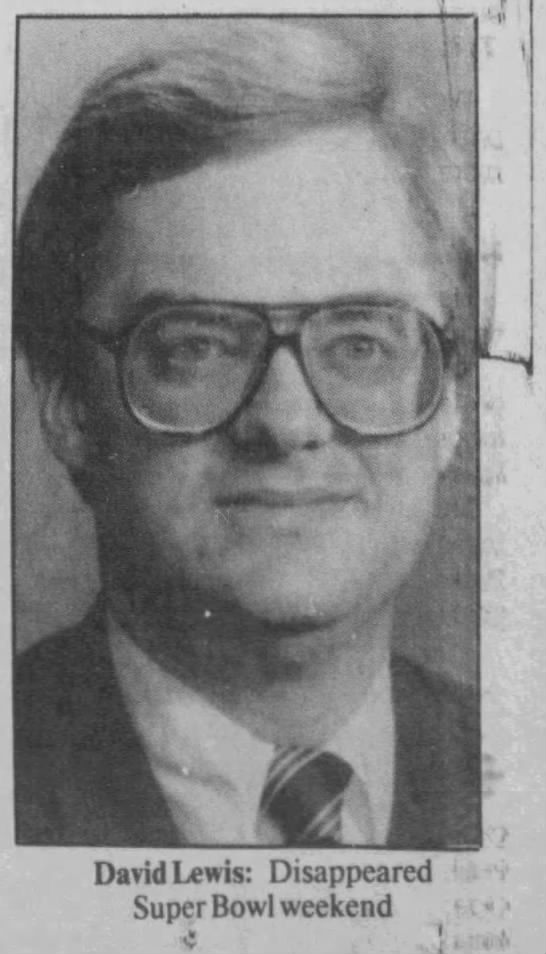
The Mysterious Death of David Glen Lewis

Fort Worth Star-Telegram, June 27, 1993, via Newspapers.com


When I wrote about the disappearance and death of Judy Smith a while back, I thought I would probably never come across another missing-persons case that strange and illogical. However, it turns out that in 1993, a Texas man met a somewhat similar fate. And unfortunately, it remains to date equally unresolved.

39-year-old David Glen Lewis was an Amarillo attorney and former court-at-law judge. He was described as a kind, generous, deeply religious man involved in charity work. On January 28, 1993, Lewis’ wife Karen and their young daughter Lauren went to Dallas for some shopping. When they returned home on the 31st, they found David’s wedding ring and watch on the kitchen counter. The VHS player was set up to tape the Super Bowl. There were two freshly-made turkey sandwiches in the refrigerator, and laundry in the dryer. The house looked normal and undisturbed. Nothing appeared to be missing...except David.

At first, Karen assumed David had gone to a friend’s house to watch the game. But when she failed to hear from him the following day, Karen contacted the police.

Investigators were able to establish at least a partial timeline of David’s activities right before his disappearance. On January 28, he left his law firm at around noon. He told coworkers that he was feeling unwell, and was returning home. That afternoon, his credit card was used to buy gas. That night, he taught a government class at Amarillo College. The next day, a friend saw him hurrying through Amarillo’s airport. He was not carrying any luggage. On January 30, someone deposited $5,000 in the Lewis’ joint bank account. A neighbor saw Lewis’ car parked outside his home. On February 1, a sheriff’s deputy saw a man resembling Lewis outside downtown Amarillo’s Potter County Courts Building. That same day, a cab driver drove someone whom he believed was Lewis from a hotel to the Dallas/Fort Worth airport. The driver said the man seemed very nervous, and paid in cash.

On February 2, Amarillo police found David’s car parked in front of the court building. The keys for his house and car were under a floor mat. His checkbook, credit cards, and driver’s license were also inside. (David normally kept those items in the car.) Karen confirmed that none of his personal possessions were missing from their home. As strange as all this was, police found no evidence of foul play. Then, they learned that someone had bought two plane tickets in David’s name. One, for a flight from Dallas to Amarillo, had been purchased on January 31. The other ticket, from Los Angeles to Dallas, was bought the following day. (It is not clear if these tickets were ever used.)

All this led investigators to conclude that, for whatever unknowable reason, David had disappeared voluntarily. However, Karen Lewis thought differently. She was adamant that he would never leave without taking at least some personal items and without contacting relatives. He had recently told her his life was in danger, although he refused to give any details. She told police that David vanished just before he was to testify in a malpractice suit filed against his former law firm. He apparently had a lot of information about the wrongdoings of his former partners, and he was not afraid to share it. Karen believed this lawsuit was directly tied to David’s disappearance, although she nervously told a reporter that she was afraid to say anything more. She added that David’s files regarding the lawsuit had vanished. Despite this ominous information, investigators, lacking any new leads, shelved the case. Unless David Lewis turned up--alive or dead--his whereabouts seemed fated to remain a mystery.

The years went by, without any clues to Lewis’ disappearance coming to light. Then in 2004, a Washington State Patrol Detective named Patrick Ditter read a newspaper story about unsolved missing-person cases, which inspired him to see what could be done using the internet. He focused on about a dozen local cold cases, including a very odd hit-and-run mystery.

On February 1, 1993, at about 10:30 p.m., a man was walking alongside Washington 24, just outside the small town of Moxee, Washington. He was fatally struck by a car which was never identified. The dead man had no identification on him, and efforts to learn who he was had failed. His case had languished in obscurity ever since. Ditter did Google searches on the man’s physical characteristics--height, weight, and so on--which led him to various missing-persons sites. When he came across a photo of David Glen Lewis, he noted the strong resemblance to a picture of the Moxee corpse. However, the hit-and-run victim was missing Lewis’ distinctive glasses. Ditter checked an evidence list of items recovered from the place where the man had been run over. Eyeglasses were on the list. Fortunately, the clothing the dead man had worn--military-style fatigues and work boots--had been preserved. Ditter found the glasses among these clothes. And they were identical to the ones worn by Lewis. DNA analysis confirmed the bizarre truth: The man killed outside of Moxee and the missing David Lewis were one and the same.

This revelation only partially solved this dual mystery. What was Lewis doing walking seemingly aimlessly along a highway 1,600 miles from where he was last seen, in an area where he had no known ties? How did he get there? His family was convinced he had been kidnapped, but by whom? And why? If such was the case, how did he escape? Was the hit-and-run merely a tragic accident, or something far more sinister?

Sadly, no one has answers for any of these questions.

Monday, November 28, 2022

The Devil's Rocking Chair; Or, The Dangers of Buying Discounted Antiques


Fifteen-year-old Jody Randall of Long Beach, California, was in most ways a typical suburban teenager.  The one thing that set her apart was a passion for antiques which was unusual for someone of her youth.  As a result of spending all her available free time (and her parents’ money) on her hobby, she eventually amassed some impressive pieces, including a doll collection noteworthy enough to earn a writeup in “Teen” magazine.

In the summer of 1970, she sold a vintage French doll to an antique dealer named Marge Lord.  While in Lord’s shop, Randall saw a heavy, ornate rocking chair dating from about 1550, of a style known as “Black Forest sleigh.”  The girl was fascinated.  She knew instantly that she must buy it, even though when she sat in the chair, she had the disconcerting feeling that invisible arms were tightly holding her waist.

Lord told Randall that she didn’t want to sell the chair, but an offer of $1,250 might change her mind.  This was way over Jody’s budget, but the teen was in love.  All she could think of was trying to find some way to get enough money to make the chair her own.

In August, Lord phoned Jody to say that she was now willing to give her the chair for $800.  Randall could even pay her in installments!  Jody was so thrilled to get the antique buy of her dreams, she never stopped to wonder why Lord’s feelings about the chair had changed so abruptly.

By early September, the chair was gracing the Randall living room.  It was not long before the family noticed that there was something…odd about their new acquisition.  No matter how well-lit the room was, the chair appeared to be in darkness, as though it was surrounded by a murky fog.  One afternoon, as Jody sat reading on the floor next to the chair, she suddenly felt a weird blackness surrounding her, leaving her immobilized.  She could not even speak.  After a period of time--she couldn’t even say how long--the dark haze disappeared, leaving her back to normal.  Telling herself that the creepy experience was all in her head, she decided not to mention it to anyone.

About a week later, the black veil again enveloped her--only this time, she saw “hellish-looking yellow eyes” appear over her head.  The terrified girl felt some evil presence was trying to possess her.  The eyes soon disappeared, but the black fog clung to her for some time.  After it finally vanished, Jody was left completely exhausted.

Jody began to feel frightened whenever she was in her house.  She had the sense that some sinister presence was stalking her.  The family’s Yorkshire terrier, Girl Dog, appeared to share the girl’s fear.  Girl Dog avoided the living room, and whenever she was alone in the house, the Yorkie would go next door to the home of Jody’s grandparents, begging to be let in.

One day in October, Jody and her mother were sitting in the living room, when the girl suddenly saw two bats fly through the room.  Her mother had seen nothing.  However, the next day, when Mrs. Randall and some visitors were in the living room, they all saw a weird light appear.  The whole family began to hear strange tapping on the walls, and the sound of invisible hands banging on the front door.  One evening, Mrs. Randall saw the heavy wooden chair vigorously rocking on its own.

Soon after this, Jody was in the kitchen when she heard loud scuffling noises coming from the living room, as if people were fighting there.  When she entered the room, she saw the chair rocking.  She then heard mocking laughter and a voice saying, “Soon she will be in my power.”  After this, the girl frequently woke up in the night to the sound of some invisible being breathing hoarsely in her bedroom.

It began to dawn on Jody why Marge Lord became so willing to sell the chair.

Despite all this, Jody’s father, Jim Randall, remained skeptical.  He did not believe in ghosts, or evil spirits, and remained convinced that the household was suffering from nothing worse than an outbreak of overactive imaginations.  However, realizing that his daughter was genuinely terrified, he offered to buy the chair from her.  He explained that if he became its official owner, she would then be left in peace.  Jim gave Jody $10, and she gave him a formal receipt.

Jim moved the chair to their garage, jokingly telling the antique that if it didn’t behave, he would turn it into kindling.  A few days later, as Jim was gluing formica to a wall, the can of glue mysteriously exploded, covering his legs with burning adhesive.  His burns were so severe he needed a series of skin grafts.

After Jim was hospitalized, his panicked family--now thoroughly convinced something satanic was going on--went to a family friend, Nadine, who was a clairvoyant.  After meditating near the chair, Nadine stated that she saw a monk standing near the rocker, and another man sitting in it.  She sensed that the sitting man was a ruler somewhere in Northern Europe who had sent very many people to their deaths.  She said it was the most disturbing vision she ever had.

Being exiled to the garage did nothing to stop the chair’s malevolent properties.  One day, when Mrs. Randall went to the garage to feed the cat, she saw the chair do its ominous rocking.  A few days later, Jody’s grandmother entered the garage.  She saw nothing, but felt such an air of unease that she left as soon as possible.  The minute she reentered the house, a large ladder that was leaning against the house inexplicably crashed to the ground.

Shortly after this episode, a friend of Judy’s named Bob Anderson playfully sat in the chair and announced that the rocker didn’t scare him.  That night, he was in an auto accident which nearly killed him.

The Randalls--rather late in the day, one would think--decided it was time to get rid of the chair.  A local antique dealer put the chair on sale, without attracting any buyers.  Then, the Randalls had the ingenious idea of writing to Anton LaVey, the notorious founder of San Francisco’s Church of Satan.  The family explained to him that they appeared to have a demon-possessed rocking chair on their hands, and--considering his line of work--they asked if he would be interested in acquiring it.

LaVey was delighted at the idea, and offered them $500.  He cheerfully explained that it was entirely possible to live peacefully with such entities, if you only understood them.

Journalist Marilyn Estes-Smith, who wrote an article about the chair in the July 1973 issue of “Fate Magazine," asked Marge Lord about the rocker’s history.  Lord explained that she had bought the chair from a Mrs. Conger.  She had planned to keep it for her own use, but after coming into the room one day to find the chair rocking on its own, she thought it might be a good idea to let young Miss Randall have the thing.  When Mrs. Conger was contacted about the chair, she became very upset and refused to even talk about it.

The backstory of this antique chair will probably forever remain a mystery.  At least Mr. LaVey had a happy ending from the story.  It’s not every day that a satanist can pick up a cursed rocking chair on the cheap.