"...we should pass over all biographies of 'the good and the great,' while we search carefully the slight records of wretches who died in prison, in Bedlam, or upon the gallows."
~Edgar Allan Poe
Showing posts with label libelous tombstones. Show all posts

Monday, October 20, 2025

The Return of the Libelous Tombstones

A while back, I did a post sharing some outstanding examples of that little-discussed, but thoroughly endearing phenomenon I’ve dubbed “libelous tombstones.”  Epitaphs are usually solemn and respectful things, but surprisingly often, they are used as vehicles to insult the dead (and the living,) make defamatory remarks, and generally raise hell.  

And I for one applaud them for it.

In the older days, at least, the practice was so common that before I knew it, I had accumulated enough news items on the subject for a sequel.  (Yes, I have a whole file of them, which I suppose is further evidence that my laptop would make fascinating material for anyone studying abnormal psychology.)

Let’s kick things off with this family dispute from the “Yorkshire Argus,” June 23, 1914:

Consett magistrates were asked by Mr. R. W. Rippon, a London barrister, to issue summonses for an alleged libel published upon a large stone cross that had been erected in Benfieldside Cemetery to the memory of the applicant's father. Rippon's complaint was that while his father's name was inscribed upon the front of the stone, the name of his first wife, who was Mr. Rippon's mother, was upon the side in small letters. The name of the second wife of Mr. Rippon’s father, however, had been inscribed prominently and immediately before the name of the appellant's father. 

Proceeding, Mr. Rippon contended that undue prominence had been given to the name of the second wife, white that of his mother had been subjected to a criminal libel.  He therefore asked for a summons against Elizabeth Rogerson, a legatee, the Benfieldside Burial Board, and J. Hamilton, clerk to the board.

In answer to the presiding magistrate, Mr. Rippon said the stone had been erected on the instructions of Elizabeth Rogerson, who had paid for it.

The magistrates eventually suggested that charges should be formalized in writing and be forwarded to the clerk before the next sitting of the court.

"Montreal Gazette," August 2, 1915, via Newspapers.com


The above reflects a somewhat complicated story.  Charles Becker, an ex-New York police officer, had been tried and convicted of the then-notorious murder of bookmaker Herman Rosenthal.  Becker was executed on July 30, 1915.  Becker was no angel--he was part of a police protection racket protecting the illegal gambling operations.  Rosenthal evidently blabbed to reporters, leading to Becker allegedly hiring Mafia hit men to eliminate the overly-chatty bookie.  However, Becker went to the electric chair protesting his innocence to the last, and there are crime historians who believe he was telling the truth.

Further murder accusations were noted in this item from the “Leavenworth Post,” September 17, 1912:

Appleton, Wis., Sept. 17.--Unless a monument over the grave of a little girl in the cemetery at Maine, a small town near here, is removed this week, or the inscription is completely obliterated, the municipal court will be asked to order the father of the child to remove it. The action is the outgrowth of the wording of the epitaph, which is as follows: "Laura lies in this grave and lot; she was shot by Guy and Jakie Scott." Laura Freeman, aged 8 years, and a daughter of Sidna Freeman, a prominent farmer, was accidentally shot and killed by Jack Scott, aged 11 years, last March. George Scott, the boy's father, objects to the epitaph. The inhabitants of the town have taken sides and it might be that there will be serious trouble before the matter is finally settled.

The elder Scott frequently has asked Freeman to change the wording of the stone, but always he has been met with scorn. The men frequently have come near to blows, because of the controversy. Time has temporarily been called, however, pending the decision of the court.

There are many who predict that Freeman will be ordered to change the stone, while others are quite certain that the court will take no action whatsoever.

The “Fargo Forum,” October 7, 1897:

An exchange says this is an inscription upon a Tennessee tombstone: 

L. B., son of J. C. and L.J. Cate, born April 10, 1870. Married Millie Freeman Dec. 21, 1887; was shot and killed by Bill Penick Dec. 11, 1896; caused by Penick swearing a lie on Cate's wife. Aged 26 years, 8 months and 1 day.

Now Bill Penick brings suit against the designer and the maker of the tombstone for libel.

A short and not-so-sweet one from the “Wilmington Journal,” May 10, 1866:

A Trenton paper says: “A walk through the Morrisville burying ground, just over the river, will bring to one's notice a queer epitaph. It is to Samuel McCracken, a former resident of that village, and bears the following addenda to the record of his birth and death: ‘If all the leading politicians and priests go to Heaven, I want to get off at some other station.' To put this on his grave stone was the order of the man by directions found in his will."

The Newport News “Daily Press,” July 29, 1905:

YORK, PA., July 28.-- A conspicuous spot in Greenmount cemetery, in this city, is occupied by a handsome Scotch marble granite monument bearing upon one of its sides a bold inscription, saying: 

A Victim of Chloroform Poisoning and Shock. 

The result of a doctor's negligence. 

Why the inscription is there and what story is back of it no one knows save the man who raised the monument and a few of his most intimate friends.

The monument marks the grave of the wife of a prosperous York merchant. When questioned, he says: "It is all the truth. Some tombstone inscriptions may lie, but that one does not. It is a long and sad story which I do not care to repeat."

Another commemoration to a murder mystery comes from the “Weekly Plain Dealer,” September 10, 1845:

The following epitaph was taken recently from a church yard in Pennsylvania. 

“In memory of Polly Williams, who was found murdered by her seducer, Aug 17, 1810--aged 18 years. 

Behold with pity you that pass by

Here doth the bones of Polly Williams lie 

Who was cut off in her tender bloom 

By a vile retch her pretended groom."

The “vile retch,” a young man named Philip Rogers, was tried for Polly’s murder, but was acquitted, leaving her killing technically unsolved.

A story strikingly similar to the Laura Freeman case was related in the “Boston Globe,” January 10, 1904:

AUGUSTA, Me, Jan 9-"Shot by the son of Elhanan Williams" is the very unusual announcement carved in large letters on a tombstone made not long ago by an Augusta marble dealer and sent to the town of South China. Some indignation has been expressed by the neighbors and friends of the Williams family over the inscription on the stone, in view of the fact that the shooting was purely accidental. 

In the summer of 1902 Herbert B. Plaisted, son of Benj. and Emma F. Plaisted, with his brother, Fred, was out in a boat fishing in China lake. On the shore, about 100 yards away, was Harold Williams, 17, who was visiting there from Waltham, Mass. 

In order that the boys in the boat might hear the of the bullet as it whizzed by them, Williams discharged a 22-caliber rifle in their direction, aiming about 20 feet to one side.

The bullet hit a wave and was deflected, striking Herbert squarely in the forehead just above the left eye. He died a few days later.

Another shout-out to incompetent medical professionals was recorded in the “Jefferson City Tribune,” November 10, 1887:

A tombstone bearing the following inscription was erected in a New Jersey graveyard recently: "In memory of Charles H. Salmon, who was born Sept. 10, 1858. He grew, waxed strong and developed into a noble son and loving brother. He came to his death on the 12th of October, 1884, by the hand of a careless drug clerk and two excited doctors at 12 o'clock at night, in Kansas."

The “Register News-Pictorial,” February 13, 1930:

LONDON, Tuesday. Mr. Justice McNaughton today refused to allow costs against Mr. Walter Ralston, whose wife had unsuccessfully sued him for libel because he had erected a tombstone to her memory after they had separated. He ordered that each side should pay its own costs.

The inscription on the stone has been removed, and Mrs. Ralston has undertaken to have the entry of her “death” deleted from the register.

I will wrap up this collection with the following item from the “El Paso Times,” February 25, 1959.  While it is not exactly “libelous”--”overly frank” might be a better description--it is unique enough to deserve notice.

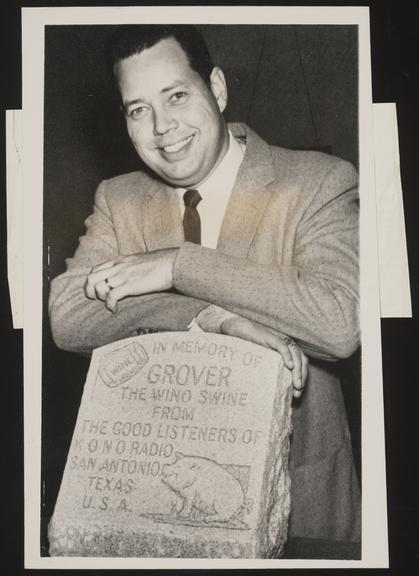
Auckland, New Zealand (UPI)--A marble tombstone for an English pig that drank himself to death arrived here Tuesday aboard the Orient Liner Orsova. 

The tombstone is the gift of American admirers of a porker named Grover and is on its way to Rottingdean, England. 

Grover the pig broke into his master's wine cellar last December and drank his complete stock of wines before going out in a drunken stupor. 

Radio Announcer Doug China of San Antonio, campaigned to immortalize Grover's accomplishment, and bought the tombstone with donations sent in by listeners to his program.


Wednesday, June 14, 2023

Newspaper Clipping of the Day

Via Newspapers.com


Consider this to be a brief sequel to my recent post about Libelous Tombstones.  I found this story after that post was published.  And it's a goodie.  The "Washington Times," February 25, 1899:

Did you ever visit--when you were in London--the Dogs' Cemetery in Hyde Park? If you ever were there, you will be pained to know that the old custodian, Mr. Woolridge, died last month.

If you do not know the cemetery, listen to the story told by Mr. Woolridge to Mr. G. R. Sims.

It is a tale of petty and malignant vengeance, and we repeat it in Mr. Sims' own words. Over the grave of a cat you will find a pathetic statement to the effect that poor pussy was cruelly poisoned, and, in spite of all that veterinary science could do, died in a few hours in the arms of her broken-hearted mistress. Then immediately beneath this statement you will find inscription in the hieroglyphics of the Third Dynasty, or something of the sort. This will astonish you.

"What on earth," you will say, "has a cat's grave to do with hieroglyphics?" Listen and you shall hear. When the lady buried her beloved cat in the Hyde Park Cemetery, her. heart was filled with bitter hatred of its cowardly assassin. So she cursed that assassin in fine Biblical language.  The curse was carved on the tombstone.  It cursed the murderer in his uprising, and his down-sitting.  It cursed him on earth and it cursed him in hell.  As old Woolridge said, it was the sort of curse that made you blind and took your breath away. 

Now, His Royal Highness the Duke of Cambridge, was Ranger of. Hyde Park, and his attention was called to the curse, and George Ranger was shocked. So the officials communicated with the lady and ordered her to remove the cursing portion of pussy's headstone.  Eventually the lady yielded, and the headstone was to be altered.

When it was brought back and set up again the space which the curse had hitherto occupied was filled with ancient hieroglyphics.  But the lady had not abandoned her curse. It was that hardly anybody could read it. She had taken the headstone to the British Museum, engaged the services of a learned professor, and the professor had translated the curse into ancient Egyptian. And so pussy's murderer is still cursed upon pussy's tombstone in the Hyde Park Cemetery.

Monday, May 29, 2023

The Fine Art of Libelous Tombstones; Or, Go Ahead and Speak Ill of the Dead, and Everyone Else For That Matter

"Muskogee Phoenix," August 10, 1935, via Newspapers.com


One of my favorite minor categories of Weird History is the Libelous Tombstone.  Surprisingly often, loved ones create memorials that focus less on eulogizing the deceased, and more on settling scores and generally venting spleen.

And bloggers of my particular sort bless them for it.

Murder accusations are a favorite topic for this particular type of grave marker.  A story similar to the example above was reported in the "Savannah Morning News," August 28, 1904:

A murder charge on a tombstone, made by the family of the victim, which the courts of Mississippi have not confirmed, involves the grand lodge of the Woodmen of the World of Omaha, Neb., in an embarrassing position. It has several hundred thousand members, mainly in the South and West, and is facing a situation that will become a precedent for benevolent organizations. 
A summary demand on the grand lodge of the Woodmen of the World to remove a monument erected by the order from the grave of a dead member on account of a dispute over the inscription is the outgrowth of the famous Lawson-Semmes murder case. 
Dr. F. G. Semmes of Hickory, a wealthy man, was indicted for the murder of T. D. Lawson, and on the filing of a habeas corpus was admitted to $12,000 bail. Eminent lawyers of Mississippi are defending him. 
Lawson, as a member of the order under its constitution received a monument. The family of Lawson selected a Scriptural epitaph, which was sent to the grand lodge and approved. Morris Brothers of Memphis contracted to erect the monument. Meantime a local agent at Hickory, at. the request of the dead man’s family, had Morris Brothers change the inscription, without the sanction of the grand lodge. 
The words "T. D. Lawson, kiiled by F. G. Semmes." were inscribed instead of the original approved words. As Dr. Semmes does not admit the murder and the words convict him of the deed, the matter was appealed to the grand lodge by the friends of Dr. Semmes, and this body ordered the monument-makers to remove the words and substitute the original inscription. This was done. 
The Lawson family thereupon immediately demanded of the grand lodge that the monument be removed from the grave. A second and more insistent demand has now been made for its removal. 
The grand lodge, under its constitution, must erect a monument for every dead member, no matter where the body is located, and will have to set up the monument somewhere. It is the first case of its kind, and on account of the numerical strength of the order in the South and all the parties involved being members it has created a sensation.
For anyone interested, at his trial, Semmes admitted shooting Lawson, but claimed it was self-defense.  He was acquitted.  I have no idea what finally happened to Lawson's monument. 

The "Atchison Daily Champion," June 17, 1883:

A queer case has been recently tried at Marshall, Mo.  A man named Potter had a son drowned while bathing in the Blackwater, with two men named Finley and Beggs. The boy's father believed that foul play had been done, and caused a stonecutter named Tiffing to erect a tombstone over his son's grave with the inscription: "Rock of ages cleft for me, let me hide myself in thee. Drowned in the Blackwater by Philander Finley and Mort Beggs." The parties thus charged brought suit against Potter, and have recovered $800 damages.

Unsurprisingly, these vengeful memorials frequently result in court action.  Another case was mentioned in the "Gloucestershire Echo," August 9, 1923:
A farmer at Allschwil, near Basle, recently lost his young wife—and also her dowry, a fairly large sum, which on her death went to her relations under the marriage settlement. 
The husband was annoyed at losing the “dot” and in revenge ordered a large marble tombstone, with an inscription dwelling on the defects of his wife's character. It ended by saying that she had taken her dowry “to heaven or hell, probably the latter place.'’ 
Every evening a small crowd collected in the cemetery before the unusual tombstone. Eventually the family of the dead woman appealed to the communal authorities, who ordered the tombstone to be removed within a week. The family’s libel action against the husband will go on all the same.
A rather curious case was heard in London in 1954.  The following report comes from the "Evening Standard" of April 7:
Bessie Solomon, 27, who claims that she was libelled by an inscription on her mother's gravestone, told the High Court today about a religious ceremony at which the stone was consecrated by a rabbi. 
The inscription read: “In loving memory of Rose Simmons who went to her eternal rest on October 27 1950 aged 43 deeply mourned and sadly missed by her sorrowing husband Mark son Eddie daughters Betty and Alicia.” Miss Solomon, the court have been told, is always known as Betty. 
Miss Solomon, slim and dark-haired, was asked how she felt when she read the inscription. She replied “I was surprised, my brother was surprised But it was not the sort of place to have any quarrels or arguments."  
Mr. Bernard Gillis, counsel for Mr. Mark Simmons, one of seven people Miss Solomon is suing, asked her: “You would not wish to do anything which would have caused your mother any feelings of distress?" Miss Solomon replied: “ Not if I could have avoided it while she was alive." "Now that she is dead does that mean you have no regard for her reputation or memory?" — "I have the same feelings about her."  "You cherish her memory?" —"Yes." 
Miss Solomon, who gave her address as Thurlow Place, Kensington, alleges that the inscription on the gravestone—in Golders Green Jewish Cemetery—imputes among other things that she is illegitimate. 
The defendants are Mr. Mark Simmons of Westminster Court, Aberdeen Place, St John's Wood, a bookmaker with whom Miss Solomon’s mother was living at the time of her death, Mr Albert Elfes, stonemason, Plashet Road, Upton Park, Mr. J.H. Valentine, keeper of the cemetery, and four trustees of the West London Synagogue of British Jews who own the cemetery. All deny that the inscription it bears is defamatory or that it bears any of the meanings which Miss Solomon alleges. 
Miss Solomon said that her parents separated when she was three.  First she lived with her father, but in 1942 on returning to London after evacuation, she went to her mother, who was living with Mr Simmons. “I called him Uncle Mark" she said. 
When her mother died Miss Solomon did not attend the funeral—it was not the custom for women to do so. She learned that a gravestone was being brought from Italy. She attended the consecration ceremony, her father did not. 
Mr Gillis — "Which name do you say your mother would have preferred on the gravestone: Rose Simmons, by which she was known for many years, or Rose Solomon?" "Miss Solomon— As Mr Simmons was already married before the stone was set up it is hard to say."

Miss Solomon added that she was upset about the part of the inscription which referred to “husband Mark.” 

Mr. Cyril Salmon QC for the trustees — "If your mother was known as Rose Simmons why are you bringing this action?" Miss Solomon—"I am trying to clear my name." "The alternative to bringing the action was to let the matter rest?"— "Yes." "Why did not you adopt that alternative?" — "Mr. Simmons is not my father."

The jury found for the defendants.  

A case from Budapest was reported in the "Columbia Missourian," August 4, 1926:

The inscription upon a tombstone here has given rise to one of the most unusual lawsuits in the annals of Hungarian courts. 
A few weeks ago, Julius Fall, a clerk, argued with his wife whom he accused of unfaithfulness.  Mrs. Fall indignantly denied the accusation."I swear by the life of our little boy," she cried, "that I have never deceived you in our marriage." 
Shortly after this scene, the 6-year-old son died suddenly.  This tragedy moved Fall to petition for a divorce.  The death of his son, he declared, was the reply of fate to the oath sworn by his wife.  The boy's death, he insisted, proved that God was avenging his wife's alleged adultery. 
Happening to pass by the cemetery one day, Mrs. Fall discovered that the tombstone on her son's grave displayed a verse, the first letter of each line spelling her middle name.  Translated, the poem read:  "The slumber of death wrested me from you,And your guilt stifled my blossoming life..." 
Mrs. Fall promptly sued her husband for libel.  The court sentenced Fall to two months' imprisonment and ordered the removal of the inscription from the tombstone.
More family troubles appeared in the (Stoke-on-Trent) "Evening Sentinel" for February 22, 1980:
A court at Baltimore, Maryland, awarded £875 in damages to a woman who sued her brother for ordering this inscription on her father's tombstone:  "Stanley J. Gladsky, 1895-1977, abused, robbed and starved by his beloved daughter." 
The daughter, Gloria Kovatch, claimed she was libelled and held up to public scorn by the inscription, which resulted from a family dispute.
Yet another legal fracas was reported in the "Muskogee Daily Phoenix" for July 26, 1923:
CHATTANOOGA July 25 — "Can a tombstone be libelous?” This is the question which the Hamilton county grand jury will be called upon to answer here. 
Authorities from Walker county, Georgia, served notice that they would appear before the local inquisitorial body and ask the indictment of R.D. Baker for criminal libel as the result of erection of a tombstone near here to George Baker, his son. 
The tombstone bears the inscription that the boy had been unjustly hanged at La Fayette, Georgia, for the murder of Deputy Sheriff Norton near there last summer.
In order to avoid prosecution, Baker removed the offending words from the stone. 

The efforts of an accused murderer to clear his name was reported in the "Winston-Salem Journal," March 24, 1949:
Raleigh—An old mountaineer freed in 1917 from a murder charge may soon win his lengthy battle for eradication of a libelous tombstone inscription. 
Hamp Kendall, a 71-year-old native of Lenoir, served 10 years for a murder he did not commit. He was later pardoned and the State paid him about $5000 for his servitude. However, as Kendall recently told a nation-wide radio audience, the murder victim’s tombstone in a Lenoir cemetery still carries an inscription stating that the deceased was “murdered and robbed by Hamp Kendall and John Vickers Sept 25 1906.” 
Vickers died shortly after his release from prison. But Kendall is still very much alive and he wants the slur erased from the tombstone. 
Kendall appealed to the Governor and other officials to have the imputation removed. All his efforts were in vain, however, as State law prohibits molestation of tombstones. 
Yesterday a solution to the problem came to light. A North Carolina legislator from Lenoir introduced in the Senate a bill that would make it “illegal to erect or maintain a gravestone bearing an inscription charging anyone with the commission of a crime.” If the bill is passed and enacted into law Kendall probably will have no trouble getting a new marker. 
The Monument Builders of America have already offered to erect without charge a new monument over the body of Lawrence Nelson, the victim. This offer was made the day that Kendall appeared on “We the People,” a CBS coast-to-coast program. He related over the air the story of his trial imprisonment and life after servitude.
Happily for Kendall, his efforts to have the inscription removed were successful. 

Finally, we have a unique example of a man who libeled himself.  The "Macon Evening News," November 4, 1931:
In Skipperton, a sleepy, sunny little farm settlement about 10 miles from Macon, they wonder all kinds of things about why Charlie Skipper put his own monument up in the cemetery 20 years ago with the strange epitaph “This poor fellow talked too much.” 
Some say he has made a will, the reading of which after his death will solve the matter, and it has been hinted that his second marriage had something to do with it, but nobody knows and all agree that no satisfaction is to be got out of Charlie himself about it.  
Anyway, in the little country cemetery behind Rutland school there it is—a big seven or eight-foot marble shaft with a broad triple base between two marble slabs with carved backs and marble vases for flowers for the tombstones of his two deceased wives. 
The lot, about 50 feet square, is fenced with a picket fence the gate bearing in iron letters, Skipper. When one enters the gate one notices the queer sentiment carved on the back of Charlie Skipper's premature monument in simple slanting marble letters, “This poor fellow talked too much.”  
The gravestone of his first wife, Ella L. Skipper, tells that she was born in 1862 and died in 1904, while the second wife was considerably younger and died not quite two years ago. 
Coming upon Charlie Skipper at work on his truck farm one finds him to be a jolly old fellow full of sly jokes and chuckles of enjoyment. He seems so jolly, in fact, with his white hair, sturdy weathered face and white mustache, that one thinks his very drawling chuckling love of cracking a joke throws some light on the strange monument and epitaph.  
“Well,” he explained quite simply, “I just thought I better put this monument up while I had the money before I wasn't able nor my children neither."  
And that's all there seemed to be to it—except his reason for such a singular choice of an epitaph.  
“Well they all say around here I talk too much or a mighty lot anyway,” he offered with a grin, and added, “I just thought I'd help ’em out.”  
“It's been there 20 years and maybe I ain't dead yet—but mighty near it!” he insisted, shaking his head and smiling. 


Mr Skipper doesn’t look by any means “mighty near it.” He's so hale and hearty and young for his 70-some years that one can hardly imagine his ever resting under the handsome marble shaft that he prepared so long ago. And the thought would seem forbidding and gloomy to anybody, but Mr Skipper who declares heartily and happily that: “No it don't makes me feel bad to have it there; it makes me feel good to know it's all ready for me when I need it!” because he seems to figure that “I ain’t got so much longer I guess.”  
He maintains that he keeps as young as he is now by exercise in the form of hard work on his farm that begins at 4 o'clock in the morning and lasts until 8 at night. And though he claims to be a “mean fellow” his chief vices are chewing tobacco and smoking a cigar on Sunday. He never drinks since prohibition which is “a great thing to keep whisky away from ’em." 
He and his brother George, for whose father he believes the town was named, are the last of the two Skipper boys left there. He has the following children living in Macon: Mrs. Mattie Parker, Mrs. Beulah Burke, and B.F. Skipper.  
So perhaps there isn't any weird mystery in a man's preparing his own grave some 20 years before he dies.  It seems to be simply that Charlie Skipper thought he'd better do it while he had the money. But one wonders if there isn't something to 'old Charlie's joke about “helping 'em out” in their contention that he “always talked too much.” He seems to be the kind of fellow who would depart this life leaving a last chuckle behind him.
I like Charlie.  The old boy clearly had the Strange Company spirit at its finest.