"...we should pass over all biographies of 'the good and the great,' while we search carefully the slight records of wretches who died in prison, in Bedlam, or upon the gallows."
~Edgar Allan Poe
Showing posts with label cats. Show all posts

Wednesday, January 7, 2026

Newspaper Clipping of the Day

Via Newspapers.com


Hey, when a boxing, beer-guzzling cat becomes the subject of litigation, I’m there.  The “San Francisco Examiner,” October 21, 1898:

Life has lost its roseate hue for former Senator W. J. Dunn since Bob disappeared. Dunn keeps a saloon on Third street, near Stevenson, and Bob is a big Russian cat with fur as black as Egyptian night except for his white-tipped paws. Bob was last seen about 10 o'clock Wednesday night in the company of Sidney Perry, who is now dodging a warrant held by the police.

Dunn charges Perry with stealing the cat. Bob came from St. Petersburg and was brought to San Francisco by a seafaring friend of Dunn. He is large and fat, but as gentle as a sofa pillow. On shipboard the sailor taught him to spar, and almost every night for a year past Bob has sat on the end of the bar and made uppercuts and jabs at the patrons of the place.

Perry was formerly in the commission business on Stevenson street and rented his office from Dunn. Incidentally he became well acquainted with Bob and taught him the new blows as they came out. Dunn thought the friendship harmless, but now he swears vengeance on the ungrateful. When last seen Bob was tucked snugly under Perry's right arm.

On that same date, the “San Francisco Chronicle” gave further details:

A black cat has crossed the friendship which formerly existed between ex-Senator William J. Dunn and S. Perry, his former business partner, bringing bad luck to the latter.

Dunn and Perry were associated in the ownership of a saloon and poolroom on the corner of Third and Stevenson streets up to a few days ago. They parted then, evidently with mutual amicable feelings, having satisfactorily divided the assets. Among the items which fell to Dunn was a big black Thomas cat, the pet of the saloon and all its patrons, owing to his strange preference for steam beer over skimmed milk. Dunn still owns the saloon, but the black cat is no longer its main attraction. In fact, Dunn alleges that Perry has stolen the feline beer bibber.

His charge took legal form yesterday in the Police Court, when he applied to Judge Mogan for a warrant for the arrest of Perry on the charge that he "embezzled one cat, value $25.” Judge Mogan instructed Dunn to see Assistant Prosecuting Attorney McGovern of Judge Low's court about the complaint. McGovern hesitated about issuing a complaint, on the ground that a cat could not be considered property. He applied for advice to Acting Prosecuting Attorney Mann of Judge Mogan's court, who drew his attention to a decision of the late Police Judge Campbell, which maintained in a somewhat similar case to that of Dunn and Perry that a house cat was ferae naturae--of wild nature--and could not be claimed as a personal belonging by anybody. Despite this authority the warrant against Perry was issued.

On October 26, the “Chronicle” gave an update on this saga:

Bob, the boxing, beer-bibbing black cat that disappeared about a week ago from the saloon of ex-Senator William J. Dunn, on Third street, has not yet come back to its owner. and Sidney Perry, Dunn's former business associate, must now face a trial in Police Judge Mogan's court on a charge of having embezzled the accomplished feline. His case was called yesterday, but owing to the subtle legal possibilities which it presented a continuance was ordered to October 31st.

Perry was arrested on Monday night for the alleged cat embezzlement. It is understood that his defense will be a contention that the cat in controversy is not Dunn's property, in fact, but a wild beast. All cats, according to the theory held by Perry's attorney, are wild beasts, subject to capture by whoever chooses to hunt for them. This line of legal reasoning is not unknown to Police Court jurisprudence. An opinion rendered by the late Judge Campbell in a case where a man poisoned three of his neighbor's cats because of their depredations in his spinach bed contained the ruling that the feline species, whether of the forest or house variety, were ferae natural and not amenable to domestication.

As against this argument Dunn will present expert testimony showing that his lost Bob was tamed to such a degree that he could drink steam beer like a brewery wagon driver and give Sharkey points with the gloves.

Frustratingly, I could not find out how this important and instructive moment in legal history was resolved.  What became of the lovely and talented Bob?!?

Wednesday, June 19, 2024

Newspaper Clipping of the Day

Via Newspapers.com


Any cat can make your life difficult.  But when the cat in question died some three centuries earlier, you know you’re dealing with one special kitty.  The “Vincennes Sun-Commercial,” November 17, 1975:

SUDBURY, England (AP) — Residents of this East Anglia town hope they’ve seen the end of a series of local misfortunes now that the mayor and the rector have reburied a 300-year-old cat.

The trouble began four years ago when Arthur Kemp tore down a 16th Century building to build a hotel and found a mummified cat buried beneath. It was the custom in medieval times to bury a live cat in a building under construction to ward off witches and prevent fires. 

Kemp decided to place this historical curiosity in his shop. 

Shortly thereafter the shop caught fire for no apparent reason. 

Kemp then put the cat in a workshop. The workshop caught fire. 

Then serious defects suddenly appeared in the new hotel Kemp built, although it had appeared structurally sound. The defects showed up just above the spot where the cat was found. 

Kemp and the city fathers got the message. On Friday, Mayor Tony Moore placed the feline remains in a glass-topped casket and with a special service by Canon Peter Schneider buried it in the floor of the hotel. 

“My prayers were for the building” Rev. Schneider stressed. "I could not become involved in a religious ceremony for a cat”.

Hopefully, both Kemp and the cat were subsequently able to coexist in peace.  Although I can't say I like Rev. Schneider's attitude.

Wednesday, May 29, 2024

Newspaper Clipping of the Day

Via Newspapers.com


Here’s something a little different for this space:  The adventures of a famed four-legged WWII veteran.  The “Australian Woman’s Weekly,” May 3, 1941:

This is the story of Tawny the Caldew cat, the most celebrated cat of Great War II. Three people helped to make Tawny famous--a young British seaman and two Australian girls in the British Consulate at Gothenburg, Sweden. Tawny's adventures, which began with the torpedoing of the British trawler Caldew, have been chronicled in a despatch to the Admiralty, in the august London "Times," the New York "Times," in Scottish, American, and Belgian newspapers. The "Times" mentioned him in a leading article, a Swedish poet wrote a verse in his honor, and a Swedish cartoonist portrayed him sitting on a copy of the "Times." And now one of the Australian girls who put him on the road to fame, Miss Elizabeth a 'Dare, has returned to Australia with the story. She and Miss Ima Barra, both Australian girls, both actresses, were stranded because of the war in Gothenburg, Sweden.

There they started work at the British Consulate. One day they heard the Consulate's naval adviser, Captain Clover, talking on the trunk line: "Yes, drown the cat," they heard him say. "It's the only thing to do with it." "Drown a cat! Whose cat?" shrieked the two Australians. "A torpedoed ship's cat. British," Captain Clover told them. 

"Well, you certainly can't drown their cat," said the two women. "It costs a lot of money to land a cat in a foreign country," explained Captain Clover.

"It doesn't matter. We'll pay for it," they said.

From Captain Clover they learned the story of Tawny. A week before, an English trawler, the Caldew, put out to sea in the direction of the Faroe Islands. While on its way it was overtaken and stopped by a German submarine. The captain and crew of eleven were given ten minutes to get off the trawler. One of the crew, a boy of nineteen, sacrificed his personal belongings and made a frenzied search for Tawny, the ship's tomcat. Then with Tawny in his arms he joined his companions in the lifeboat.

The submarine then blew the trawler to pieces and went off, leaving the crew tossing in the small lifeboat. A day or two later the men were picked up by the Swedish motor ship Kronprincessan Margareta, which was on its way to Gothenburg. But, the Swedish ship was still outside Swedish territorial waters when she was overtaken by two German destroyers which had orders to stop the Kronprincessan and take the Englishmen aboard as prisoners. The German destroyers, however, refused the cat. Parted from his English master, Tawny made friends with the Swedish crew.

At Gothenburg there were difficulties. To land a foreign cat in any country is troublesome, because of quarantine regulations. The Swedish captain accordingly telephoned the Consulate, first to report the story of the English sailors, secondly to ask what to do with the cat. "It was then that we heard the telephone call," said Miss a'Dare. "Captain Clover warned us of the expense of quarantining and the difficulties of finding a home for the animal. "But we were determined that a cat who had escaped being torpedoed, a cat for whom his master had risked his life, should not be drowned.

"Much telephoning had to be done! First to the ship, to stop the execution order. Then a long-distance call to the British Legation in Stockholm requesting permission to keep the cat. Then to a veterinary surgeon who visited the ship to certify that Tawny was in good health. Finally to the quarantine station, which sent an officer to collect him.

A telegram was dispatched to the British Admiralty to tell of the Caldew's fate. At the end of it was the message, "Ship's cat safe and being cared for by ladies of Consulate." While Tawny was in quarantine his story was printed in Swedish newspapers, and letters poured in from cat lovers, many people sending contributions. (Incidentally the expenses came to nearly £10). One letter was addressed. "Fru Barnes, Cat Lady, British Consulate," another to "Chief of Cat Department," a third to "Kind person who saved katt." Best of all is the following letter brought back by Miss a'Dare.

"I am ola swedish woman. No english can I. My son is a seeman. He speak english like englishman. He helped write this letter.

I red about katt. It is kindly of you to help him. I like them very much. Have 4 self. Such nice animals.

I am poor but send 50 ore' (about sixpence) "Plis by fish for it. Katts like fish. The ware such nice animals. The are too very good for amatism. I have it in my back but wen she steps in my back I am very bettre. Hav you reumatism.

"Yours truly, Hulda Carlasson." 

And another: "I hat read with pleasure so much that you interest yourself entirely about one poor English cat; he is I think saved three times from a death in the sea. "I hope so much that I may be allowed to seen you dear Miss Barnes, one kroner for to buy this cat some good Svedish milk. 

"Yours faithfully, JOHN ERICSSON." 

Miss a'Dare at first hoped to bring the cat home to Australia with her. But when she set about getting visas for herself to travel via Russia, the Black Sea, Turkey, Syria, Iraq, and India she realised that quarantines in these countries for Tawny would occupy the rest of his life. So she and Miss Barnes accepted one of the numerous offers of a home for the cat--of an English racehorse trainer in Sweden, Mr. Herbert Brown. With Mr. and Mrs. Brown, two spaniels, and the racehorses, Tawny nowadays travels from one end of Sweden to the other.

Twice he has been kicked by racehorses--because of his habit of jumping on their backs when they are being groomed--and twice saved by the care of the vet. That accounts so far for five of his nine lives. His original rescuer, the young seaman, now in an internment camp in Germany, hears regular news of him from Mr. and Mrs. Brown, Captain Clover became so interested in the animal that he devoted a special file to him in the Consulate records.

This, including clippings, statement of receipts and expenditure, and letters, has been brought to Australia by Miss a Dare, It is labelled "Le Chat Fidele"--the faithful cat--although, as the Stockholm correspondent of the "Times" said, "faithful seemed more a description of the letter-writers than the object of their solicitude."

I was unable to find out anything about Tawny’s subsequent career, but after all his close calls, I hope he went on to have a long and peaceful life.  One where he learned to avoid racehorses.

Wednesday, November 1, 2023

Newspaper Clipping of the Day

Via Newspapers.com


This story borrows the title of the classic Tin Pan Alley song, “The Cat Came Back” with a little feline telepathy thrown in.  The “Buffalo News,” January 23, 1891.  (A reprint from the “Syracuse Journal.”)

Fritz Heath is the noble son of a worthy mother. Fritz is a large gray and white tiger cat. Fritz and his mother, Gyp. are the proteges of Mr. and Mrs. Thomas Heath. Both are cats of unusual size and beauty, that of Fritz being only marred by a jagged rent in his right ear, incurred in some slight youthful disagreement.

Fritz is an amateur acrobat of considerable ability, and will roll over, jump through a hoop and turn somersaults at word of command. He also has the trick of jumping to catch the edge of the table top with his paws and swinging suspended while he surveys the prospect of a good dinner for Fritz. Two years ago there was mourning in the house of Heath. Fritz had suddenly disappeared. At night Gyp came into the house, sniffed at the basket she and Fritz had occupied together since the latter's kittenhood, and walked disconsolately away.

The Heaths thought perhaps their pet had been carried across the canal and could not get back, so they wandered in Finegan avenue and the purlieus of the Fourth ward and searched diligently, but he could not be found. Time heals broken hearts, and as the months passed by all but Gyp forgot the missing member of the household. She could not be induced to go near the accustomed bed still kept for her by the fire, and refused to be comforted. 

A little more than two weeks ago she jumped into the basket for the first time since Fritz's disappearance, and lying down began to purr contentedly. A few days afterward Mr. Heath and his wife returned from an evening call. A cat, which they in the darkness supposed to be Gyp,  was crying on the doorstep, and as they opened the door it ran into the hallway and out again as quickly.  Later in the evening Mrs. Heath heard the crying at the door, and, being possessed of a tender heart toward suffering animals, proposed going down to bring in the poor thing, which had proved not to be Gyp, and give it something to eat. As she opened the door the cat darted into the hallway and up the stairs to the Heath apartments. When it came into the lighted sitting room Mrs. Heath exclaimed, “Why, Tom, it's Fritz!” 

Hearing his name Fritz bounded into Mrs. Heath's lap, from hers to her husband's, turned somersaults, rolled over and performed all the tricks he had been taught, as if to thoroughly identify himself or to express his joy at getting home. "It surely is Fritz," thought the rejoiced Heaths, and they examined the cat's right ear. It was split! There was little doubt then of its being Fritz, but to make assurance doubly sure a small stick was thrown down the stairs into the dark hallway.

"Go get it, Fritz," said Mr. Heath, and the cat darted downstairs, returning instantly with the stick triumphantly balanced in his mouth, a trick, by the way, common enough with retrievers, that few cats have ever been taught to perform. After a good supper the reclaimed Fritz went straight to the basket behind the stove and cuddled down contented. Gyp gave the intruder a smart rap with her paw, but seeming at once to recognize her prodigal son fell on his neck and kissed him. 

Fritz now stays very closely at home.  His two years' absence seems to have given him an increased regard for the shadows of the family roof tree. 

A strange question, and one which should interest psychologists, is this: Did the old cat receive some telepathic information that Fritz was about to return which dispelled her aversion to the basket? Had she seen him prowling around the house for two or three weeks, not daring to come back, or was it simply a coincidence? 

Wednesday, September 6, 2023

Newspaper Clipping of the Day

Via Newspapers.com


On January 29, 1900, the “San Francisco Examiner” published a perfect example of the sort of ghosts you’ll get when there’s a cat around:

SAN RAFAEL, January 28. After driving one prisoner to suicide and frightening confessions out of a dozen others, the ghost of the Marin County Jail has at last been discovered.

The spook was nothing more than a sedate old pussy cat prowling through the bastille late at night, looking for rats and mice. She bears no resemblance whatever to the spirit of a departed Chinese, and is still following her legitimate occupation at the jail. 

Some years ago a Chinese hanged himself in the cell where so many superstitious prisoners have since claimed to have seen his ghost. The shadowy figure, wearing chains that clinked, glided along the wall, with his queue sticking up in the air, so the terrified hobos said, and they begged to be removed from the haunted cell before they died of fear. In a corner near the haunted cell is a water tank, upon which the cat jumps in her rat-hunting rounds.

While moving around on the tank her body casts a shadow which a fevered mind might liken unto the shape of a hanged Chinese. Her swaying tail supplies the queue. When prowling behind the tank the cat bumps into some chains banging there, and thus produces the blood-chilling clank. The cat belonged to the Mongolian who killed himself, and while living in the cell with him she learned the run of the jail. She is now a free feline enjoying a good home with A. Kappenmann and using the jail only for a hunting ground whenever she can break in.

A tramp serving a term for petty larceny killed himself in the haunted jail because of the moving shadows and the rattling chains. Another prisoner pleaded guilty when he might have later gone free, and was sent to San Quentin to escape the cat. He said he would lose his mind if the ghost bothered him much longer.

Only a few nights ago Anton Jason, a sixteen-year-old boy, was found cowering in the haunted cell and howling for help.  Jason said the ghost was scaring him to death and begged the jailer to save him. Since then a watch has been kept until the ghost was caught with a dead mouse in her teeth. The prisoners are happy now and the jail officials no longer tumble out in the night to prop a tottering reason on its throne. 

This is not the first time the cat has distinguished herself. It is only a short time ago that she saved Miss Bertha Kappenmann from being burned to death by awakening her from her sleep after the young woman’s clothes caught fire from the stove by which she was seated.

Three years earlier, there was another ghost outbreak at the jail.  No word on whether or not cats were involved. 

Wednesday, June 14, 2023

Newspaper Clipping of the Day

Via Newspapers.com


Consider this to be a brief sequel to my recent post about Libelous Tombstones.  I found this story after that post was published.  And it's a goodie.  The "Washington Times," February 25, 1899:

Did you ever visit--when you were in London--the Dogs' Cemetery in Hyde Park? If you ever were there, you will be pained to know that the old custodian, Mr. Woolridge, died last month.

If you do not know the cemetery, listen to the story told by Mr. Woolridge to Mr. G. R. Sims.

It is a tale of petty and malignant vengeance, and we repeat it in Mr. Sims' own words. Over the grave of a cat you will find a pathetic statement to the effect that poor pussy was cruelly poisoned, and, in spite of all that veterinary science could do, died in a few hours in the arms of her broken-hearted mistress. Then immediately beneath this statement you will find inscription in the hieroglyphics of the Third Dynasty, or something of the sort. This will astonish you.

"What on earth," you will say, "has a cat's grave to do with hieroglyphics?" Listen and you shall hear. When the lady buried her beloved cat in the Hyde Park Cemetery, her. heart was filled with bitter hatred of its cowardly assassin. So she cursed that assassin in fine Biblical language.  The curse was carved on the tombstone.  It cursed the murderer in his uprising, and his down-sitting.  It cursed him on earth and it cursed him in hell.  As old Woolridge said, it was the sort of curse that made you blind and took your breath away. 

Now, His Royal Highness the Duke of Cambridge, was Ranger of. Hyde Park, and his attention was called to the curse, and George Ranger was shocked. So the officials communicated with the lady and ordered her to remove the cursing portion of pussy's headstone.  Eventually the lady yielded, and the headstone was to be altered.

When it was brought back and set up again the space which the curse had hitherto occupied was filled with ancient hieroglyphics.  But the lady had not abandoned her curse. It was that hardly anybody could read it. She had taken the headstone to the British Museum, engaged the services of a learned professor, and the professor had translated the curse into ancient Egyptian. And so pussy's murderer is still cursed upon pussy's tombstone in the Hyde Park Cemetery.

Monday, January 30, 2023

The Witch-Cats of Scrabster


Show me a story about beer-swilling Scottish witch cats, and, naturally, my immediate reaction is to yell for joy and start typing.  A blogger lives for that sort of thing.

Our little tale opens in late 1718, at the Burnside of Scrabster home of a mason named William Montgomery.  He and his family had a cat problem.  Of late, a number of highly sinister felines had mysteriously invaded his home.  They terrorized his servant into quitting, (after hearing the cats talking among themselves in human and intelligible voices,) and left Mrs. Montgomery so frazzled that she threatened to leave her husband and retire to the less cat-plagued town of Thurso.  Worst of all, the diabolical kitties drank up his ale.

Montgomery decided serious measures were called for.  Arming himself with a sword, a dirk, and an ax, he launched an assault on the unwanted guests, killing two of the cats and wounding several others.  At least, he thought at the time that two of them were dead. Curiously enough, by the following morning their corpses had mysteriously vanished.  He also noted that the wounds he had inflicted drew no blood.

Then things really got weird. A local woman, Helen Andrew, who had long been suspected of being a witch, died unexpectedly.  Another reputed sorceress named McHuistan killed herself by leaping into the sea.  Most startling of all, an old lady named Margaret Nin-Gilbert had one of her legs suddenly fall off.  The local residents--who could put two and two together as well as anyone--immediately concluded that the three women were among the cats who had infested the Montgomery home. Nin-Gilbert’s “black and putrefied” leg was presented to the local sheriff (something which must have really made his day) and he was ordered to take the appropriate steps.

Margaret was quickly arrested.  Under what was probably not very gentle questioning, she soon admitted that she had been inside Montgomery’s house in the form of a “feltered [shaggy] cat,” and that the loss of her leg was due to the injuries his dirk had inflicted.  Nin-Gilbert stated that the trouble began when a woman named Margaret Olson had been evicted from her lodgings due to the “wickedness of her behavior.”  The Montgomery family moved into her former home.  As a result, Olson solicited Nin-Gilbert to “do mischief” in revenge.  

Besides Olson, Nin-Gilbert named four other women as her cat-confederates.  Naturally, they were arrested as well.  Margaret died in jail soon afterward.  (Accounts vary as to whether she succumbed to natural causes, or if she was murdered by the women who were, thanks to her, fellow inmates.)

Eventually, the whole affair reached the ears of Lord Advocate Robert Dundas.  He wrote a stern letter to the sheriff scolding him for proceeding on such a matter without his authority.  The entire case, to his mind, was so utterly absurd that he ordered the investigation to cease.  The women Nin-Gilbert had accused were freed, and that, it seems, was that.

Unfortunately, history does not record if Montgomery ever saw the cats again.

Monday, October 31, 2022

The Cat and the Terrifying Blue Light: A Ghost Story of Sorts


The following creepy little story seemed appropriate for Halloween.  This--for lack of a better word--”haunting” is one I find particularly disturbing, because the…ghost? elemental? apparition? natural phenomena? whatzit? was one that seemed to target not people, but animals.  This account, written by one “G. Llewellyn” appeared in the “Occult Review” for November 1910:

I must inform all and sundry that I am not a spiritualist, and that I know nothing whatever about spiritualism. I have been informed by several people that I am what is termed a “sensitive.”

I have never attended a séance or any meeting or gathering of the kind, nor had I ever read any literature dealing with such subjects as spiritualism or mysticism or occultism or anything of kindred nature until quite recently, when my attention was called to the Occult Review, which I found intensely interesting and illuminating.

As a journalist, and a very busy one, I am, as a rule, so tired when I go to bed--invariably in the small hours--that I fall asleep almost immediately and sleep for hours without ever a break. On a never-to-be-forgotten night I was in my usual state of health, I was untroubled and without a vestige of care.

I had had my usual supper. I had been in bed a short time and was in that blissful condition of mind when one is just dozing off. The room was in total darkness, as I had switched off the electric light and drawn thick, heavy curtains over the holland blinds that covered the two large windows. My pet cat invariably sleeps on my bed, and was in its customary place, curled up on the quilt, fast asleep.

As I lay there, with half-shut eyes, there suddenly appeared at the top of the wall on the right (the side to which I had turned), a long shaft of light, of the most beautiful shade of light bright blue. It moved and quivered along in the direction of the right window, and I watched it with fascinated gaze.

“How extraordinary!” I thought, “I never saw the moonlight come in in this fashion when those thick curtains were drawn right across, and it is a different blue from moonlight blue, too, and moves about so oddly...what can it be?...but of course it must be moonlight, and perhaps there are clouds passing over the moon?”

The light--a heavenly forget-me-not sort of blue--the counterpart of which, however, I have never seen, either before or since, still wavered and drifted across the room in the same part, near the ceiling, and I stupidly looked at the top of the door (over which hung a heavy crimson plush portière) as if a light could have been cast through a solid brick wall!

At last I jumped out of bed, pulled curtains and blind aside and looked out of the window. Nothing but impenetrable darkness met my astonished gaze. No moon, not a star, not a ray of light to be seen! Intense blackness and gloom--nothing more. I could not distinguish the road, or the opposite trees, or, in short, anything at all. The street lights are put out early in the country, and the night was of inky blackness.

“Could it have been some one with a lantern, or a searchlight?” I pondered, still marvelling over the occurrence, as I returned to bed. I was not in the least alarmed, and it had not even occurred to me that there was anything at all supernatural in connexion with the affair.

As I went on puzzling, or rather, trying to puzzle it out, the cat suddenly jumped up on the bed, his fur bristling all over his body, his eyes glaring, and with one bound he leaped to the door; and as he tore frantically at the plush portière, he emitted the most awful howl or scream that I ever heard from an animal--in fact, I did not think such a horrid, blood-curdling sound could have been given. I think my hair stood on end then, but even after this I did not entertain the least idea of anything at all supernatural. My idea was that the cat had suddenly gone mad! As for the blue light, this new and startling development had quite driven it out of my mind.

Hydrophobia or no hydrophobia, I was so distressed at seeing the poor animal’s agony of fear that I took it up in my arms and tried to soothe it. Trembling all over as if with ague, it cowered against me, hiding its head, and giving evidence of the most fearful state of terror and distress. I soothed and petted it, and gradually it grew calmer; but to my astonishment it peered over the side of the bed, glaring fearfully, its eyes blazing as if on fire, and its fur bristling again as at first. I saw nothing, but that the cat saw something I am absolutely convinced, and nothing could shake that conviction.

Feeling safe in my arms, now that the first shock of the horrid sight--whatever it may have been--was over, poor Fluff craned his neck eagerly and looked down on the carpet, watching the movements of the (by me) unseen enemy, as it apparently travelled along the bedside and rounded the end of the bed in front of the dressing-table. The “thing”--whatever it may have been--was on the floor, and made no attempt to get on the bed. Had it approached us, I am certain that Fluff would have expired at once; but, from the safe shelter of my arms, he watched the nocturnal visitor, following it with his eyes along the side of the room, between the bed and a huge mahogany chest of drawers, and round the end of the bedstead to the left. It seemed so strange to see the cat craning its head and following with its gaze some object undiscoverable by myself that I got up, and, leaning over the brass rail at the end of the bedstead, looked anxiously and intently in the direction indicated by the cat. All I saw was the carpet!

But it must be remembered that I saw the blue light when the cat was asleep. It might be suggested that my fear of the light was communicated to the cat, but then I had no fear of it, for I deemed it an ordinary (though perhaps unusually beautiful) shaft of moonlight until I found that there was no moon, and the night was as dark as Erebus.

One friend suggested that perhaps it was all a dream! Well, I know, and am prepared to swear, that it was not. If I had been asleep, the mere fact of getting out of bed, going to the window, drawing the curtains, and switching on the electric light, would have been sufficient to rouse me; and, again, I am not, and never have been, subject to delusions of any sort. As the editor of the Occult Review knows, I am on the staff of a well- known London weekly paper, of large circulation, and my pen-name is known all over the world. I am practical, business-like, and logical--not a dreamer, or a visionary. I may say, too, that my house is a new one. There has never been the slightest suggestion that it was haunted. There have been no other manifestations in it either before or since.

Recent studies of the effects of light upon living things have brought many new and surprising theories to the front. It is said that we are bathed in light, visible and invisible, for there is a radiation which has been termed “black light” which cannot be seen by our eyes, but which may be visible to eyes differently organized. Professor Jerviss declares that it is possible that these ghostly sheaths of ours are perceived by certain animals possessing the power to see in the dark.

Some time after my own remarkable experience my attention was drawn by a friend (to whom I had confided the whole matter) to an almost identical experience related by Mr. Maurice Hewlett to Miss Constance Smedley. There was the same blue light, wavering and flickering; there was a pet animal--a dog, not a cat, in this particular instance--sleeping on the bed; there was the fearful terror of the animal, its whining and moaning and whimpering, and, finally, there were ghostly hands seen passing over the dog, as if stroking it. At length, the whimpers slackened, and, ere long, ceased. The dog was dead…In the event of any one scoffing at my own honestly set down experience, I would ask these questions: Whence came this mysterious light, and how could the cat’s extraordinary terror be accounted for? Suppose, for instance, that my mind might for once have been subject to such an extraordinary hallucination, or that my eyes might, for once, have played me false--for we know that there are such things as optical illusions--it is difficult to believe that the cat should at the same moment suddenly have experienced the same hallucination, delusion, or illusion--call it what you will. Then, too, the cat was obviously terrified to the farthest limit of its endurance--had I not soothed it, and covered its head, I think it would have died from its fright--but I was not alarmed in the least. Puzzled I was, most assuredly, but not alarmed.

Perhaps it was a “cat” phantom, or a “dog” phantom that my poor Fluff saw--the ghost of some former pet of mine that haunted its erstwhile owner, and was suddenly seized with an access of jealousy and rage. It must have been a horrid object, anyway, for Fluff is the quietest, gentlest cat I have ever known. For a long time we fancied he was dumb, for by day or by night no sound was ever heard from his “voice-box.” He was fearfully scalded on one occasion, but even then only gave two small piteous “mious.” On another occasion he was trapped in a door, in a gale of wind, and gave a small and almost human cry at the moment he was released, but the howl he emitted when he saw the ghost--or whatever it was that he did see--was so loud and so horrible that I shall never forget it, nor the sight he presented after I had got a light and I saw him tearing at the plush portière in frantic efforts to escape.

If any one can offer a solution, or even make an attempt at a solution, I should be both interested and gratified. I have no theories of my own on the subject, though I have exhausted every possible field of speculation.

Wednesday, April 27, 2022

Newspaper Clipping of the Day

Via Newspapers.com


This heartbreaking little tale appeared in the “Hull Daily News,” July 27, 1928.  The author used the pseudonym “Perambulator”:

I like ghost stories and have read a good many; but I know only one which, to me at least, is absolutely convincing, and that is the story that I tell you to-day. The trouble to me about the others, to my own mind, is that they are too vague; names, and dates and places are not precisely given in the printed books or papers which contain the yarns; and, if someone tells you, by word of mouth, what it was that is supposed to have happened, it never (in my experience) happened to the man himself, but only to someone he knows or once heard about. However excellent the setting and apparently authentic the ghosts, the evidence for their appearance at any particular place or time, and to any particular persons, always seems to me too shaky to make a genuine demand upon my powers of belief. I do not, that is to say, really "believe" any of the many "ghost stories" that I have read or been told.

I live in a house where, if anywhere in Hull, it should be possible to "see ghosts," and there are stories stretching over its hundreds of years of history which should encourage "psychics " to see and to hear all sorts of amazing and inexplicable sights and sounds; but I am obliged to say that though I have heard of these things, as happening to people who lived here before me, I have heard of them only at second or third hand, and not from anyone to whom the marvels actually happened. 

I am, that is to say, prejudiced against the “ghosts," almost to the point of arguing that “there ain't no such things." 

Having said this, I trust you will accept what I now write as a truthful account of an experience, which I give with full references to place and time and persons, as being a faithful record of what I still regard as altogether inexplicable, and which I now relate with all the respect for absolute truth of which I am capable. 

It was in July, eight years ago, here in my own garden, and it happened to me myself, who writes these words; so there you have the date and the place and the person all complete, since the Editor knows who I am, and that I really live in Hull, and am a more or less truthful and reliable fellow. 

I had gone to London for the first Anglo-Catholic Congress at the Albert Hall, and on the morning after my arrival in town I had a letter from Perambulatrix saying that she was very sorry, but on the afternoon of my leaving home (i.e., on the previous day), she had been obliged to have our cats destroyed, since she had found them sleeping in the baby's cot, along with the baby, and was afraid lest they should get over the child's face and smother him. 

These two cats were my peculiar property and care. I had brought one of them from Gloucestershire soon after the Armistice, and the other, a mere kitten, had been born a few months before, at Bridlington, just before we removed to Hull. The mother-cat was undersized, and the kitten was black, with white waistcoat and gloves, and they belonged especially to me in the sense that it was I who attended to their food and gave them shelter whenever they wanted it in my study, where they could come in and go out as they pleased, and where nobody ever interfered with either of them. 

Whether because of the regular feeding, or by reason of the peace and quietness of the room into which nobody ever came except myself and these cats, the animals attached themselves particularly to me. and used to follow me about and wander round the garden with me; "Daddy's cats" the children called them. Especially, when in the evening I cut the grass, the creatures would walk beside the machine or sit under the mulberry tree which is the patent of our garden's nobility and watch what I was doing, or perhaps dream, for all I know, of what I should be doing in a little while, when the time came for their supper. 

I knew the two animals pretty well, you see, and as far as any mere man can care for a cat, or cats allow themselves really to bother about human beings, I was fond of them and they managed to appear as though they were interested in me. 

And so that morning in London, when I heard that they had been done in, I was, first of all shocked, and then afterwards very sorry indeed! There was nothing to be said or done about it. of course. If Perambulatrix feared for the well-being of a child she did right when she gave the fatal order. And the Porter, his name was William Carltorn, did but his duty when he put them in a sack with a couple of bricks and dropped them into the Hull River. I myself should have taken them round to a vet. or a chemist, but they were not the first pussycats that have gone overboard like that nor will they be the last. 

Writing home I said nothing about the tragedy, nor when i returned at the end of the week did we talk about what had happened. The thing was done, and probably rightly done, however sorry I felt, and however much I missed my cats there was an end of it! 

But, as you are to hear, not quite the end! The grass, naturally, had grown while I was away, and on the Saturday afternoon I began my job of cutting it. The task took four or five hours, and I was accustomed to finish up near the mulberry tree. On this Saturday evening, round about half-past eight, as nearly as I remember. I had made good going, and was within a few minutes of the end of the job, when I noticed my two cats sitting, as they were wont to sit, under the tree, side by side, waiting, as it seemed, and as they had done a score of times already that summer, for the moment when I should drag the machine away and go indoors with them and give them their supper. 

I thought nothing about it until I realised, very slowly, that the two creatures simply had no business to be there! 

I stopped my grass-cutting and walked towards them, looking closely at them from a distance of three or four yards. snapping my fingers and saying something about “Pussy-tats. Pussy-tats," as I had said so often, in similar circumstances before. 

Instead of coming to me, as I think I expected them to do, the under-sized tabby mother moved deliberately round to the back of the tree, and the little black kitten with the white waistcoat and gloves skittered off among the shrubs and disappeared, and that was the last I ever saw of either of them. 

So far the thing seems simple and explicable enough; but there is more to come. I myself thought, as I left my unfinished lawn and walked towards the house, that my imagination was working too vividly; that I had perhaps been over-excited by the week in town and by the little domestic tragedy of the death of the creatures I knew so well; and that was what I went on thinking for another week or two; nor did I speak of the matter to anyone, in the house or out of it. 

Until a fortnight later, when the Vicar of Drypool—l am anxious, you notice, to give as many exact details as I can—was having supper with us one Friday evening after preaching in a neighbouring chapel. 

I told him the story of the cats as I have told it to you: their violent death and their subsequent reappearance under the mulberry tree, and it was at this point that the real difficulty began, for Perambulatrix burst out excitedly, and all that she said was supported by a cousin who was staying with us at the time, the wife of the Vicar of St.. Leodegarius, Basford, in the Diocese of Southwell, who had been our guest while I was away in London, and who had been sitting with Perambulatrix while I cut the grass, and who together with her had, unknown to me, seen my rencontre with the cats that had no business to be there, and had wondered what in the world to make of it. 

People to whom I have told the tale have offered three separate "explanations,'' none of which, however, seems to me satisfactory. 

(1) I imagined the whole thing, and that as I say, was my own opinion at first. Against that, there is the fact that while I left the machine and called to my cats under the tree, two other people were sitting thirty or forty yards away; that they had seen the cats before I did, and wondered why they were there, that they had watched me, as stated, go towards them, had seen the cats get up and disappear, and then had seen me come into the house, but had not cared to speak to me about it all. "Imagination" does not cover these facts, unless we accept the statement that the three of us imagined precisely the same unexpected and inexplicable things at precisely the same moment and in exactly the same spot. 

(2) They were not the same cats, but some others that chanced to come into the garden and to sit just there just at that moment Truly, a multitude of cats lives hereabout and in those days before a new dog took charge of this garden, many of them were accustomed to dig and scratch and howl therein at all hours of the day and night.  But none of them were friendly with me, none of them ever sat down in my presence, but rather fled for their lives when they saw me coming. No! Those were my own cats, and no other, for a man recognises animals that belong to him as surely as he knows his own hat or his own pipe; and there was no mistaking the size and the markings and the behaviour of that mother and daughter who sat, not for the first time in one special spot under one particular tree and quietly watched me cutting the grass! 

(3) The cats were not really drowned by the Porter, and had somehow found their way back, as cats do to the familiar hunting-grounds. It it true that for a few weeks after these things happened, my children would sometimes say that they had seen "our pussies" in the garden; but I think they made the easy mistake, for them, of thinking that strangers and trespassers were the creatures that used to come in and out of Daddy's study and follow him in the garden, though they never had much to do with other people in the house. I made careful enquiry at the time, and there was no room for doubt that the Porter did exactly as he was told, and got rid once for all, of those two unfortunate cats. I have never seen or imagined that I saw anything of either of them, except on that one occasion on a Saturday evening, as here related. 

What explanation then do I myself offer? I have nothing of the sort to give. As far as I know the meaning of truth, I have told this story truly; but it remains as one of the most puzzling incidents in my life, and until someone provides an adequate and reasonable solution of the whole inexplicable business, it will be, for me, the one occasion on which I have "seen ghosts," even though the ghosts were merely those of a couple of quite ordinary cats.

I have to say, I was hoping this narrative would end with “Perambulatrix” being stuffed into a sack and tossed into the river.  Oh, well.

Wednesday, August 25, 2021

Newspaper Clipping of the Day

Via Newspapers.com


Since Hoodoo Cats are the official Strange Company mascots, I bring you this spooky tale from “The Head-Light,” April 9, 1886:

"What am I going to tell you," said Capt. Rockwell of the schooner Fame, "occurred about ten years ago on Lake Michigan. I was then in command of the schooner Gordon, and in the grain trade. One afternoon, just before we were ready to tow out of Chicago, a stranger came aboard with a big black cat in a rude cage and offered her for sale. I was born with a constitutional hatred of cats. On board of a grainer there are plenty of rats and mice, but I'd rather have the vermin running over me in my sleep than to keep a cat aboard, as many vessels do. Outside of my hatred for cats I didn't like the looks of the man. He was a rough-looking fellow, with a cock eye and two or three front teeth hanging out to windward, and if I'd have wanted someone to do a bit of dirty work I'd have picked this chap from among a thousand. I sent him off in a hurry, as you may guess, but as he reached the wharf he turned the cat loose and cried out: 

‘My curses on the ship and crew forever!' 

"The feline might have run into the elevator, but she didn't. She just scrambled right aboard of us, and in a whisk was out of sight down the main hatch. Some of the men looked a bit serious and some treated the matter as a joke, and just before night we were towed out and had a fair wind to lay our course. The hatches were all battened down, of course, and nobody seemed to have given a thought to the cat while getting out of the harbor. It was as fine a June night as you ever saw, with a moon so bright that you could see a vessel a mile away, and a breeze to send us along at about five miles an hour. 

"Well, we had made everything ship shape, and had supper, when the black cat was suddenly seen on the end of the jibboom. She was looking inboard at us, her hair on end and her eyes blazing. I brought up my revolver to have a shot at her, but just as I was about to pull trigger, the cat yeowled out in a dismal manner, and down came the peak of the mainsail, the halyards showing as if they had been cut clean across with a sharp knife. They were new, stout ropes, and nobody could say they had been broken by any sudden strain. We had to reeve new ones, and when this job was finished I went forward to put a bullet through that cat's head. She set up a dismal yeowling, and as I pulled the trigger down came the whole foresail, both throat and peak halyards having parted. I hoped I had killed the black witch, but when the smoke lifted we saw her in the same place, safe and sound. Every man aboard agreed that the halyards had been cut with a knife, and as the men passed them from hand to hand they began to mutter against me for trying to bring about a calamity by seeking the cat's life. 

"By the time we had the foresail up again the cat had disappeared, going no one knew whither, and the weather had suddenly changed until the moon was overcast and the breeze was a third stronger. I never saw that craft steer as she did that night. She'd yaw and swing, and go wild, in spite of all the best sailor aboard could do. By the time we were off Waukegan there was a smart sea on and a nasty look all around. The wind gradually hauled into the northeast, and we had to go in stays and make long boards dead to the east, and then make our gain on the other leg as we ran to the northwest. Every time we went in stays the schooner acted like a balky colt, just barely keeping us out of irons, and the ugly cross sea banged her about until everything groaned. We were about to go in stays for our board to the northwest, and the men were aloft to care for the topsails, when the Gordon slipped into a hollow and rolled port and starboard like a stuck whale trying to get rid of a harpoon. There was a loud squall from the cat, which creature, it appears, was in the mainmast crosstrees, a terrible scream from the sailor, and as the Gordon rolled to starboard he was flung clear of her side by thirty feet and went down like a stone. 

"By this time the crew were so worked up that nobody would turn in, and every man seemed to be momentarily expecting some new disaster. It came before midnight. The wind hauled dead to the north and grew stronger, and when we came about from a run to the northwest the Gordon missed her slays, was taken flat aback, and several calamities followed. Three or four seas boarded us and swept the decks, the foreboom jibed and crushed a sailor's skull, and jib and outer jib whipped loose, and went sailing away with the wind.  We came within an ace of being dismasted, for the men cowered down in abject terror, and the mate and myself had the whole work on our hands. We finally got her head off and ratched away for the Michigan shore, but before daylight we sprang a leak, and we made Grand Haven only by the skin of our teeth, with our cargo damaged more than $3,000. From an hour past midnight to broad daylight that infernal cat kept up a steady walk between the two masts on the triantic stay, and now and then she would utter a yell which brought all our hair on end.

"Taken altogether we suffered a loss of over $4,000 and lost a life, and it was all on account of that cockeyed man and his black cat. No sooner had we got into port than everybody except the mate ran away, and the cat leaped to the dock with a farewell yeowl and took refuge in a pile of lumber. The story of our mishaps got noised around, and the Gordon had to be laid up for the rest of the season for want of men to work her."

You see what happens when you’re not nice to kitty?

Wednesday, August 11, 2021

Newspaper Clipping of the Day

Via Newspapers.com


I’m someone who prefers their cats live, not mummified.  However, when I come across a story on the topic which includes the phrase, “right of inheritance,” I take notice.  From the “Lansing State Journal,” September 24, 1926:

HARRODSBURG, Ky., Sept. 24. The question of ownership of a mummified cat and kitten found in the wall of a century-old house being torn down here is causing wide interest and some agitation. There are three people who claim the relics. 

Berry Lawson, tearing away the residence of Dr. J.T. Price, found the mummified felines walled into the building. It was evident the mother cat and kitten had been caught in the space inside the wall, unknown to work men, who had built around them. This was early in the last century. 

Lawson took the curious remains and so many persons clamored to see them that it was reported a small admission fee was charged. 

The question of ownership arose when Lawson claimed the mummies by right of discovery and proprietorship of the house. Dr. Price said the cats belonged to him as he sold the house to Lawson, but not the contents of the building. 

The third claim has attracted the most attention of all. Beriah Magoffin of McAlester, Okla., who has been spending the summer here, says the cats' remains belong to him by right of inheritance. 

The old house was built by his grandfather, Beriah Magoffin, the first, father of Beriah Magoffin, the second, who was governor of Kentucky during the Civil War and held Kentucky as neutral ground in that struggle.

Mr. Magoffin says the first Beriah had a pet cat, whose mysterious disappearance became a family legend, handed down through the generations. The mummy cat, he believes, is the lost feline of his grandfather, and he wants to link the past and present to that extent anyway.

Unfortunately--or, now that I think of it, perhaps fortunately--I was unable to learn who finally won possession of the earthly remains of these tragic, if highly-prized, cats.  Ave atque vale.

[H/t Chris Woodyard]

Wednesday, August 4, 2021

Newspaper Clipping of the Day

Via Newspapers.com


About all I ask from the Blog Gods is that every so often, they send me stories about towns haunted by sinister witch cats.  The “Buffalo Enquirer,” January 22, 1897:

Toledo, O., Jan. 22. About twenty-one miles out of Toledo in a little town known as Richfield Center, a remarkable condition of affairs exists, and the German country residents are panic stricken. Nearly twenty families are down with a disease which baffles them completely. They can find no explanation for it, and tell extraordinary tales of the singular manifestations of some evil influence among them. They believe they are bewitched, and nothing can move them from this opinion. 

The afflicted ones insist that they can neither eat nor sleep, and that many of their number are slowly dying from witchcraft. A. F. Miller, a farmer, came in from there last night after a daughter who was in the city and whom he wanted to go home and assist in nursing her mother who is down with the disease. In his family there are also four sons stricken, and one of them is near death. He says, and in this Henry Nieman, another farmer, confirms his story, that at night their great trouble occurs. Black cats, in some mysterious manner, enter the bedrooms, no matter how securely the doors may be fastened, and hiss, snarl and caterwaul about the room, leap up on the bed and follow the inmates about the room when they arise. If the bedrooms are vacated the animals disappear as miraculously as they appear. 

The epidemic, affliction or plague started three or four weeks ago, although a disease somewhat similar existed in the community last autumn. The youngest son of one of the families who is afflicted cannot sleep in a bedroom, but lies down in the kitchen beside the stove. He will not go into a room where there are any beds. It is claimed this is true with the children in at least a dozen other families. 

One woman, who has three children, says that they have all been sleeping in one room recently, and that as many as four of the black cats have entered the room at a time and their actions are such as to frighten the strongest hearted. A farmer, Andrew Wolson Miller, it is related, put up a stove in his barn and took his family there to sleep, but they experienced the same illusions as in the house. The livestock also became frantically alarmed. 

Miller says the farm horses, which have been in good condition until recently, will suddenly snort and rear around their enclosure, wild with fright. Sometimes the animals will do this for several hours at a time, until completely exhausted. Several have died as a result of fright and exhaustion. The milk of the cows in these families, it is alleged, is red, and this is cited as one of the surest evidences of witches.

Another remarkable part of the story, as told, is that the feathers in their pillows and beds have been found to be formed in perfectly made wreaths, hard and compact. Mrs. Miller says that she has destroyed at least ten pounds of feathers in a hope of removing the spell, and that the other women in the neighborhood have burned whole feather beds for the same reason. One man says that wooden chips in a box near a bedroom door curled into wreaths.

Doctors seem unable to give any relief or diagnose the condition of affairs. They are of the opinion that the trouble arises from some sanitary arrangement from which a disease which plays havoc with the imagination grows and which is slowly spreading in the neighborhood.

As late as May of that year, newspapers continued to report weird, mysterious illnesses and deaths in Richfield Center, for which no cause could be found other than our goblin cats.  Then, as generally happens, the story seems to have quietly faded away with no known resolution.

Wednesday, July 14, 2021

Newspaper Clipping of the Day

Via Newspapers.com


On this blog, I have featured sailor cats, ghost cats, witch cats, hoodoo cats, and, of course, hypnotizing cats.  So, naturally, it’s time to bring on the weather-predicting cats.  “The Menasha Record,” April 17, 1925:

Ever since the total eclipse of the sun scientists, storekeepers and post-boys in Middletown, Conn., have had a wholesome respect for Weathervane, the meteorological cat of East Hampton, which has been offered to President Coolidge by its owner, Louis James, the Boston Transcript says.

The cat predicted fair weather for the eclipse when the astronomers who came to Middletown to set up their instruments to view the eclipse were getting cold feet and taking out rain insurance to protect their expeditions from loss if the rain should come on that day. The success of Weathervane's prediction on that occasion won him name and fame as surely as did the prediction of the 1888 blizzard for the late Horace Johnson of Middle Haddam.

Weathervane was a foundling and was picked up by Ellis Hughes of East Hampton and taken to a warehouse in that village. Mr. Hughes told Richard Gillon, an employee, to give the cat a bed of blankets and to allow it the run of the warehouse. Mr. Hughes now claims he showed the cat a thermometer. and declared that is what stirred the meteorological instincts of the animal.

Later Louis James took the cat home to his wife, who gave it some catnip and three meals a day. The cat thrived under this treatment and soon began to predict the weather with a success that bade fair to rival that of the United States weather bureau. 

Those who have learned to decode the cat's forecasts say he is unerring in his predictions. For several years now he has been giving valuable dope on the weather. This is done by mannerisms and purrings as weather changes impend.  Strong, rhythmic purrings forecast fair weather. Contortions announce sudden changes. A haughty attitude indicates a frost.  If the cat insists on rolling over there will be ice and snow.

Weathervane is not handsome and does not take to many people.  A great many, however, now come to the James house to find out what the weather is to be.

Weathervane was born before his time.  Imagine the high-paying gig he could have gotten on the Weather Channel.

Wednesday, October 14, 2020

Newspaper Clipping of the Day

Via Newspapers.com


A mystical cat who loves beer, enjoys fine dramatic works, and hates the news media.  You bet I’m inviting him into the hallowed halls of Strange Company HQ.  The “San Francisco Chronicle,” October 13, 1899:


The Baldwin Theater possesses a very peculiar black cat who has probably received more attentions from dramatic celebrities male and female than any member of the feline tribe in the country.  Selim is the name of the highly cultivated mouser, the title having been bestowed on him by some discriminating actor who was doubtless impressed by the rather Oriental tastes of the sable pet. Exactly how or when Selim became one of the properties of the theater no one can tell. All at once he sprang into notice and favor as a habitue of the greenroom and the stage and soon made himself as much a feature of the establishment as anything with four legs and a mercurial disposition can possibly be.  When the Fanny Davenport combination occupied the theater recently, Selim attracted unusual attention in the greenroom, as there were several confirmed spiritualists in the company who hold the Pythagorean doctrine of the transmigration of souls. 


John Thompson, who can Impose spiritual activity into any inanimate object from a doughnut to a chunk of coal, and bring a fusillade of raps out of an ordinary piece of furniture, pronounced Selim at first sight a reanimated actor. 


Property Master Marcus, who was listening to Thespian Thompson’s diagnosis, suggested that possibly Selim was the shadow of some snide song and dance man.


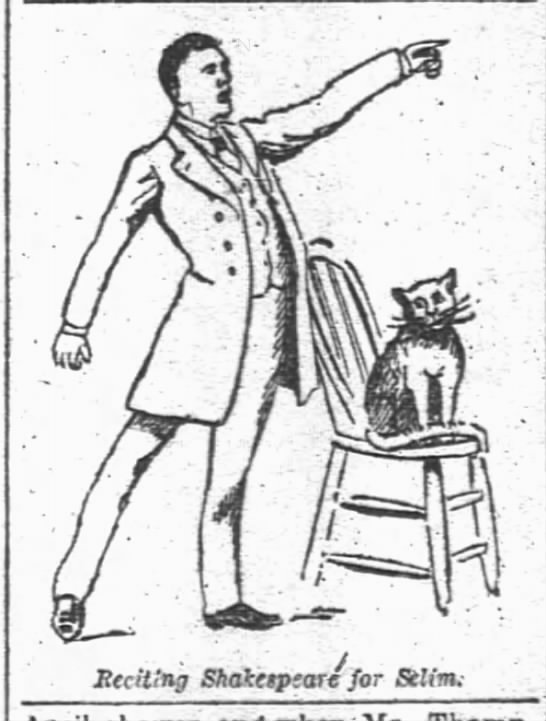
“In sooth thou speakest well, good Marcus,” quoth the Thespian, “but we shall soon test the temper of his former dramatic ability,” and forthwith Mr. Thompson hurled at the defenseless cat a chunk of Shakesperian blank verse that would have staggered Joe McAullife if it hit him anywhere within the scope of his intellectuality. Instead of rolling over and dying instantly, the wonderful cat faced the poetic avalanche as calmly as a duck would an April shower, and when Mr. Thompson, at the end of his declamation, fell exhausted and perspiring over the prompter’s table, Selim was as calm as Eve.


“My life upon it,” exclaimed Mr. Thompson as soon as he could collect the remnants of his breath, “Selim was a legitimate actor.”


Selim, who was listening gravely, was plainly seen by Mr. Bouvier to nod his head approvingly, and in the general discussion that followed in the greenroom the conclusions were reached that Selim was certainly the spirit of some eminent actor who once strode the Baldwin stage.


Morris Peyser thought that Selim’s appreciation of tragedy indicated that he might be the ghost of the talented William E. Sheridan, but Master Mechanic Abrahams was ready to make affidavits that the weird feline was none other than Frank Evan Rae, the Beau Brummel of the melodramatic stage.


“Why, one day when Margaret Mather put a pink ribbon round her neck, I saw him go up to the mirror and tie it into an elaborate bow with his forepaws,” said Mr. Abrahams.


Whatever the former status of Selim may have been, his future in cat life at least is assured, for his position in the theater is as well defined as that of Manager Hayman himself.  Selim is the stock pet and any spare affection which the actresses have to bestow goes to him.  Fanny Davenport during her recent engagement never tired of caressing Selim and the cat’s gallantry toward her was tireless.  He met the actress every evening at the stage entrance and greeted her with a cordial purr and after receiving the expected caress, trotted after her to the door of her dressing-room where he left her with a respectful “meaow.”  While the star was on the stage Selim stood on the first entrance watching her with evident interest and wagging his tail cheerfully whenever the auditorium echoed with appreciative applause.


The fourth act of “La Tosca,” where Scarpia presses his unwelcome attentions on the heroine, affected Selim in an unusual manner, but his emotions have so far overcome his regard for stage etiquette as to lead him to dash from the wings on the stage and aid the actress in her struggles with the athletic Scarpia.


That Selim is a cat of the most extraordinary kind was shown by his conquest of Frank Willard, Miss Davenport’s stage manager.  When the Davenport combination occupied the theater Assistant Treasurer Peyster called Willard’s attention to the fact that Selim was regarded as something supernatural.  Mr. Willard, who is quite a connoisseur in cats and a skeptic of the strongest type, smiled at the story, but before two days he was a firmer believer than anybody in the superstition about Selim.  The phenomenal intelligence of the stage pet so impressed Mr. Willard that Selim got more privileges than were granted to the most favored bipeds of the company.  The unheard of liberty of sitting on the prompt table during rehearsals was allowed Selim, and in the fourth act he was permitted to occupy the first entrance without drawing forth the vigorous reprimand that such a crime calls forth when a human biped is the offender.


Miss Davenport at the close of her recent engagement presented Selim with an expensive jeweled collar in presence of the full company.


The only person around the Baldwin Theater who discredits the superstition that Selim is the reincarnation of some actor’s spirit is Forrest Seabury, who will have it that the wonderful cat is some departed scene-painter.  Whenever Selim is not engaged downstairs he wanders up to the paint frame and sits for hours at a time watching the pictorial work with an interest that is altogether unfeline.


Selim’s almost insane antipathy to the attaches of snide dramatic sheets shows, however, that artist Seabury is wrong and that the wonderful cat is imbued with the soul of a true actor.


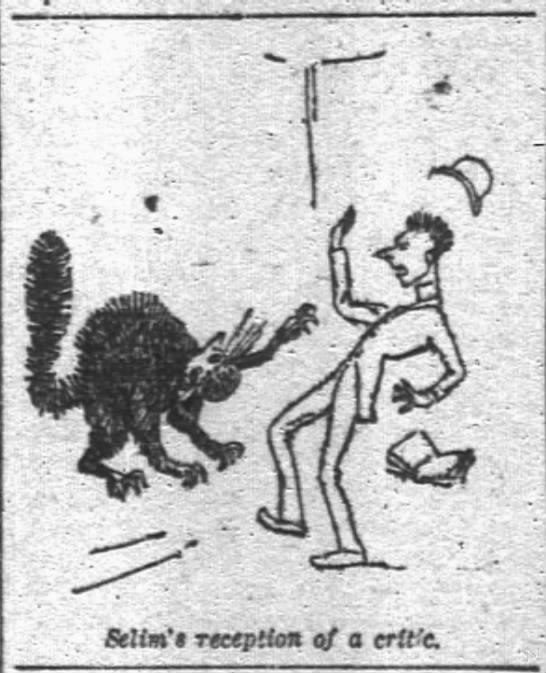
Selim knows every offensive scribbler by sight, and when he catches a glimpse of them behind the scenes flies into an ungovernable rage.  His form swells to gigantic proportions, his sleek back becomes corrugated, and the bristles on his inflamed tail stand out like spikes on a telegraph pole.  His eyes blaze with fury and his whole aspect denotes the progress of a regular whirlwind of passion.  If the intruders ask for an interview with the star who may be playing, Selim’s rage finds expression in whines and howls which Charley, the doorkeeper, interprets into such words as “blackmail,” “scurrility,” etc.  It is evident that whatever branch of the dramatic art Selim followed in his former life, he learned to hate the newspaper scribes cordially, and when he displays his feelings toward them most of them are inclined to beat a hasty retreat.


Though apparently well advanced in years Selim has all the true Thespian’s admiration of the opposite sex, and his four-footed female admirers are numerous; whenever he wants to show his partiality toward some sleek dame of his tribe he introduces her behind the scenes, and during the Davenport engagement appeared to be so beset with applications for free passes that Doorkeeper Charley had to repress the crowd with a club.  In every other respect but his blind infatuation for the other sex Selim is a most exemplary cat, and though he can chew tobacco like a forty-niner and drink beer he never carries these habits to excess.  His gallantry, however, occasionally scandalizes the staid members of the company, but Manager Haymond overlooks all Selim’s moral obliquities, believing that he is a mascot of the most pronounced type.  Doorkeeper Charley has orders to keep Selim supplied with delicate cutlets of liver when the ordinary forage of the theater, such as rats, mice, and cockroaches runs low.  Another of the doorkeeper’s duties is to groom Selim once a week, but the post of tonsorial manipulator of the cat’s whiskers is a sinecure, as the ladies of the ballet are constantly titivating Selim and bestowing their affections on him in a way that would drive the bald-headed holders of front seats wild with envy.


The latest rumor round the Baldwin Theater about Selim is that Mr. Bouvier, who is quite a playwright, is constructing a drama with Selim as one of the leading characters.  Selim is the pet of the heroine, who is restrained by hard-hearted parents from visiting her unfortunate lover, who is incarcerated in the fourth story of a Bush street boarding-house for non-payment of dues.  Selim, to please his fond mistress, defies a ferocious bull-terrier in the backyard of the hashery, and scaling to the bedroom of the imprisoned lover with a clothesline wound round his tail, sets the captive free.  In the last scene the happily wedded pair are shown by the domestic hearth, surrounded by thirteen beautiful children, while Selim grown old and gray, but still as joyous and talented as ever, sits on the window-sill and sings “Auld Lang Syne.”


It is thought that this will cap the climax in the way of pure and emotional domestic dramas.

Wednesday, July 22, 2020

Newspaper Clipping of the Day

Via Newspapers.com


As I have mentioned before, I have a particular fondness for Sailor Cats. This week’s post pays tribute to one of the most well-traveled of them all. The “Kansas City Times,” January 31, 1897:
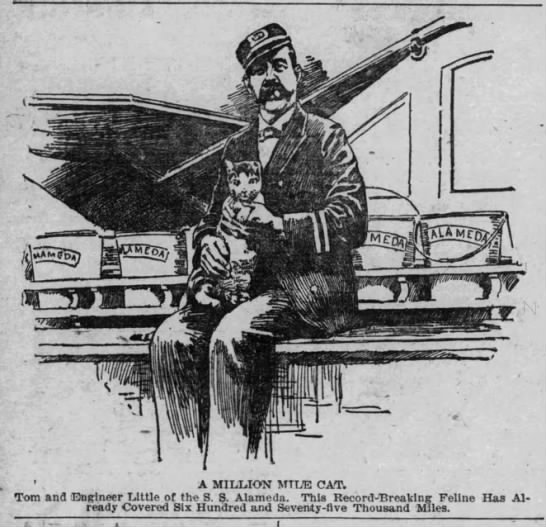
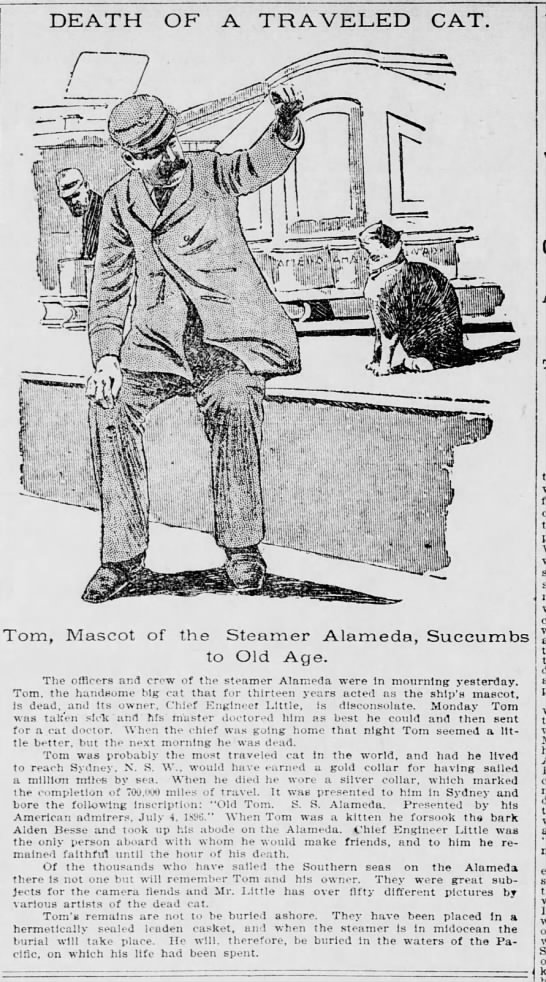
Here is a cat that is striving to make a unique record. To cover 1,000,000 miles is the goal of its ambition and that of its owner, Chief Engineer A. D. Little of the steamer Alameda of the Oceanic line.

It is the most widely traveled cat in the world. Up to the present time Tom has covered a distance of 675,000 miles during his wanderings, and both he and his master are living in the hope that he will be able to reach the million mark. Incidentally, Tom has had many strange experiences. He has been battered about and laid on the sick list more than once, but never has this prevented him from continuing his travels.

Tom has done most of his journeyings on the Alameda, on board of which Mr. Little has sailed as chief engineer for over thirteen years. The Alameda plies between San Francisco, Hawaii, New Zealand and Australia, and at every port where the vessel touches Tom is as well known as the oldest salt in the service. There are dozens of persons interested in him, and many of them keep a record of the miles he travels, adding to the score whenever the famous old feline reaches port. On the waterfront at San Francisco Tom is as well known, in fact, better, than the oldest policeman on the beat, and surely twice as well liked, and at Honolulu, Apia, Auckland and Sydney he is first favorite with all who frequent the docks.

There will certainly be a general lamentation if Tom is not spared to make his record of 1,000,000 miles, but the chances are that he will, for at present the old cat is as healthy as he ever was. It was not until Tom had been at sea for ten years that Mr. Little began to figure up the number of miles he had covered, but since that time he has kept a careful record, and at the close of the last voyage, when it was discovered that Tom had covered a distance of 675,000 miles, there was general feasting among the crew. At present the feline globe-trotter is forging his way over the ocean, adding more miles to his record, and when he left San Francisco he looked as strong as if he were still in his prime, and so the race between him and death goes on, with time having the best of it up to now.

Tom, originally, belonged to the crew of the bark Alden Bessie. He was then quite a kitten. This was about thirteen years ago. One day he crawled up the gangway of the Alameda and started to run round the deck as if he was anxious to start a record for traveling. Several of the sailors tried to catch him, but Tom would not be caught. He secreted himself in various parts of the ship until she went to sea, and from that day to this, he has been on board the Alameda.

As he grew older, Tom began to settle down to business, and it was not long before the upper part of the ship, and the 'tween decks were perfectly clear of rats. It was this quality that brought him so much good luck, and also a great deal of comfort.

From the moment that Tom boarded the Alameda he kept to himself. No amount of coaxing could make him friendly. He would not allow anyone to pick him up, and if any of the sailors tried to stroke him, he would dart off, and disappear for a couple of days. Then he would renew his crusade on the rats. This was the case on the first voyage that Tom took. One day he was hunting the vermin and happened to chase a monster rat into the galley. In his anxiety to catch his foe Tom jumped onto the stove. His feet were badly burned, and with a howl of pain he rushed out of the galley and stowed himself away in the 'tween decks. Engineer Little, who has always been very fond of Tom, started for him, groping among the cargo for several hours, at last finding him writhing in pain between two barrels. Little picked up the cat and took him to his room, dressing his feet with vaseline every day until they were cured, and from that time Tom has been friendly to the chief engineer.

There are now three cats on board the Alameda, but of course they are not such old voyagers as Tom, and he seems to know it. for under no circumstances will he allow one of the "green hands" to walk on the poop. Perhaps when they, too, have traveled 675,000 miles things will be different, but now Tom is very strong. Thirteen years of good food and sea air have told their tale, making him one of the healthiest feline specimens that ever went to sea.

Of late years Tom has acted as sentinel at the door of Engineer Little's stateroom, but there is something paradoxical about his methods. He will kill every rat that dares to make an appearance, but if he ends the life of one anywhere else on the ship the first thing he does is deposit the carcass by Mr. Little's door.

But this wonderful traveling cat is sagacious in other ways. He knows the sound of a flying fish, and never one falls on the deck that does not find its way to the chief engineer's door. Flying fish are considered quite a delicacy at sea, but Tom is always rewarded for his faithfulness by being allowed to eat his captive. The only annoying part about this peculiarity of Tom's is that he will often crawl onto Mr. Little's bed and awaken him if he has a victim's body on display. But his master never chides him for this, and so the old cat remains happy, at least in this regard.

Tom has never missed a sailing day. He is too anxious to travel. In his younger days he used to go ashore a great deal, and sometimes he stayed away for a day or two at a time, but he always showed up at muster on sailing day. Mr. Little has always been at a loss to know how the cat seemed to realize that the ship was about to sail, but the fact remains that he did so, and does so still.

At present Tom is traveling with one ear and a half. This condition was brought about by an encounter with a cat in Sydney, in which, although Tom came out ahead, he did not do so without receiving several reminders of the affray.

When Tom had finished his first 600,000 miles of travel, his American admirers in San Francisco presented him with a silver collar, marked with the inscription "Old Tom, S.S.. Alameda. Presented by his American admirers July 4, 1896."

There was considerable fun at the presentation. A delegation waited on Mr. Little and explained to him their mission. Tom was escorted to the ship's saloon and seated on a table by his master's side. Many of the ship's company were present, and when the speech-making began they were all as interested as if they were listening to an oration over the body of some fallen hero. Tom's history was rehearsed, and due tribute was paid to his superiority as a traveler. Then the collar was presented. Mr. Little, in replying, explained how honored Tom felt at the distinction, and expressed the hope that they would all meet again after he had finished his 1,000,000 miles, for which sentiment there were loud cheers. Then the chief engineer explained that if it was not for the fact that all present were known to be true friends of Tom, he would feel, to some extent, that an insult had been offered by the gift, inasmuch as Tom was well known to be a gold cat. However, he continued. Tom would wear his silver collar on all state occasions, though it must not be expected that he would change his political views.

After the ceremony was over a light luncheon was served, in which Tom joined, and after his health had been drunk several times, the party disbanded. But It was a proud day for Engineer Little, who thinks as much of his pet as he does of anything in the world. Tom's friends in Sydney have asked the privilege of presenting him with a gold collar when he has finished his 1,000,000 miles, and it is expected that there will be great rejoicing when the event comes off.
Sadly, Tom never reached his goal. The “Honolulu Adviser” for July 22, 1898 reported that this great Sailor Cat had made his last journey:
Chief Engineer Little's handsome big cat Tom, for thirteen years the mascot of the Alameda, died at San Francisco when the ship was last in that port. Tom was buried at sea.

Tom was probably the most traveled cat in the world, and had he lived to reach Sydney, N.S.W., would have earned a gold collar for having sailed a million miles by sea. When he died he wore a silver collar, which marked the completion of 700,000 miles of travel. It was presented to him in Sydney and bore the following inscription: "Old Tom. S.S. Alameda. Presented by his American admirers, July 4, 1896."

When Tom was a kitten he forsook the bark Alden Bessie and took up his abode on the Alameda. Chief Engineer Little was the only person aboard with whom he would make friends, and to him he remained faithful until the hour of his death. Of the thousands who have sailed the Southern seas on the Alameda there is not one but will remember Tom and his owner. They were great subjects for the camera fiends and Mr. Little has over fifty different pictures by various artists of the dead cat.
RIP, Tom. You had a great run.

San Francisco Call, July 13, 1898