"...we should pass over all biographies of 'the good and the great,' while we search carefully the slight records of wretches who died in prison, in Bedlam, or upon the gallows."
~Edgar Allan Poe

Wednesday, June 1, 2022

Newspaper Clipping of the Day

Via Newspapers.com


Yes, another gruesome one, but you have to admit that's one eye-catching headline.  The “Arizona Silver Belt,” March 31, 1910:

With an eastbound Santa Fe passenger train running at full speed out of Needles yesterday the express agent and baggageman were so badly scared by the movements of a corpse in the baggage car that they would have deserted the car had it not been what is known as a blind baggage, according to the statement of a passenger who arrived here last night, says the Prescott Courier. 

The corpse was being shipped from California to Ohio for interment. The body was that of a man who died four months ago. Soon after the train pulled out of Needles the occupants of the baggage car saw the lid of the box encasing the remains move, although it was sealed in the usual way. Aware that the man had been dead four months they were surprised at seeing such remarkable signs of life. 

After recovering from the first shock they approached closer to the coffin casing and were further surprised to see the lid slowly rising from the box as if being pushed up by the strength of the body in the coffin. With the lid open the corpse continued to rise until almost in a standing position before the next station was reached, when with the aid of the trainmen the body was pushed back into its place and unloaded at the depot to be further prepared for shipment to its last resting place. 

Passengers who saw the body claim that it was not scientifically prepared for shipment, judging from the odor, and that the box containing the coffin was not hermetically sealed strong enough to comply with the rules governing the shipment of corpses. The queer action of the corpse is believed to have been provoked by the warm weather prevailing in Needles and vicinity.

When everyone left the train, I hope there was a bar nearby.  I’m sure they needed it.

Monday, May 30, 2022

The Pharmacy That Dispensed Death: The Ohio State University Poisonings

As I’ve mentioned before, murder by poison can be some of the most difficult crimes to solve, for the simple reason that the murderer does not have to be anywhere near their victim in order to kill them.  Seemingly random, motiveless slayings are usually equally baffling.  Combine these two factors, and you may well see a mystery would leave Sherlock Holmes baffled.  Such was the tragic situation that haunted Ohio State University in early 1925.

When the University’s students needed medicine, they went to the health service office, where a doctor would write a prescription to be filled at the College of Pharmacy’s dispensary.  On January 29, a student named Timothy McCarthy, who was suffering from a bad cold, obtained a prescription for the standard remedy of the time--capsules filled with aspirin and quinine.  However, the supposed cure just made him feel worse.  Immediately after taking a capsule, he began suffering from terrible pain and cramps throughout his body.  Fortunately, McCarthy had the sense not to take any more of the capsules, and after a few days of misery, recovered his usual good health.
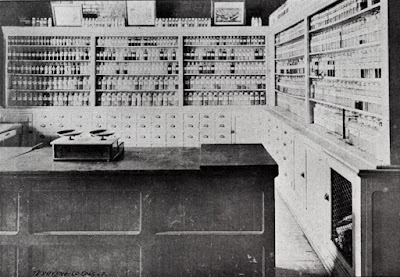
The dispensary in the early 1900s. Via Ohio State University Archives


On January 31, two other students with colds, Harold Gillig and Charles Huls, also took medication from the dispensary.  Like McCarthy, both young men instantly fell gravely ill.  Gillig pulled through, but Huls died while suffering violent convulsions.  Campus doctors ruled that Huls died of tetanus.
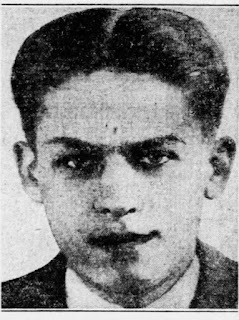
Charles Huls


On February 1, yet another student, David Puskin, got cold medicine from the dispensary.  Twenty minutes after taking a capsule, he was dead.  The doctors decided the unfortunate young Mr. Puskin succumbed to meningitis, and placed all his friends in quarantine.

Two days after Puskin’s death, OSU student George Delbert Thompson took cold medicine he had received from the dispensary.  He immediately fell so spectacularly ill that campus officials were finally forced to realize that something very weird was going on.  An analysis of the contents of Thompson’s stomach revealed that he had swallowed strychnine.  Campus doctors, sheepishly muttering that, after all, it would be easy to confuse the symptoms of meningitis or tetanus with those of strychnine poisoning, admitted that Huls and Puskin had also been poisoned.  Four other students were sickened by the dispensary “cold medicine,” but fortunately, all survived.  And it became obvious that strychnine could not have been added to the cold medicine by mistake: the poison was found in only a few capsules.  In any case, strychnine could easily be differentiated from quinine.  The University realized they had a serial poisoner on their hands, one who lived or worked in the campus, and the police were brought in.  

The obvious suspicion was that the killer worked at the dispensary, but no one could understand how, even under those circumstances, he or she could have tampered with the capsules.  All dispensary medications were made up under the close supervision of faculty members in the College of Pharmacy.  The sixty-four students who had been working at the pharmacy just before the poisonings began were all questioned by police.  Nearly all of them expressed utter bafflement at how the poison could have been added, considering how no prescription was filled without faculty looking on.  The one exception was a young woman who admitted that she had filled the aspirin-and-quinine capsules so often over the last two years that she stopped bothering to bring in supervision when that prescription was made up.  She pointed out that the bottles of quinine and aspirin were always stored together in the same place, so making a mistake with them was virtually impossible.

Chemical analysis of the remaining stock of cold medicine found that the majority of the capsules were harmless--except for one, which contained pure strychnine.  This discovery proved it was impossible for the poison to have mixed in by accident.

Unsurprisingly, every student who still had cold medicine they had obtained from the dispensary wasted no time giving their capsules to investigators.  Among them was one capsule which contained enough strychnine to kill someone four times over.  Taking into consideration the number of students who had been sickened by the capsules, it was calculated that of the three hundred capsules that had been recently made, eight had contained poison.

The State Pharmacy Board looked at all recent legal sales of strychnine, and found nothing suspicious.  On the night of February 4, Dr. Clair Dye, the dean of the College of Pharmacy, inspected the dispensary in hope of finding something that might shed light on the mystery.  In the back of a shelf in the chemical storeroom, he found a small bottle of strychnine.  However, it was nearly full and covered in dust, suggesting that it had sat there, forgotten, for some time.  This potential clue turned out to be a red herring: the bottle had belonged to William Keyser, who belonged to the pharmacy’s faculty.  He had on two occasions taken strychnine from the bottle to use in his classes.  

For a while, it looked like a pharmacy student named Nelson Rosenberg was a promising suspect.  He admitted to having bought strychnine tablets off-campus, as a stimulant to help him concentrate on his studies.  (Yes, back in the good old days, many people took minute doses of strychnine and arsenic as a “health tonic,” and if you are thinking that this must have led to a lot of unpleasant unintended consequences, you are perfectly correct.)  Rosenberg told police that a bottle of strychnine had been kept in a campus laboratory, easily accessible to anyone who had murder in mind.  However, all the other students insisted that they had never seen such a bottle, and Rosenberg himself admitted that he had no idea what happened to it.  All this emitted a very strong odor of fish, but Rosenberg must have somehow managed to persuade investigators that he was not a maniacal mass poisoner, because the police appear to have lost interest in him.

Another odd figure who emerged from the investigation was a 19 year old pharmacy student named Louis Fish.  When questioned, Fish admitted that he had given David Puskin the killer capsule.  He explained that he and Puskin had been friends, and when Puskin fell ill, he asked Fish to fill his prescription for him.  He confessed that he had sneaked into the pharmacy “without authority,” in order to get the medicine.  He had not told anyone about this before, as he had no wish to get mixed up with a murder investigation.  Fish had been the first student to work in the dispensary the week the fatal capsules were circulated.  Furthermore, on the night of January 30 Fish suddenly left campus to go to his home in Canton, 100 miles away.  However, as soon as he arrived in Canton, he drove straight back to the University.  When asked about this curious behavior, Fish could only say that “I didn’t want to stick around Canton.”  Fish was put under arrest, only to be released the following day.  Police presumably had some good reason to drop both Fish and Rosenberg from their investigation, but if they did, it was evidently never publicly recorded.
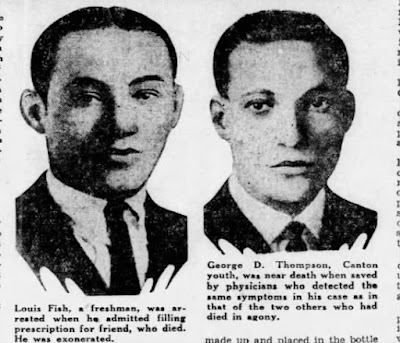
"Atlanta Constitution," June 3, 1934, via Newspapers.com


In July 1926, the Ohio State Board of Pharmacy released its report on the mystery, and it was one long salute to Captain Obvious: the poisonings were deliberate and the strychnine had been obtained off-campus.  The End.

That was also The End of any official investigation.  Not only do we not know who the killer was, we cannot even say why the poisonings were done.  Did the evildoer intend to murder just one person, and distributed the other fatal capsules to hide who the real target was?  Or was it a case of some secret psychopath getting their kicks by poisoning people at random?  In either case, they got away with murder.  Perhaps not for the first time.  Or the last.

Friday, May 27, 2022

Weekend Link Dump


"The Witches' Cove," Follower of Jan Mandijn

While you read this week's links, be entertained by the Strange Company Orchestra!


The fateful silver casket of Mary, Queen of Scots.

Queen Victoria and parliamentary ceremony.

The oldest city in the New World.

One of the last "fireship" attacks.

The shortest war in history.

Toronto's classiest con artist.

The early days of San Antonio, Texas.

The controversial Shapira Scrolls.

That time blimps were used to fight a duel.

The fire that transformed New York City.

A Pennsylvania murder-suicide.

The man who discovered Troy, and wrecked it in the process.

This Week in Russian Weird looks at an...unusual view of world history.

The mysterious petroglyphs of Dighton Rock.

A lonely Japanese writer in London.

A Georgian-era trip advisor.

The Brazilian revolution of 1848.

The last smallpox patient.

A guy who really, really wanted to be Consul of Baghdad.

A lovely medieval Psalter.

Victorian mockery of vegetarianism.

A gourmet cat in Brooklyn.

Some surprises in old documents.

India's singing temples.

An unhappily married woman found freedom in South Dakota.

Some prehistoric battle sites.

A brief history of the Blue Plate Special.

The mystery of the disappearing observatory.

The Flying Dragon of Death!

The midwife's ghost and a secret burial.

How Shirley Temple went from child star to diplomat.

The secret gardens of Spitalfields.

A black cat hoax.

Yet another trunk murder.

Some vintage "favorite recipes."

Victor Hugo as a political symbol.

That wraps it up for this week!  See you on Monday, when we'll look at a mysterious series of poisonings.  In the meantime, bring on the marimbas!

Wednesday, May 25, 2022

Newspaper Clipping of the Day

Via Newspapers.com


It’s time for Mystery Lights!  The “Montreal Gazette,” November 29, 1938:

Esterhazy, Sask., November 28. Tabor Cemetery's mysterious light which threatens to give Esterhazy folk the jitters, tonight still challenged efforts to find its source. An attempt to unravel the mystery Saturday night failed because the eerie beam did not maintain its usual midnight schedule. 

During the last few weeks, the pinkish light appeared suddenly each night. It moved with terrific speed towards watchers, residents said, then quickly disappeared. Saturday night at 10:30 o'clock, a group of men trooped to the cemetery. Within half a mile they huddled in groups and smoked and talked quietly until after midnight but they trekked home disappointed because the ghostly glare did not appear. 

"This thing is giving everybody the jitters around here," one resident said later. "A number of men are now organizing to go on watch in the graveyard to see if any explanation can be given for the weird light." 

Some of the superstitious residents expressed fear "something awful is going to happen." Religious minded mothers daily reminded children to pray that no harm came to any one and the children are sent early to bed with windows covered with papers.

Subsequent reports stated that the eerie light continued to be seen by “hundreds” of people over the next several weeks.  (The crowds around the cemetery became so large that one enterprising fellow spoke of setting up a hot dog stand at the site.)  One woman suggested people were merely seeing “marsh gas,” but an investigation by the R.C.M.P. failed to find the source of the light.  About six weeks before the Tabor light was first noticed, a pilot named David Imrie reported seeing what seemed to be “navigation lights of a night-riding ghost plane” as he was flying the night mail between Regina and Moose Jaw.  That plane--if it was a plane--was never identified.

Monday, May 23, 2022

The Bones in the Wall: An Edinburgh Castle Mystery

Engraved print of Edinburgh Castle, 1833


All ancient buildings have secrets, and Edinburgh Castle is no exception.  One of its more obscure mysteries was recorded in the “Glasgow Courier” on August 14, 1830:


“On Wednesday last, [August 11] as the masons were knocking off the loose lime, previous to re-casting the old palace in the Castle, they discovered a hole in the wall. The workmen described it as being three feet and a half long, one foot two inches high and one foot in breadth. Between the end of the opening and the surface of the wall (it is the front of the palace) there was a stone about six inches thick and about the same length which was supposed, from the thickness of the wall, to be between the extremity of the opening and the inner surface of the wall or room. In this cavity was found several human bones, some pieces of oak supposed to have been parts of a coffin, and bits of woollen cloth, in all probability the lining of it. On the lining the letter J was distinctly visible, and some of the masons said they saw the letter G also. The bones appear to have been those of a young child. Some of them are in the possession of the person from whom we received this communication. It is right to add that the opening was across the wall.”


All anyone could say about this strange find is that those bones had obviously been in that wall in the old Royal Apartments for a very long time.  At a February 14, 1831 meeting of the Society of Antiquaries of Scotland, an account written by one Captain J.E. Alexander was read.  According to Alexander, the shroud was of “Silk and Cloth of Gold, having the letter J embroidered thereupon.”  (Note: other observers thought the letter was an “I”.)  At that same meeting, the Society was presented with several of the bones.  In July of that same year, Sergeant Major Dingwall sent the Society more of the ancient bones and a piece of the coffin.  Unfortunately for historians, the physical evidence of the burial--cloth, coffin, bones, and all--have been lost over the centuries.


Over the years, this simple--if extremely weird--discovery inevitably had all manner of romantic fictions and inaccurate details attached to it.  Castle tour guides were fond of telling visitors that the tiny coffin held the remains of a stillborn child of Mary Queen of Scots, with some newborn baby smuggled in as a substitute.  In 1909, an antiquary named Walter B. Woodgate went even further.  As he thought James VI bore a strong resemblance to the Earl of Mar, he proposed that the Countess of Mar was James’ real mother.  Others have suggested that the bones were those of a “foundation sacrifice”--the body of some small animal buried to ward off evil spirits.  More prosaically, it has been theorized that the box or coffin of bones was a reliquary, although this notion does not explain why a holy relic would be so ignominiously walled up.  Jan Bondeson, who examined this puzzling story in his 2018 book "Phillimore's Edinburgh," threw cold water on all those theories, but did not venture to offer one of his own.


The many embroideries that have grown around the original discovery have caused many historians to automatically assume that the discovery of the secret burial never actually happened.  This is regrettable, because there is a genuine mystery here, one well worth contemplating, even if finding a solution is almost certainly impossible.


Friday, May 20, 2022

Weekend Link Dump


"The Witches' Cove," Follower of Jan Mandijn


Enjoy the Link Dump, but be aware that the Strange Company HQ staffers are on the war path today.

Watch your step.


A homicidal sister-in-law.

The life of Marguerite of Provence, Queen of France.

In which Mario Puzo and Frank Sinatra have a less-than-cordial chat.

In which we learn that T.S. Eliot and Groucho Marx were pen-pals.

Ancient intestinal parasites.  Ain't nothin' an archaeologist loves more than ancient intestinal parasites.

The melancholy of phone boxes.

The tragic life of child star Lora Lee Michel.

A modern history of the Loch Ness Monster.

The possible origin of the "Wow!" signal.

The loss of HMS Royal George in 1782.

A look at library cats.

The paranormal side of an English village.

I don't get car sick, but I still wouldn't drive on this road.

Adder snake superstitions.

A look at when Manhattan had country estates.

An unsolved murder in Finland.

Another one for the "pushing back human history" file.

It's no joke that you really shouldn't steal from Indian temples.

An ancient forest has been hiding inside a Chinese sinkhole.

Photographing an angel.

Related: we may not be our planet's first advanced civilization.  

Two newspapers get into a spat.

The Society of the Double Cross, and tales of hidden treasure.

The "war scars" of 1950s Britain.

A 130,000 year old tooth.

An unconventional Victorian marriage.

A death on Hackney Marshes.

Some odd little stories about family Bibles.

The men who revolutionized choral singing.

George Orwell's humorous side.

A case of life-saving...uh, poop.

18th century marriage customs.

The ongoing mystery of crop circles.

WWII's "Operation Mincemeat."

The world's oldest known fake eye.

The "Bloodhound of the Far West."

Dogs as crime fighters.

The first ghostbusters.

A review of a new book about Madeleine Smith, one of Scotland's luckiest poisoners.

A life-saving Fire Department horse.

That's all for this week!  See you on Monday, when we'll look a mystery set in Edinburgh Castle.  In the meantime, here's what happens when Bach meets heavy metal.


Wednesday, May 18, 2022

Newspaper Clipping of the Day

Via Newspapers.com


This tale of a Welsh poltergeist--complete with all the classic trimmings--appeared in the “Buffalo Sunday Morning News,” January 16, 1910:

(Special Cable to the Sunday News)

CARDIFF. Jan. 15. A quaint tale of a spook comes from the small Carmarthenshire village of Llanarthney, and in this case the ghostly visitant seems to be peculiarly vicious, missiles being hurled through the air by an unseen hand.  The mysterious happenings which have terrified the peaceful villagers have taken place at the Emlyn Arms Inn, and a local correspondent says appearances go to show that this old-fashioned hotel must either be haunted or that an exceedingly marvelous conjurer has been able to completely defy police and other detention. 

On Wednesday night, just after closing the inn, Mrs. Meredith, the landlady, whose husband was spending his holidays in North Wales, was pelted with stones as she was tending the cattle. She attached no significance to this, but when her servant girl, aged 13, who bore her company, responded to a knock at the front door a candlestick came whizzing through the passage. Yet not a soul was seen either in or about the premises. 

More mysterious still, various missiles were presently hurled from every quarter of the kitchen, and, terrified in the extreme, Mrs, Meredith shrieked for help. Mrs. Jenkins, wife of the village constable, and her sister-in-law, Miss Jenkins, hurried to the house of mystery at midnight, but so eerie were the antics of the presumed visitant from the spiritual world that neither dared enter the Inn, nor would others venture therein, until the arrival at 2:30 A.M. of Police Constable Gwilym Jenkins, who had cycled through the colliery districts on duty. 

He believed that his services were needed to arrest a burglar, but search where and how he would, no person could be found, although he heard the tramping of "padded feet" on the stairway and in the upper chambers. Bottles fell at his feet and were smashed, says our correspondent. A heavy black varnished stone ornament "jumped off" a bedroom mantelpiece and fell close to his head as he was looking under the bed for a burglar, and stones which bad been immersed in white lime went hither and thither in most inconceivable fashion, while teapot covers and covers of other things came hurling down, to the astonishment of the constable, his wife, sister-in-law, post office officials and the occupants of the inn. 

The spectators, it is said, saw a polished box fall from Meredith's waistcoat, which was hanging in the kitchen. This waistcoat was ironed by Mrs. Meredith on the previous evening, and she could not have failed to notice the box had It been there then. At 3:30 in the morning mistress and maid sought refuge in the house of a mason employed by Earl Cawdor, who owns the inn, but when they returned the following morning with the constable the mysterious happenings were resumed. 

These occurrences were witnessed by other people, including the vicar and curate of the parish. Constable Jenkins, who has been in the Carmarthenshire constabulary about nine years, asserts that this narrative is true in detail, and that it is not the imaginings of Christmas hilarity, for the spectators were perfectly sober and he is a strict teetotaler himself.

The whole affair is simply inexplicable. The constable had the house surrounded by workmen, and had a burglar been at the inn he would have been captured.

I couldn’t find any updates to this story.  Possibly this was one of those polt incidents that comes and goes almost immediately.