"...we should pass over all biographies of 'the good and the great,' while we search carefully the slight records of wretches who died in prison, in Bedlam, or upon the gallows."
~Edgar Allan Poe
Friday, September 16, 2016
Weekend Link Dump
This week's Link Dump is sponsored by the Confederacy of the Bookplate Cats!
Where the hell is Atlantis? This Italian scientist thinks he knows.
Where the hell is HMS Terror? Now we think we know.
Who the hell killed James Garfield? This author thinks he knows, and the murderer may not have been who you think it was.
What the hell is this Neolithic stone?
What the hell was the Loomis Street Affair?
England's first Wicked Stepmother.
A murder mystery with an inconclusive ending.
The secret diary of an 18th century planter. Read the excerpts and you'll see why it was secret.
Some etiquette tips if you're ever transported to the 18th century.
The Clock Bewitcher.
The ultimate cure for rheumatism.
The Mitford Sisters, the Kardashians for the intellectual set.
The battle over Nefertiti.
Canada's role in the Louisiana Purchase.
Dog-grooming in 19th century high society.
9,000 year old Australian homes.
A Scottish "Physic Well."
Medieval recycling.
A Brownstone for your favorite hipster cat.
The first attempt at optography.
This week's "Well, duh!" moment: It's finally dawned on scientists that dolphins have a language.
The biggest witch trial in history.
The top American folktales.
A Series of Unfortunate 1843 Events.
A doomed Rat Utopia.
That time someone wanted to drain the Mediterranean.
A look at some megalithic tombs.
Re-evaluating the Black Prince.
Some WWI dowsing.
The life of an 18th century courtesan and spy.
The world's oldest snowshoe.
Another one for the "Our Ancient Ancestors Were a Lot Smarter Than We Think" file.
A bad landlord leads to a family tragedy.
Living on the fringes of Empire.
Visions of the American flag.
Particularly strange cases of missing children.
Anyone else up for booking a room in a haunted lighthouse?
The Case of the Howling Queen.
Some French animal tales.
How to lose a 137-carat diamond.
A magistrate's extremely colorful casebook.
An 18th century Zelig.
An interesting experiment testing the power of mind over our bodies.
Poisons and love potions.
This week's Advice From Thomas Morris: Beware the snake poo salesmen.
Also, what not to do with pins.
A British MP puts in the ultimate overtime.
More about fortune-telling with moles.
Cows and the full moon.
The Shaman's Apprentice.
An early Northern Ireland UFO sighting?
Is there a secret message in the Sistine Chapel?
A place where a very peculiar woman thinks the world is falling apart and surrounds herself with cats because she thinks they're gods. Despite what you're assuming, this is not a profile of Strange Company HQ.
An ill-fated Duke of Burgundy.
Why we all love black pigs.
The death of a prostrated pirate.
A case of "Second Sound."
How to raise a genius.
A French Court of Miracles.
A guide to eloping.
Bird trees and barnacle geese.
This week in Russian Weird: This one's for anyone out there nursing a delusion that life under the Soviets was fun and games.
Except, of course, when they were trying to find the hollow earth. That was fun and games.
And that's all for this week. See you on Monday, when we'll look at a still-controversial 18th century murder mystery. In the meantime, here's a song that has been covered by pretty much everyone who ever stepped up to a microphone, but this is probably my favorite version:
Wednesday, September 14, 2016
Newspaper Clipping(s) of the Day
Chris Woodyard's outstanding collection of morbid delights, "The Victorian Book of the Dead," featured the sad end of Alice Knott, murdered by her "evil-dispositioned" parrot, who had the habit of "pulling the tips off the gas burners with his strong beak and inhaling the gas until it stupefied him." While this was nothing but fun and games for the bird, one night it was death for his mistress.
This memorable tale left me wondering if this was a once-in-lifetime sort of event, or if there were other tales of people gassed to death--intentionally or not--by their pets. Just a short browse through the old newspapers left me convinced that our beloved furry and feathered friends are in league to kill us all.
Let's kick things off with the soulmate of Miss Knott's bird, Dolly the Parrot of Death. This story comes from the "La Crosse Tribune," September 25, 1947:
Jersey City, N.J.--Her pet parrot who turned on a kitchen stove gas jet was blamed today for the death of 66-year-old Mrs. Fannie Stewart.
Mrs. Stewart, a widow, was revived by police rescue squad workers but died later at the Jersey City medical center of what hospital authorities said was cerebral thrombosis.
She had told rescue workers that her parrot, Dolly, flew about her Beacon avenue home at will and had turned on the gas jets once before when it alighted on the kitchen stove. Mrs. Stewart, however, said she had discovered the escaping gas before any damage was done that first time.
Neighbors who detected gas seeping from Mrs. Stewart's home summoned the rescue squad yesterday.
![]() |
| Dolly's mug shot. |
The "Dundee Courier," April 7, 1948:
Mr. John Blackman returned to his home in Crewys Road, Charles Hill, Cricklewood, to find his wife was missing.
He thought at first she must be shopping or with neighbours.
There was a strong smell of gas. He went upstairs. In the bathroom he found his 56-year-old wife, Susan Maria, dead.
At the Hendon inquest yesterday a gas official said the geyser safety device was faulty, and a bird had built its nest in the flue pipe.
Verdict--Accidental death from coal gas poisoning.
Sadly, there was at least one case where the tables were turned on our homicidal birds. The "Perth News," April 21, 1928:
Melbourne, Saturday.--That a mouse should cause a parrot's death seems incredible, but such a thing happened in the flat of Mr. and Mrs. P.R. Garvie, Mary-street, St. Kilda, this week.
Mrs. Garvie was accustomed to leaving the parrot's cage in the kitchen overnight to protect the bird from cats.
On Thursday night a mouse crept from its hiding place, and in its search for food climbed a gas pipe, leading to the copper. The tap on this pipe was very loose. It turned under the weight of the mouse, and the room was filled with gas. In the morning when Mrs. Garvie entered the kitchen she found her pet bird and mouse lying together dead in the bottom of the cage.
I suppose it should not be a surprise that cats excel at creating DIY gas chambers for their owners. They were, by far, the leading practitioners of this particular animal hobby. This next brush with death comes from the "Virginia Recorder," July 22, 1938:
Des Moines.—Less than 24 hours after three young women of Des Moines received a cat as a mouser, the animal brought death close to the girls by turning on a gas burner as they slept. The girls are the Misses Lavona and Evelyn Hove, sisters, and Miss Helena Adair. They occupy a basement apartment in the rooming house of Mr. and Mrs. Harry Bougher.I found no follow-ups to this story, but I'm guessing Tippy got her body count in the end.
A few days ago the girls heard a mouse in their room. Learning of this, Miss Adair’s mother offered the cat as a solution. The three girls promptly installed the cat in the apartment and named her Tippy. It was about 1 a.m. when the girls retired. Tippy was lying curled up in a corner, apparently content. A little before 6 a.m. Bougher went to the house furnace in the basement. When he returned to his quarters a few minutes later he told Mrs. Bougher there was a strong odor of gas in the basement.
“I can smell it up here,” Mrs. Bougher replied. “Say—l wonder if it can be coming from the girls’ apartment? You know it’s right below this room.” The couple hurried to the basement, knocked on the apartment door, but received no answer. “I thought right then that they were dead,” Mrs. Bougher said. “The gas was so strong it almost knocked me down,” she said. “I yelled several times and then one of the girls answered. Mr. Bougher ran into the room and opened the windows. “We found that one of the burners on the stove was about half-way open. That’s where the gas was coming from.” The three girls were aroused and taken to the Bougher apartment. None suffered any apparent ill effect. Neither did Tippy. All three girls were certain the gas had not been on when they retired. And certainly, they said, the burner had not been half-way open for five hours. This left Tippy as the only possible suspect. “I guess it was a pretty close call,” said Miss Lavona. “After this,” added Miss Adair as she stroked the cat, “Tippy is going to have to sleep out nights.”
Same goes for this cat recorded in the "Sydney Herald," April 28, 1931:
Wellington (N.Z.) Monday. Left inside a Wellington house to catch mice, a cat jumped on the gas stove during the night, in search of some fish that had been left there, and turned on a gas jet, and as a result the occupants of the house were nearly asphyxiated. The mother and three children were overcome by fumes, and the others became violently ill. One member of the family had awakened earlier, smelt the gas, and turned off the tap, without telling the others.
"San Francisco Call," November 1, 1913:
A pet cat in the home of Edward Clarkson, Brooklyn, disconnected a rubber tube from a gas stove in the kitchen, causing the death of Mrs. Ida Clarkson from asphyxiation. Clarkson was asleep at home, as also was his wife. He was removed unconscious to the Holy Family hospital."Perth Times," March 25, 1934:
A pet cat is believed to have been responsible for the death of its 90-year-old owner, Mrs. Margaret Kingston, who was found in a gas-filled room at her home at York-road, Hove, England.
Mrs. Kingston loved her cat--a Persian--so much so that every night she took it to bed with her.
It is believed by the police that while she was lying asleep the cat brushed against a gas-jet, turning on the tap.
When they entered the room Mrs. Kingston was dead in bed. Her daughter Mrs. Moorhead, and the cat were lying on the floor unconscious.
Mrs. Moorhead and the cat recovered after the police had applied oxygen to both.
The "Western Press," August 13, 1931:
Mr. J. Lewis, of Frazer Street, Bedminster, Bristol, had his moustache and eyebrows singed when an explosion occurred in the gas stove at his home yesterday.
The force of the explosion broke panes in the kitchen window and damaged the ceiling.
Mrs. Frazer expressed the opinion to a reporter that the cat must have turned on the gas in the oven.
When her husband lit the gas on top of the stove, he smelt an escape, and opened the oven door, a loud bang being the result.
[Note: You know you have one heck of a slow day in Bristol when J. Lewis' singed moustache is headline news.]
A rare instance of a would-be killer cat's change of heart was reported in the "Columbia Missourian," March 15, 1929:
Cats usually come under the category of "dumb animals" but "Rags," a persian cat belonging to Mrs. N. A. Dysart, 208 South Eighth Street, has proved the exception. About three o'clock yesterday morning Mrs. Dysart was awakened by "Rags" jumping upon the bed and then racing into the hall. The cat continued this until she finally awakened her mistress enough to know that something was wrong and that the cat was trying her best to tell her.
Mrs. Dysart followed the animal out into the hall where gas fumes were so heavy that it was almost impossible to breathe. She succeeded in getting the window open and making her way into the kitchen from which the gas seemed to be coming. Groping though the dark until she located the light switch, she found that one of the gas jets was on.
"Rags" was in the habit of getting upon the stove to catch mice that were making their home there. In so doing she had accidentally turned on the gas and sensing that something was wrong sought to warn her mistress of the accident.
The "Meriden Morning Record," March 2, 1912:
Newton, Mass., March 1.--The cat in the household of Louis Andrews at Newton Upper Falls could not control its curiosity as to the shutoff on the gas range in the kitchen early today. The consequence was that four of the occupants of the house were rendered unconscious by escaping gas and were not revivied for several hours.
When the excitement was all over a searching investigation revealed that the cat, which had been asleep in the kitchen, had turned on the gas.
Mr. Andrews is in doubt whether the family pet became despondent and contemplated suicide or hit the gas cock in a playful mood. The cat suffered no ill effects from the gas.
"Playful mood," my eye. Mr. Andrews had yet to learn that a few days earlier, the cat secretly took out life insurance policies on the entire family.
I kid, I kid.
You don't have gas in your home, you say? You're immune from having your darling pet asphyxiate you in your sleep?
Ahem.
The "Yorkshire Post," July 19, 1933:
The prowling of a cat in the cellar of the house of Mr. Bower, Hillhouse Lane, Huddersfield, nearly resulted the family being gassed by ammonia fumes. Mr. Bower, who is a grocer, had a carboy of ammonia In the cellar underneath on which stood some ginger beer bottles. It is thought the cat, walking along the shelf, knocked over a ginger beer bottle on top of the carboy. The glass was broken, and ammonia fumes spread rapidly over the house while the cat made her escape.
When Mr. Bower realised what had happened, he called the fire brigade, who it found Impossible to get inside the house without the aid of masks. So far had the fumes spread that the ordinary gas mask was no use, and a special one had to secured. This was attached a box containing several different kinds of chemical crystals to counteract the effect of different gases. The mask had not previously been used against ammonia fumes by the Huddersfield brigade, but Sergeant Hutton, who went to the cellar to carry out the carboy, felt no effect from the fumes.
You dog owners must be feeling pretty smug right now. No lethal birds or treacherous cats for you. No worries!
Read on.
"Kalgoorlie Miner," October 9, 1948:
London, Oct. 8--A dog, by jumping on a gas cooker and turning on the tap, caused the death of his master, 53-year-old Ernest Herbert Gibbons, who was found gassed in a first floor bedroom of a house in the London suburb of Cricklewood.
Gibbons was in bed and evidently asleep when the dog jumped.
Here is a particularly incriminating story from the "Sunderland Echo," December 30, 1933:
A dog belonging to John Carter, of Hull, accidentally turned on a gas tap in the room where its master was sleeping.
The dog then went to another room where its play awakened the man's brother.
John Carter was found unconscious from the effects of the gas fumes.
"Gloucester Citizen," January 30, 1939:
A pet dog found unconscious on a kitchen floor is thought to have been the cause of a gas tragedy in which a man, his wife and a child lost their lives at Manchester during the week-end.
The dead people were: William Edward Webb, aged 52, a railway worker, Jane, his 51-years-old wife and Roy, aged 6, their adopted son.
Policemen who were called by neighbours to their house in Eltham-street, Levenshulme, found Mr. Webb and Roy dead in bed in the back bedroom. Mrs. Webb was in the front bedroom.
The house was full of gas which had escaped from a tap on the scullery boiler, which was turned on slightly.
The dog revived after treatment.
The only theory as to the cause of the tragedy is that the dog, which was allowed to run about the house during the night, had brushed against the tap and turned it on.
The lesson to be learned from today's post? Keep the catnip, gourmet bird seed, and caviar dog biscuits handy, my friends. Maybe we can bribe them into sparing us.
Monday, September 12, 2016
The Ghosts of Antigonish
Most real-life ghost stories start suddenly, unexpectedly. Life is normal one moment, and awash in The Weird the next. A notable exception is one of Canada's most well-known hauntings, usually known as "The Fire-Spook of Caledonia Mills." This paranormal tale started with a lethal curse, which should have given everyone involved fair warning.
The site of our tale is the isolated farm of Alexander MacDonald, in the remote rural village of Caledonia Mills, Antigonish, Nova Scotia. According to legend, trouble began in 1900, when MacDonald's wife Janet got into a bitter argument with her mother, Mary Cameron. In her fury, Janet snapped, "I hope the devil in hell comes and takes you before nine o'clock tomorrow morning!"
Yes, indeed, the next morning Mrs. Cameron suddenly died. Before nine.
Anyone familiar with such tales knows that when you summon the aid of Satan, it can be very hard to get the fellow to leave. Unnerving things began to happen at the MacDonald farm. Household belongings mysteriously vanished, later reappearing in remote spots on the property. MacDonald's horses and livestock would somehow be set loose from their stalls, and nothing MacDonald did seemed able to stop it. During the night, horses and cattle switched places, with the cows in the stables and the horses in the cattle areas. The animals' tails were found elaborately braided. The poor creatures were always left terrified after these occurrences. Heavy farm equipment would be moved about, as if by invisible hands. Passers-by often noticed a weird blue light playing around the barn.
In 1910, the MacDonalds adopted a two-year-old girl named Mary Ellen. She was the daughter of a local woman who could no longer take care of her. The child rarely attended school and had no outside friends or interests. She grew up in the morbidly private world of this increasingly eerie farm.
The family's private descent into hell became very public on January 6, 1922, thanks to what became known as "The Night of 38 Fires." Mary Ellen braved walking through a fierce blizzard to seek out the neighboring farm of Leo MacGillivray. Her family, she pleaded, needed help. Fires kept breaking out at all sorts of different locations in their home, and the MacDonalds were unable to control them.
When MacGillivray and other neighbors arrived at the MacDonald's, they saw immediately that these were no ordinary house fires. MacGillivray later said that the place would suddenly become illuminated as if by a short circut on a high-tension wire. Then, bluish blazes would suddenly appear on the unlikeliest places--including soaking wet papers, rags, and wood. The wallpaper would periodically shoot out flames. As soon as the fires were extinguished, new ones would pop up to take their place. There was a strange lack of heat to the fires. No gasoline or other flammable materials were inside the house.
Perhaps the most curious occurrence was reported by two neighbors, Michael McGillivray and John Kenney. One day, as they were approaching the MacDonald home, they saw a hand grasping a piece of white cotton projecting from an upstairs window. The white cloth was waved three times, as if giving a signal, before it disappeared. Residents of the house swore that no one had been upstairs at the time.
The MacDonalds were exhausted from battling the unremitting blazes, and in a state of confused panic about what was happening to them. By January 12, the family, terrified that they might be burned alive, had no choice but to flee. They took shelter with the MacGillivrays.
Naturally, word soon spread of the peculiar events at the MacDonald farm. Harold Whidden, a reporter for the "Halifax Herald" was assigned to visit the farm. With him was a retired police chief, Peter Carroll. The men spent two nights at the farmhouse. They were spared the mystery fires, but reported hearing footsteps and other eerie noises. A...something angrily slapped them on their arms and faces.
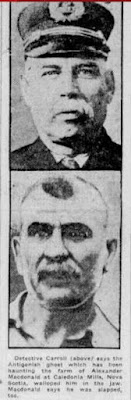
| Peter Carroll (above) and Alexander MacDonald |
Whidden, increasingly convinced that the farm was plagued by paranormal forces, turned to automatic writing. He soon felt his mind "controlled by some unseen power. Every movement [of his hand] appeared to be dictated or automatic. The writing was not of my own violation."
The invisible tormentors were asked, "Who set the fires in Alexander MacDonald's house?"
"Spirits!" Whidden's hand wrote on the paper.
It was then asked, "Did you slap Harold Whidden on the arm the second night he and Mr. Carroll were in the house?"
Whidden wrote "Yes," explaining, "Because I wanted to show him that the mystery fires were caused by spirits!"
Whidden wrote for over two hours, receiving what he believed were many different messages from the "spirits." However, he never revealed their full contents, explaining that most of them "were of the utmost significance and not a few of them were of an entirely personal character." Whidden concluded, "I will...believe to the hour of my death at least, that the fires in Alexander MacDonald's house and the mysterious unfastening of his cattle were caused by spirits." Carroll agreed. He later described the MacDonalds as "straightforward, substantial and God-fearing...I firmly believe that neither the fires nor other strange occurrences about the farm were the cause of human hands."
So...what did cause them?
Walter Franklin Price, a scientist at the American Research Society of New York, believed he had the answer. He spent nearly a week at the MacDonald farm, and returned convinced that Mary Ellen was responsible for the fires. He wrote that Mary Ellen may have been in an "altered state of consciousness" and in the grip of a "discarnate intelligence" when these seemingly occult acts were committed. However, he absolved her from conscious guilt, writing that "I am emphatically of the opinion that the girl was not mentally culpable. She is mentally exceedingly young for her years and witin the past year has had singular 'dream' states, from which it was difficult to rouse her. It is very probably that she was the victim of altered states."
Dr. Price did not bother to explain why, if such was the case, Whidden and Carroll experienced weird phenomena when Mary Ellen was nowhere in sight.
An even less likely theory was offered by Edward O'Brien, of St. Francis Xavier University. O'Brien proposed that the so-called "Fire-Spook" was really due to wireless currents that ran through the area from nearby radio towers. The commotion with the livestock, he scoffed, was just Mary Ellen playing pranks on her gullible family. No one else, however, managed to take O'Brien very seriously, particularly after Guglielmo Marconi himself publicly dismissed the idea.
Poltergeist tales rarely have a happy ending, and sadly, this was no exception. Neighbors indignantly refuted Dr. Price's suggestion that Mary Ellen was in any way to blame for the chaos that had engulfed her family. They described her as a sweet, good-natured girl who loved her adopted parents and was incapable of playing such sadistic "pranks." The strange events at her home, coupled with the common tendency to place responsibility for them on her shoulders, proved to be too much for Mary Ellen. In October 1922, she was temporarily committed to an insane asylum. After her release, she eventually married, and did her best to put the horrific experiences of her youth behind her. The MacDonalds abandoned the farm for good. Some years later, it mysteriously burned down, and no one showed any inclination to rebuild on the notorious plot of ground. To this day, there is a belief that the land where the farm stood is "cursed," and that if anyone removes any item--no matter how small and insignificant--from the site, the "Fire-Spook" will prey on their home, as well.
When asked what he thought of the events at the MacDonald farm, Harold Whidden would invariably answer, "It is beyond me. The solution of the mystery may be quite simple, but to me it is a very strange affair, and I would not offer a suggestion."
That may have to remain the final word on the matter.
Friday, September 9, 2016
Weekend Link Dump
This week's Link Dump is sponsored by the Cats Who Are Ready For the Weekend!
Who the hell killed the Princes in the Tower? Could it have been...the woman who went on to become their sister's mother-in-law?
Watch out for the Portrush Merman!
Watch out for those haunted swords!
Watch out for those seagoing poltergeists!
This week in Russian Weird: It's still the 17th century in a corner of Alaska.
Oh, and their rivers are turning red.
Scotland's famed Gretna Green.
How the rest of the world saw the Great Fire of London.
Well, no, we haven't actually found Black Shuck. Sorry.
Mysteries hidden in old documents.
The kind of thing that happens when a medieval scribe has a hangover.
The kind of thing that happens when the Devil visits Wales.
The first British WWI deserter to be shot.
How to go from India to Mars.
Artifacts of 9/11.
A "buy one, get two free!" fossil.
A "buy one get one free!" Fortean combo.
Caricaturing Napoleon.
Jamestown's mail order brides.
Pig Clubs and the Donkey Express.
The death of George IV.
A beloved sailor cat came to an unlucky end.
Fortune telling via moles.
Ancient Egyptians collected fossils.
Some 18th century female felons.
A pioneer in forensic ballistics.
The dark side of Smithfield.
A malicious prosecutor gets his comeuppance.
Some wonderful names of ancient prostitutes.
An intuitive spy.
The Victorian "Cult of Death."
Let's talk Bog Bodies, shall we?
Or would you prefer to discuss Emily Bronte's coffin?
If not, there's the always-lively topic of fatal royal hernias.
How about a detailed history of the world's worst rock song?
Give this pianist a hand! Uh, a finger, at least.
The "fearefull and dreadfull fire."
The shark of the Thames.
Canada's WWII "Oopsie!" moment.
How the September Massacres influenced fashion.
How they watched YouTube videos at home 100 years ago.
The history of wedding rings.
19th century thrift.
Somebody stole this pub owner's ghost, and he wants it back.
This week's Advice From Thomas Morris: Buy a flyswatter.
And...that's that for this week. See you on Monday, when we'll be visiting Canadian poltergeists. In the meantime, how about some German brass?
Wednesday, September 7, 2016
Newspaper Clipping of the Day
This eighth installment of the "Boston Post's" "Famous Cats of New England" showcases a feline with admirably versatile interests:
Fire chiefs may come and go, but up around Engine 26 on Mason street is looks as if Tige would go on forever. It is nearly 10 years since Tige adopted the fire station there.
Since then there's not been a fire that Tige has not seen the boys off to. Moreover, there's not been a show at Keith's or the Boston that Tige has not taken in. Tige knows 'em all, these stage stars of the last 10 years.
If he prefers to see the show from behind the scenes no one ever objects. "OK on Tige" is the word passed by the stage hands. Even the dressing rooms have open house to Tige, and he has sat round-eyed while many a little dancer has been busy with the lip stick and the rabbit's foot.
Just now he is terribly disgruntled because of the extensive repairs going on at the old Mason street station. He misses the horses he used to know, and whenever a horse stops anywhere along Mason street Tige chums up to him, rubbing his head against his feet.
When the froth of the theatre and the excitement of the fire palls he strolls into the school committee rooms next door in search of something solid.
He gets a good line on politics, too, by strolling through the lobby of the Adams House each evening. Personally known to Governor Coolidge, he occasionally sits beside him while he smokes.
Exclusive Tremont street shops back on Mason street near the fire station, and Tige tours them from time to time. From buyers to bundle girls, they know him, and even the office doors of firm heads are not barred against him.
He sleeps impartially on every bed in the fire house dormitories. He sits up on the apparatus when the men are working around and cleaning it. He curls up on the cushioned chair by the captain's desk and regards it as so much his property that, rather than disturb him, the captain has been known to go off somewhere and borrow a less comfortable seat.
~December 15, 1920
Monday, September 5, 2016
The Mystery of Gabby's Bones
This is one of those compact little stories that, despite its brevity and irritating inconclusiveness, is packed with Weird from start to finish.
In Thermopolis, Wyoming, in 1986, a man who is only known to us as "Gabby"--evidently one of those lost souls so rootless he couldn't bother to burden himself with a full name--left some of his possessions with a friend named Newell Sessions. Prominent among these items was an old steamer trunk. Sessions placed this trunk in a shed and promptly forgot all about it. Six years later, he happened to remember about the trunk, and, out of idle curiosity, decided see what might be inside.
This proved to be something like opening his very own Pandora's Box. Inside the trunk was the skeleton of a human being. His wife--taking "don't get involved" to new heights--urged him to bury the bones and put this nasty little surprise behind them, but Sessions overruled her and contacted police.
Forensic examination showed the bones were of a man in his 50s or 60s. He had been shot in the head from a .25 caliber gun that dated from the turn of the 20th century. The bullet--which was still inside the skull--had been manufactured sometime after 1908. The trunk possibly was used by someone in the Armed Services sometime between the two World Wars. The only other item found in the trunk was an old bag--believed to date from the 1950s--belonging to a grocery store chain called "Hy-Vee's."
The police tracked Gabby down and invited him to share his thoughts about the matter. Gabby either played dumb or was genuinely so--it's hard to tell which. He vaguely said that he had picked the trunk up some 10 or 15 years ago--perhaps in Wyoming. Or Iowa. Or was it Illinois or Oklahoma? He couldn't remember. Although he had carried the trunk around with him for some time, he had never bothered to look inside of it. (Which raises the obvious question of why he had the trunk at all.)
The Sheriff investigating the case thought Gabby's story was as fishy as they make them, but he believed the man was not involved in any murder. From the few facts we have in this story, it is not clear why the officer was so ready to exonerate Gabby. Perhaps he felt the old boy was too obviously a woolly-brained doofus to pull off even a simple murder.
And...that's it. Who was this man? Who shot him? Who put him in the trunk? Where and how did the trunk fall into Gabby's hands? Was he telling the truth when he said he never looked inside? In any case, why was he carrying it around with him for so long? Was Gabby involved in this man's death, or wasn't he?
We'll likely have to wait for the answers to all these questions until Judgment Day, when, if you believe the Bible, "Nothing is covered up that will not be revealed, or hidden that will not be known."
In Thermopolis, Wyoming, in 1986, a man who is only known to us as "Gabby"--evidently one of those lost souls so rootless he couldn't bother to burden himself with a full name--left some of his possessions with a friend named Newell Sessions. Prominent among these items was an old steamer trunk. Sessions placed this trunk in a shed and promptly forgot all about it. Six years later, he happened to remember about the trunk, and, out of idle curiosity, decided see what might be inside.
This proved to be something like opening his very own Pandora's Box. Inside the trunk was the skeleton of a human being. His wife--taking "don't get involved" to new heights--urged him to bury the bones and put this nasty little surprise behind them, but Sessions overruled her and contacted police.
Forensic examination showed the bones were of a man in his 50s or 60s. He had been shot in the head from a .25 caliber gun that dated from the turn of the 20th century. The bullet--which was still inside the skull--had been manufactured sometime after 1908. The trunk possibly was used by someone in the Armed Services sometime between the two World Wars. The only other item found in the trunk was an old bag--believed to date from the 1950s--belonging to a grocery store chain called "Hy-Vee's."
The police tracked Gabby down and invited him to share his thoughts about the matter. Gabby either played dumb or was genuinely so--it's hard to tell which. He vaguely said that he had picked the trunk up some 10 or 15 years ago--perhaps in Wyoming. Or Iowa. Or was it Illinois or Oklahoma? He couldn't remember. Although he had carried the trunk around with him for some time, he had never bothered to look inside of it. (Which raises the obvious question of why he had the trunk at all.)
The Sheriff investigating the case thought Gabby's story was as fishy as they make them, but he believed the man was not involved in any murder. From the few facts we have in this story, it is not clear why the officer was so ready to exonerate Gabby. Perhaps he felt the old boy was too obviously a woolly-brained doofus to pull off even a simple murder.
And...that's it. Who was this man? Who shot him? Who put him in the trunk? Where and how did the trunk fall into Gabby's hands? Was he telling the truth when he said he never looked inside? In any case, why was he carrying it around with him for so long? Was Gabby involved in this man's death, or wasn't he?
We'll likely have to wait for the answers to all these questions until Judgment Day, when, if you believe the Bible, "Nothing is covered up that will not be revealed, or hidden that will not be known."
| Facial reconstruction of "Trunk Man" |
Friday, September 2, 2016
Weekend Link Dump
This week's Link Dump is sponsored by the League of Cats Who Are Just Out For The Contents of Your Purse.
Who the hell murdered Charles Walton?
How the hell did "Lucy" die? Now we know?
What the hell is this signal?
What the hell flew over Ireland in 1910?
Watch out for the ghost cats of York!
Watch out for the ghost sausage of New Orleans!
Watch out for the monster of Labrador!
Watch out for the lizards of Ireland!
Ancient fossilized rivers on Mars.
The first U.S. policeman killed in the line of duty.
The elves of Iceland are angry. You won't like the elves of Iceland when they're angry.
I don't claim to know what to make of this, but here's the most interesting description of NDE I've ever read.
How many people were killed by the Great Fire of London? Well...one heck of a lot.
An unsolved family murder.
A notorious 17th century murder.
A Georgian female arsonist.
The world's oldest fossils.
Ancient library wars.
The Georgian Coachella.
A cautionary tale for anyone who thinks immortality is a great idea.
One very friendly dog.
One very heroic dog.
What to call a 17th century drunk.
A brief history of cheesecake.
A brief history of gargoyles.
The death of a repentant infanticide.
Photography and spook lights.
A new light on Etruscan culture.
A new light on a WWI hero.
Calling Bob "Happy" was like calling a bald guy Curly.
What it was like to stage Shakespeare in Soviet Azerbaijan.
Victorians were in the pink.
The medicalization of death.
The fight over Queen Victoria's coronet.
The birth of the dog biscuit.
Driver's licenses of the rich and famous.
Punch Magazine observes French manners.
The Chesterfield Fire Fiend.
The King of Smokers.
A strange 600-year-old home.
The king who was reduced to haunting a Norwegian garage.
When you're named "Edward the Martyr," you know life is going to be tough.
We're all schizotypy now.
This week's Advice From Thomas Morris: What not to do with a poet's skull.
Hell is a volcano.
The Queen of Valor: surely a unique stage career.
The stranding of the Oroya.
The cat who was rescued from a mailbox.
The man who arrested a Mexican Emperor.
Whitewashing Blackbeard.
This week in Russian Weird: there's a statue commemorating Peter the Great's vomit.
Thomas Edison films a New York street, 1901:
That's all for this week. See you on Monday, when we'll look at one very weird skeleton in somebody's closet. In the meantime, here's some Mozart:
Subscribe to:
Posts (Atom)


