"...we should pass over all biographies of 'the good and the great,' while we search carefully the slight records of wretches who died in prison, in Bedlam, or upon the gallows."
~Edgar Allan Poe

Friday, April 5, 2019

Weekend Link Dump


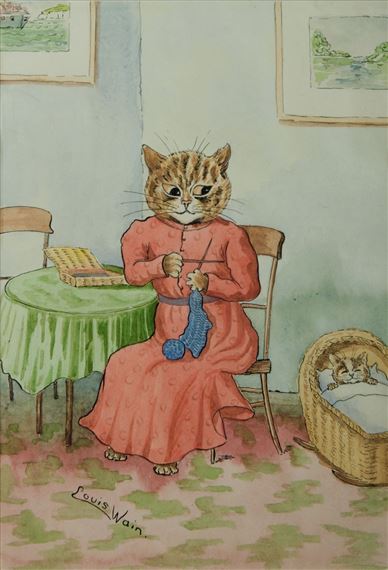
The cats scheduled to host this week's Link Dump cancelled at the last minute.

They were busy hacking my Ravelry account.


Who the hell really killed the Hoy family?

The day that nearly killed all life on earth.

Ancient Egyptians had a way with egg incubators.

Why we're blue.

Casimir Pulaski, Father Mother? of the American Cavalry.

Mr. Hitler's Neighborhood.  And Mr. Stalin's, Mr. Tito's, Mr. Trotsky's...

So it turns out we don't have to worry about Betelgeuse exploding.  That's nice.

Let's talk 19th century snakes.

Once again, science wastes their time coming up with findings that any cat owner already knows.

On a related note from that last link...

Victorian board schools.

How the Georgian era dealt with bed bugs.  Sorry, BUGGS.

The place to move if you really want to get away from it all.

When IKEA meets Satan.

This week's Advice From Thomas Morris: what not to do with a watch spring.  Or a bean.  Or a clove of garlic.

A how-to guide for surviving solitary confinement.

Poland's favorite monsters.

Singapore and a tale of shipboard cholera.

The strange tale of the West Milford UFO.

Mars as object of despair.

A mystery religion in South America.

The Duke of Devonshire's illegitimate daughter.

Our sometimes-unhealthy fascination with skin.

How to be an 18th century apothecary.

A funeral for a popular rat.

The first house to have electric lights.

Tracking down fugitives in the Early Modern era.

The Burfords and Non-Conformism.

The start of the Pony Express.

The boy who broke into Buckingham Palace.

Walking the Black Path.

Did da Vinci invent the egg timer?

Speaking of Leonardo, have you seen any sign of this painting?

When science goes barking mad.

Why zoos hate April 1st.

The history of April Fool's Day.

Some vanished explorers.

The Anglican cats of Greenwich Village.

The woman who feels no pain.

Britain's Bermuda Triangle of cars.

A really bad father-son tradition.

How the newspapers covered the doomed Robert Scott expedition.

Three 18th century Paris gardens.

That's it for this week! See you on Monday, when we'll look at a famous poisoning mystery. In the meantime, here are the Dixie Cups.


Wednesday, April 3, 2019

Newspaper Clipping of the Day

via Newspapers.com


Poltergeists can bring a lot of misery to their victims, but they are very rarely actually dangerous. One of the few cases where it was alleged they committed acts of physical violence was detailed in this story from the "Edmonton Journal," August 15, 1960:
White River, South Africa (Reuters) A police officer reported attacks by an "unseen agency" on 20-year-old Jimmy de Bruin of nearby Farm Datoen.

Police Chief John Vessels described the attack in these words: "He would suddenly scream, 'They're cutting me' and then show gashes, some so deep that blood flowed freely on his body under his clothing."

Police, church ministers and doctors were baffled by the attacks on de Bruin, which started Wednesday.

Wessels said he went with one white and two African constables to the farm to investigate reports of mysterious attacks on the youth. They had been told of glassware and other objects being smashed without apparent cause.

"I walked through the house and as I left the lounge an ornamental sealed glass bowl containing a flower smashed to the floor four feet from the shelf on which it had been standing," he said.

While Wessels was there, de Bruin was wearing shorts and gashes appeared on his legs. The following day a cut appeared on the youth's chest in the presence of two detective sergeants from White River police station, where Wessels is in charge.

Wessels said the cuts crisscrossed up to six inches long and deep enough to draw blood in some cases. "We are completely mystified," he said. A priest of the local church who has seen the attacks prayed for de Bruin throughout Saturday. Local doctors have also been present during the attacks.
I found no further news reports about the case. I presume that either the phantom attacks were exposed as a hoax, or, as is usually the case with poltergeist accounts, the phenomena soon stopped as inexplicably as it had started.

Monday, April 1, 2019

The Queen's Dwarf


The course of our lives is often changed by the most unavoidable and unlikely quirks of fate. As an example, for one 17th century man, his entire life was literally determined by a matter of inches. It took him from what would otherwise have been an entirely ordinary, anonymous existence and brought him lasting fame, royal patronage, and adventure.

In the end, it's likely that he would have preferred the anonymity.

Jeffrey (or Jeffery) Hudson was born in 1619 in Oakham, Rutlandshire. As he grew up, something very unusual happened: namely, that he didn't grow. Although his parents and siblings were all of normal size, Jeffrey, although handsome and perfectly proportioned, was less than twenty inches tall when he reached adulthood.

His pixie-like stature unsurprisingly made him an object of humorous interest to everyone around him. One story--which is sickening to our modern sensibilities, but appeared to have 'em rolling in the aisles in those days--relates that when Jeffrey was a youth, some "pranksters" stole an elderly woman's cat, Rutterkin. They killed the cat, skinned it, and dressed Jeffrey in the pelt. One afternoon, as the woman was serving lunch to some guests, the costumed boy padded on four legs into the room. One of the guests asked if Rutterkin would like a bit of food.

"Rutterkin can help himself when he is hungry," Jeffrey replied. Panic ensued.

One hopes this story is apocryphal, but from what I know of the 17th century, I doubt it.

Hudson's father was keeper of "baiting bulls" for George Villiers, Duke of Buckingham, which is how the diminutive boy caught the attention of royalty. When Jeffrey was eight, his parents made a present of him to the Duke and Duchess. In those days, it was fashionable for the upper classes to keep human curiosities in their households, as walking, talking toys and objects of general amusement. Jeffrey's remarkable proportions, coupled with his native wit and intelligence, made him a particular prize. Jeffrey was treated as an honored member of the royal household, and given his own staff of servants. When Charles I and his queen Henrietta Maria visited the ducal estate, the Duchess used her pet human to devise an amusing surprise for the guests. At dinner, a large pie was brought to the table and set before the queen. And then out popped Jeffrey from inside the pie! Jeffrey made such a hit with the gathering, the Duchess immediately presented him to the queen as a gift.

Hudson and Henrietta Maria, by Van Dyck


Young Jeffrey soon became renowned as "Lord Minimus" and "The Queen's Dwarf." He was a pampered and well-liked member of the royal entourage, who featured in many court entertainments. In a typical skit, William Evans, the "court giant," would pull a large loaf of bread out of one pocket, and Jeffrey from another. The seven-footer would then make a "sandwich" out of Hudson and pretend to eat it. Jeffrey was a particular favorite with the court ladies. A contemporary wrote, "He could make married Men Cuckolds, without making them jealous, and mothers of Maids, without letting the World know they had any gallants." Many verses were written paying comic tribute to "Minimus," and he was a favorite subject of the court painters. Despite his size, Jeffrey learned to shoot, became a talented horseman, and took an active part in the usual court activities and entertainments. The queen raised him in her Roman Catholic religion. She eventually appointed him a "Captain of Horse." The title may have been merely an honorific one, but Hudson was very proud of it, and to the end of his days, insisted on styling himself as "Captain Jeffrey Hudson."

19th century illustration of Hudson and Charles I.


When Jeffrey was eleven, he was part of a mission sent to Paris to obtain a French midwife for Henrietta Maria. The French court was equally charmed with the tiny envoy's precocity and sophistication, and he was showered with gifts and praise. Unfortunately, the on the return trip, Jeffrey's ship was captured by pirates. He was imprisoned by them, but he was soon either released or he managed to escape. Sir William Davenant wrote a poem, "Jeffreidos," commemorating Hudson's maritime misadventure:
Each eye was now employed; no man could thinke
Of any uncouth nooke or narrow chinke,
But strait they sought him there; in holes not deep
But small, where slender maggots used to creep;
At last, they found him close, beneath a spick
And almost span-new-pewter-candlestick.
A sapient Diego, that had now command
Of ships and victorie, tooke him in hand;
Peis'd him twice, tasted his discourse; at length
Beleev'd that he dissembled wit, and strength:
Quoth he, 'Victors and vanquished, I bid
You all give eare to wisdom of Madrid.
This that appeares to you a walking-Thumbe
May prove, the general spie of Christendome.'


When the political situation in England deteriorated and Civil War drew near, Hudson remained utterly loyal to his benefactor, the queen. When Henrietta Maria fled to France in 1643, Jeffrey was among the small group of courtiers who followed her into exile. It was during this period in Paris that Hudson made the mistake that would send him spiraling into disaster.

As he grew older, Hudson became increasingly disgusted with being treated as a toy, the object of everyone's amusement. He may have had the body of an infant, but his mind and his soul were those of a grown man, and he wanted that acknowledged. One person who insisted on still treating him as a clown was the brother of William Crofts, another English exile. It is unrecorded what Mr. Crofts did to offend Hudson, but it was enough to make the "Queen's Dwarf"--who always had a hot temper--to challenge the man to a duel in October 1644.

Crofts--very unwisely, as he was soon to learn--took the entire affair as a gigantic joke. He arrived at the appointed place armed with only a large squirt gun. Hudson, enraged at this additional insult, instantly shot his opponent. Crofts literally died laughing.

However provoked he may have been, this rash act landed Hudson in very serious trouble. Dueling was outlawed in France, particularly when it ended fatally, and the dead man's brother held a powerful position in the queen's household. Hudson was imprisoned and sentenced to death. However, Henrietta Maria was able to get this decree commuted to permanent banishment from France. Hudson was alive and free, but he didn't have much else going for him. There were not many career opportunities in England for an ex-professional dwarf--particularly a Catholic Royalist one.

The rest of Hudson's life is poorly documented. It is said that after his return to England, he fought with distinction in the King's Cavalry. In 1649, he was on a ship that was captured by Barbary pirates (Hudson seems to have had little luck with sea voyages.) He was sold into slavery, where for about the next quarter-century he suffered brutal treatment at the hands of his captors. One oddity about this period is that while a slave, Hudson had a growth spurt that increased his height to 3'9". (Hudson attributed this increase in stature to the "buggery" he regularly endured during captivity.  Run this one past your family doctor and note the reaction.)

Hudson reappeared in England some time around 1668. It is not recorded how he escaped slavery, but it is presumed that he was among the Turkish captives ransomed by the English government. He lived in obscurity in Oakham for some years, living off a small pension granted to him by the Duke of Buckingham. He also received money from Charles II's Secret Service fund, an intriguing hint that Hudson may have been employed as some sort of secret agent or spy for the government. During this period, he gave an interview about his turbulent life to antiquarian James Wright, which is our chief source for biographical information about Hudson. In 1679, while visiting London for unknown reasons, Hudson, as a known "Roman Catholick," was arrested on suspicion of being involved with Titus Oates' notorious "Popish Plot." After about a year, he was released, and disappeared back into anonymity. Hudson died some two years later, and was given an unmarked grave in a local Catholic paupers' cemetery.

The cottage where Hudson spent his last years, via oakham.co.uk

Friday, March 29, 2019

Weekend Link Dump


This week's Link Dump is, thanks to Louis Wain, again hosted by the Strange Company Choir!


Where the hell was Atlantis?  Um...India?

Where the hell is Walter Benjamin's suitcase?

Why the hell do dogs commit suicide on this bridge?  Now we know?

What the hell just fell over Alaska?

What the hell is underneath Sydney, Australia?  You probably don't want to know.

What the hell is underneath Africa?  You really don't want to know.

Watch out for those cursed ponds!

The fun of being married to Lyda Southard.

The Terror of Cambridge.

Regency era "invisible dresses."

The most wonderful map in the world.

A tale of a lover's ghost.

The modernity of medieval monsters.

The death of country houses.

The Victorian sewer king.

Sir Kenelm's closet.

Sex, scandal, and murder in Portland, Oregon.

How the 19th century dealt with "catarrh."

A controversial archaeological site.

Redheaded folklore.

The desperado of Woodward.

When theater meets geography class.

The history of a silk dress.

This policeman's lot was definitely not a happy one.

Some entertainers just never know when to retire.

Whales are creatures of habit.

The place where you can still dine in the Ottoman Empire. And when you do, here's how to dress the part.

Napoleon, master of spin.

How Victorians cured colds.

A brother's betrayal.

A ghost catches up on grocery shopping.

Neanderthals probably weren't so neanderthal after all.

A "melancholy death" on James Cook's Pacific expedition.

The Case of the Vanishing Ghost Bomber.

The first cyber attack.

A crazy cat lady in the police court.

The deadly side of Victorian hospitals.

A murderous horse trainer.

When life hands you lemons, make enemas.  Why, yes, this is a Thomas Morris link.  How did you know?

And, finally, one of my favorite blogs, "I Have Three Cats," is about to lose a resident of the Cosy Apartment.  There is a life-lesson for us all in this two-part post, so I wanted to share it in the WLD.  Everyone here at Strange Company HQ wishes Mr. Parker an easy journey to his next, permanent, destination.


That's all for this week!  See you on Monday, when we'll look at a very small man who, for a while, made a very large mark on the world.  In the meantime, here's one of my favorite pieces from my favorite composer.


Wednesday, March 27, 2019

Newspaper Clipping of the Day

via Newspapers.com


This tale of a Philly church's paranormal receptionist comes from the "Sheboygan Press,"August 14, 1908:
Philadelphia--Old St. Paul's church, headquarters of the Protestant Episcopal city mission, has a ghost. It is an eccentric shade which whisks up stairways and disappears into nothingness, but it also is up to date. When the office force has departed and the quaint old building on Third street is secure against intruders with stout locks and bolts, the ghost answers the telephone, which conduct is so utterly foreign to the popular conception of ghosts' abilities that, it has dumbfounded Rev. H. Cresson McHenry and his assistants.

On two occasions the strange visitor has answered the 'phone when the office force was absent and the building locked. Its answers, although briefly made, have indicated that the ghost is well acquainted with movements of the staff. The shade informed a friend of Mr. McHenry that he "had just left the mission," and to Mrs. George Somerer, wife of one of Mr. McHenry's assistants, it imparted the information that her husband "would be home to supper." Both persons who conversed with the unknown occupant of the mission declare that its voice was modulated to the softest tones.


Mr. McHenry saw the ghost on July 4. The office force had a holiday, but Mr. McHenry visited the church to open his mail. As he was unlocking the iron gates at the entrance to the churchyard he glanced up at one of he windows and was astonished to see what appeared to be a man standing on the stairway inside the building.

This stairway leads from the offices of the city mission in the basement to the church auditorium. As Mr. McHenry opened the gate the figure glided rapidly up the stairway. disappearing from view. The minister entered the church, locked the door behind him to prevent the escape of the intruder, and searched the entire church from cellar to roof. He failed to find any trace of the visitor. Every door and window was locked securely and the desks untouched.
The story seemed to disappear from the newspapers after this, so I have no idea if the mystery was ever resolved.

Monday, March 25, 2019

Portrait of a Bluebeard

"The Age," December 30, 1960, via Newspapers.com


At the resort town of Scarborough, England, sometime in the mid-1860s, a remarkably handsome and extremely charming Frenchman, Count Henri de Tourville, made the acquaintance of a well-to-do Englishwoman, Henrietta Brigham. A romance quickly developed, and the two were married. After a honeymoon touring Europe, the pair went to live with Henrietta's widowed mother at the family home of Foxley Hall, in Cheshire. They eventually had a son, William Henri.

Unfortunately, the couple did not live entirely happily ever after. The Count proved to be one of those aristocrats who were big on keeping up a glamorous lifestyle without the glamorous income to back it up. He habitually "borrowed" large sums of money from his mother-in-law. She had even paid for the honeymoon. Before long, Mrs. Brigham became weary of dispensing cash, and came to the very reasonable conclusion that the Count was merely a golddigger. She not only announced that he would get no more money out of her, but that she was going to insist he repay the substantial sums he owed.

This uncomfortable family situation found a tragic resolution one morning in July 1868. Tourville later told police that as he was cleaning a gun in the breakfast room of Foxley Hall, Mrs. Brigham asked to see the revolver. While she was examining it, the gun somehow accidentally went off, killing the poor woman instantly.

She had been shot in the back of the head.

Unsurprisingly, many people entertained some very ugly suspicions about this "accident," but the coroner's jury returned a verdict of "death by misadventure." Scotland Yard was brought in to examine the case, but DCI George Clarke, unable to find any solid evidence suggesting foul play, allowed the inquest verdict to stand.

Henrietta de Tourville did not long survive her mother. Distraught at this family tragedy--and, very likely, tormented by fears over what might really have happened that fatal morning--her health gradually declined until she died in 1871.

The Count now had Foxley Hall all to himself. To his chagrin, however, he was unable to exercise similar control over his late mother-in-law's fortune of £40,000. Shortly before her death, Mrs. Brigham made a new will that left her entire estate to her only grandchild, William Henri.

Soon after Henrietta died, a mysterious fire broke out at Foxley Hall. De Tourville easily escaped the conflagration, but his son and his nursemaid were very nearly burned alive. The Count congratulated himself on having had the foresight to heavily insure the house against fire.

It began to occur to the trustees of the Brigham estate that with a father so prone to "accidents" that happened to always benefit him financially, the odds of little William Henri making it to adulthood were small. They put the boy in the custody of a French couple who would bring him up in that country. His father was not allowed to know his whereabouts.

This was the first of a number of setbacks for de Tourville. The insurance company, muttering some unkind suspicions about the Foxley Hall fire, refused to pay up. De Tourville also learned that the will of Henrietta's father William Brigham, who died in 1864, decreed that if Henrietta died childless, the estate would pass to the children of William's brother. As Henrietta's son was out of the country, these Brigham cousins insisted on taking possession of the inheritance.

It finally began to occur to the Count that he had worn out his welcome in Cheshire, and he left the area for new pastures.

He soon met a widow named Madeleine Miller. Miller was considerably older than the Count, but she possessed a fine house in London, a number of valuable possessions, and a private income of £7,000 a year.

De Tourville found her irresistible. After they had known each other for only a few weeks, he persuaded Madeleine to marry him. His next step was to have her make out a will leaving him nearly everything she possessed. After that, he sweet-talked her into taking out a substantial life insurance policy in his favor.

I trust you will not be particularly shocked by what happened next. In July 1876, the Count took his bride on a romantic tour of the Austrian Tyrol. On July 16th, while the newlyweds were staying in the village of Trefoj, near the Stelvio Pass, they hired a carriage so they could take a tour of the famed mountain scenery. The hotel staff strongly urged them, for their own safety, to take along a guide, but the Count cheerfully waved off their warnings. He and Madeleine set out with their driver.

When they reached a secluded spot high on a narrow mountain pass, the Count told the driver that they no longer needed the carriage. He and his wife would walk the rest of the way.

An hour later, de Tourville returned to their hotel...alone. Alas, he sighed, while standing on the edge of a cliff, his wife had taken a bad step and fallen to her death. A search party found her body the following morning.

The police officer in charge of this latest tragedy was no fool. He did not like how the Count's face and hands were covered with deep scratches, suggesting de Tourville had been in a violent struggle.

Despite the suspicious nature of this latest addition to the Count's remarkable number of personal losses, the inquest into Madeleine de Tourville's death ruled that she had merely been the victim of a terrible accident.

After he had buried Madeleine, the Count wasted little time returning to claim the house and money he inherited from her--not to mention the life insurance money. Within only a few days of his arrival in London, he was participating in the social circuit, charming one and all and undoubtedly keeping a private list of all the wealthy and unattached women he encountered.

De Tourville was oblivious to the fact that at long last, Nemesis was on his trail. Soon after he left Austria, a Herr Markreiter, an avid mountaineer who was very familiar with the area where Madeleine was killed, went to the police. He had read about the tragedy in the newspaper and was convinced it was impossible for her to have died in the way described by her husband. The slope from the roadside where she allegedly fell was a very gradual one. If she had fallen on it, she would merely have rolled for a short distance, sustaining no serious injuries. The staff at the hotel where the de Tourvilles had stayed stated that the couple had clearly been on bad terms. It was also noted that the Count had given different people completely differing versions of how Madeleine had died. When the Austrian police recalled how the not-so-grieving husband hit the financial jackpot by her death, they--a bit late in the day--realized they very likely let a murderer go free. They immediately applied for his extradition from England. When DCI Clarke learned of the request, he was more than happy to track de Tourville down and arrest him. The Count was attending a high society dinner party at the time, which must have made it a memorable meal for all present.

During his fight to avoid extradition, a curious detail was revealed: The suave "Count de Tourville" was, in reality, a former Parisian waiter named Henri Perreau. Despite the fact that Madeleine's money enabled her widower to hire the finest lawyers money could buy, a magistrate ordered his extradition. In January 1877, de Tourville/Perreau unwillingly sailed to Austria.

After his exit from Foxley Hall, Perreau had improved his leisure time by training as a barrister. He evidently reasoned that the more he knew about the law, the easier it would be for him to break it. With his usual brash self-confidence, he insisted on representing himself at his trial.

There is that old saying about lawyers who represent themselves having fools for clients, but given the evidence against him, it is doubtful that the greatest barrister in Europe could have saved Henri Perreau. By the time DCI Clarke showed up in the courtroom--carrying Mrs. Brigham's skull--in order to argue that her death had been not accident, but murder, it was all over for the self-made Count. Perreau was found guilty and sentenced to death. However, the sentence was commuted to eighteen years with hard labor. After an attempt to escape his first prison, he was transferred to the severe, high-security Karlau Prison in Graz, where he was put to work in the local salt mines. By the time Perreau died there in 1890, he was very possibly regretting that they had not quickly hanged him. His son, William Henri was about twenty at the time his father died. Contemporary news reports stated that he took his mother's surname and, when he reached his majority, inherited her property.

"Saint Paul Globe," February 21, 1890, via Newspapers.com


After Perreau's conviction, it emerged that the law had probably underestimated his body count. It was said that shortly before his first wife Henrietta died, she had swallowed ground glass. Her husband had been alone with her at the time. Some years earlier, while working as a waiter in Paris, Perreau befriended a rich Englishman named Cotton, who was unwise enough to hire him as his manservant. During a visit they made to Istanbul, Cotton mysteriously disappeared. No trace of him was ever found. Immediately after Cotton vanished, Perreau unaccountably had enough cash to return to England and adopt his persona of "Count de Tourville," sophisticated aristocrat.

The story of this now-forgotten Bluebeard has a curious postscript that gives him a notable place among the ranks of serial killers. It is a story related by Agnes, Lady Goring in "Lord Halifax's Ghost Book" (1936)

One night, Lady Goring had a peculiar and vivid dream. She saw an old house that was unfamiliar to her. She sensed that she was visiting this house for an important purpose, but she did not know what it was. She fixated on one room,that was decorated in a striking and unusual style. Lady Goring saw an elderly woman dozing in an armchair by the fire. Then, she saw a man quietly enter the room. He crept up behind the woman, and shot her through the head. After the woman collapsed, he tried to arrange the pistol so it would look as if it had fallen from her hand. After arranging the gun and the woman's body to his satisfaction, the man left the room. Lady Goring saw this room and the face of the murderer so clearly that they became fixed in her memory.

Some time after that, she and her husband sought to rent a house in the country. They visited various properties, including an old manor in Cheshire. The minute Lady Goring entered the house, she realized it was the house in her dream. The dining-room, she knew, was the place where she had seen a murder. When she asked the caretaker about the house, he said that the previous owners had been a man, his wife, and his mother-in-law. Sadly, the older lady had accidentally shot herself, after which the house was vacated.

Unsurprisingly, the Gorings did not take the house, and Lady Goring does not appear to have sought any more details about her "dream house." However, months later, she was walking down Regent Street, when she was shocked to see a man's photograph in one of the shop windows. She recognized him as the man she had seen commit a murder. When she went into the shop to ask who he was, she learned that he was "Tourville, who was then being tried for the murder of his second wife in the Tyrol."

One way or another, murder will out. Sometimes.

Friday, March 22, 2019

Weekend Link Dump


Welcome to the first Link Dump of Spring 2019!

Time for Strange Company HQ's spring cleaning!


Where the hell did we get the phrase, "red herring?"

How a child's murder became folklore.

Yes, they're still trying to find Jack the Ripper.

And, of course, Amelia Earhart.

This week in Russian Weird: nothing to see here, just mysterious black insects taking over.

There's a town in Switzerland where the answer to the universe is not 42, but 11.

Why the Duke of Wellington should have confined his shooting to the battlefield.

More of the horrors of Victorian food.

Yet another sign that the human race is past its sell-by date.

Parson Patten vs. the ghost.

The red Taj Mahal.

Man deprives koala of air conditioning.

The $1.4 million pigeon.

The last of the leprechauns.

Hannah Martin, Messiah.

Portraits of a notorious Georgian era woman.

The race for the first artificial heart.

La Castiglione: Queen of the selfies.

Hunting for leprechauns.

Ireland is home to what may be the world's oldest pub.

Three early female detectives.  (Reminiscent of Cora Strayer and Alice Clement!)

Searching for dinosaurs in Central Africa.

The sea monsters of San Francisco Bay.

18th century organized crime.

How a recent ancient shipwreck discovery vindicates Herodotus.

There are rocks on Africa that, according to science, shouldn't be there.

The oldest known marine astrolabe.

The execution of two failed regicides.

St. Helena as it is today.

Nice's Avenue of the English.

That time Irish Americans fought for Mexico.

A man who probably got away with murder.

King Charles I's execution vest.

The life of a Tudor courtier.

A heroic dog.

Britain's oldest horse race.

Ancient DNA is...complicated.

Why so many ancient statues are missing their noses.

Marie Corelli, one of the most popular Victorian authors.  (Out of curiosity, I once read "The Sorrows of Satan."  The writing was laughably awful--a perfect parody of Victorian melodrama--but she was one of those authors who keeps you reading, in spite of yourself.  She knew how to hold your attention.  I have no desire to read any more of her books, but I understand why they were so immensely popular in her day.)

A rivalry between undertakers.

Caraboo, the strangest of princesses.

Good luck to ya, guys.

Well.  That taught him a lesson.

An Irish Roswell.

The first female film director.


That's it for this week! See you on Monday, when we'll look at a once-notorious Bluebeard and his ghostly footnote. In the meantime, here's what was Top of the Pops in ancient Greece.