"...we should pass over all biographies of 'the good and the great,' while we search carefully the slight records of wretches who died in prison, in Bedlam, or upon the gallows."
~Edgar Allan Poe

Wednesday, May 31, 2023

Newspaper Clipping of the Day

Via Newspapers.com


As I believe I've mentioned before, once you start browsing old newspapers, it doesn't take you long to learn that some of the damndest things happen in cemeteries.  Throw in that ever-popular Fortean staple, the "Woman in White," and you know things are going to get fun.  The "Omaha Daily Bee," July 18, 1874:

It was not long since that the report that the house standing at the northwest corner of Thirteenth street and Capitol avenue was haunted, excited considerable curiosity among the superstitious. This morning, however, we were told a reliable story that puts the haunted house way in the shade. 

The scene of this strange and true narrative is Prospect Hill Cemetery, adjoining which Mr. H.P. Stanwood, the well-known sculptor, has a small dwelling and a marblecutting shop, in which several hands are employed. 

On Tuesday night, shortly after one of two brothers, who sleep in the shop, happened to step out of doors before retiring, and looking out over the silent city of the dead, a vision, a ghost, a "woman in white," the invariable costume of ghosts, met his astonished gaze. The mysterious being was slowly flitting towards the building, when he ran in and brought his brother out to view the strange sight. Both became scared, and hastening out of the back door, just as the ghost in the front door came in and blew out the light, they ran over to Mr. Stanwood's residence to inform him of what had happened. 

Mr. Stanwood and the men went out to see what was the matter, and sure enough they saw before them the ghost, who hit Mr. Stanwood on the back, and asked where her children was--if they were buried in that tomb. The ghost then flitted into the house, blew out the light, and entering a bed-room, so scared the occupant that he jumped out of the window and ran away. 

One of the two brothers mentioned above, having pulled out his revolver, deliberately took aim, and fired twice at the ghost, but without effect. She then took her departure into the cemetery, followed by the men to a certain grave, where she vanished.

On Wednesday night the mysterious ghost again made her appearance, and so frightened the two brothers that they came down town to sleep during that night, and the next night. 

The above is a true statement of the facts, as related to us by a gentleman of veracity. 

Mr. Stanwood himself is not a superstitious man, and has no faith in ghosts, but our informant assures us that he substantiates the above statement.

Monday, May 29, 2023

The Fine Art of Libelous Tombstones; Or, Go Ahead and Speak Ill of the Dead, and Everyone Else For That Matter

"Muskogee Phoenix," August 10, 1935, via Newspapers.com


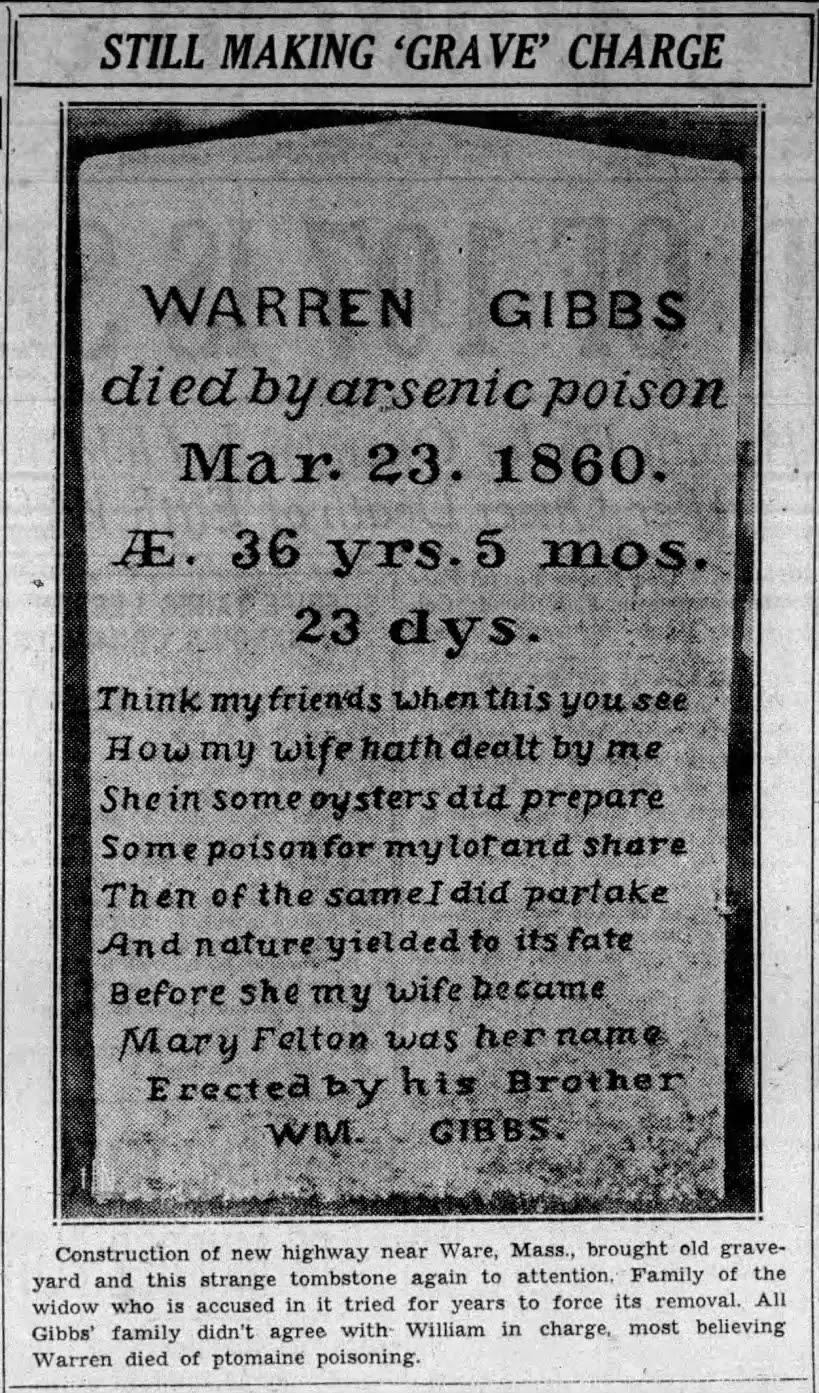
One of my favorite minor categories of Weird History is the Libelous Tombstone.  Surprisingly often, loved ones create memorials that focus less on eulogizing the deceased, and more on settling scores and generally venting spleen.

And bloggers of my particular sort bless them for it.

Murder accusations are a favorite topic for this particular type of grave marker.  A story similar to the example above was reported in the "Savannah Morning News," August 28, 1904:

A murder charge on a tombstone, made by the family of the victim, which the courts of Mississippi have not confirmed, involves the grand lodge of the Woodmen of the World of Omaha, Neb., in an embarrassing position. It has several hundred thousand members, mainly in the South and West, and is facing a situation that will become a precedent for benevolent organizations. 
A summary demand on the grand lodge of the Woodmen of the World to remove a monument erected by the order from the grave of a dead member on account of a dispute over the inscription is the outgrowth of the famous Lawson-Semmes murder case. 
Dr. F. G. Semmes of Hickory, a wealthy man, was indicted for the murder of T. D. Lawson, and on the filing of a habeas corpus was admitted to $12,000 bail. Eminent lawyers of Mississippi are defending him. 
Lawson, as a member of the order under its constitution received a monument. The family of Lawson selected a Scriptural epitaph, which was sent to the grand lodge and approved. Morris Brothers of Memphis contracted to erect the monument. Meantime a local agent at Hickory, at. the request of the dead man’s family, had Morris Brothers change the inscription, without the sanction of the grand lodge. 
The words "T. D. Lawson, kiiled by F. G. Semmes." were inscribed instead of the original approved words. As Dr. Semmes does not admit the murder and the words convict him of the deed, the matter was appealed to the grand lodge by the friends of Dr. Semmes, and this body ordered the monument-makers to remove the words and substitute the original inscription. This was done. 
The Lawson family thereupon immediately demanded of the grand lodge that the monument be removed from the grave. A second and more insistent demand has now been made for its removal. 
The grand lodge, under its constitution, must erect a monument for every dead member, no matter where the body is located, and will have to set up the monument somewhere. It is the first case of its kind, and on account of the numerical strength of the order in the South and all the parties involved being members it has created a sensation.
For anyone interested, at his trial, Semmes admitted shooting Lawson, but claimed it was self-defense.  He was acquitted.  I have no idea what finally happened to Lawson's monument. 

The "Atchison Daily Champion," June 17, 1883:

A queer case has been recently tried at Marshall, Mo.  A man named Potter had a son drowned while bathing in the Blackwater, with two men named Finley and Beggs. The boy's father believed that foul play had been done, and caused a stonecutter named Tiffing to erect a tombstone over his son's grave with the inscription: "Rock of ages cleft for me, let me hide myself in thee. Drowned in the Blackwater by Philander Finley and Mort Beggs." The parties thus charged brought suit against Potter, and have recovered $800 damages.

Unsurprisingly, these vengeful memorials frequently result in court action.  Another case was mentioned in the "Gloucestershire Echo," August 9, 1923:
A farmer at Allschwil, near Basle, recently lost his young wife—and also her dowry, a fairly large sum, which on her death went to her relations under the marriage settlement. 
The husband was annoyed at losing the “dot” and in revenge ordered a large marble tombstone, with an inscription dwelling on the defects of his wife's character. It ended by saying that she had taken her dowry “to heaven or hell, probably the latter place.'’ 
Every evening a small crowd collected in the cemetery before the unusual tombstone. Eventually the family of the dead woman appealed to the communal authorities, who ordered the tombstone to be removed within a week. The family’s libel action against the husband will go on all the same.
A rather curious case was heard in London in 1954.  The following report comes from the "Evening Standard" of April 7:
Bessie Solomon, 27, who claims that she was libelled by an inscription on her mother's gravestone, told the High Court today about a religious ceremony at which the stone was consecrated by a rabbi. 
The inscription read: “In loving memory of Rose Simmons who went to her eternal rest on October 27 1950 aged 43 deeply mourned and sadly missed by her sorrowing husband Mark son Eddie daughters Betty and Alicia.” Miss Solomon, the court have been told, is always known as Betty. 
Miss Solomon, slim and dark-haired, was asked how she felt when she read the inscription. She replied “I was surprised, my brother was surprised But it was not the sort of place to have any quarrels or arguments."  
Mr. Bernard Gillis, counsel for Mr. Mark Simmons, one of seven people Miss Solomon is suing, asked her: “You would not wish to do anything which would have caused your mother any feelings of distress?" Miss Solomon replied: “ Not if I could have avoided it while she was alive." "Now that she is dead does that mean you have no regard for her reputation or memory?" — "I have the same feelings about her."  "You cherish her memory?" —"Yes." 
Miss Solomon, who gave her address as Thurlow Place, Kensington, alleges that the inscription on the gravestone—in Golders Green Jewish Cemetery—imputes among other things that she is illegitimate. 
The defendants are Mr. Mark Simmons of Westminster Court, Aberdeen Place, St John's Wood, a bookmaker with whom Miss Solomon’s mother was living at the time of her death, Mr Albert Elfes, stonemason, Plashet Road, Upton Park, Mr. J.H. Valentine, keeper of the cemetery, and four trustees of the West London Synagogue of British Jews who own the cemetery. All deny that the inscription it bears is defamatory or that it bears any of the meanings which Miss Solomon alleges. 
Miss Solomon said that her parents separated when she was three.  First she lived with her father, but in 1942 on returning to London after evacuation, she went to her mother, who was living with Mr Simmons. “I called him Uncle Mark" she said. 
When her mother died Miss Solomon did not attend the funeral—it was not the custom for women to do so. She learned that a gravestone was being brought from Italy. She attended the consecration ceremony, her father did not. 
Mr Gillis — "Which name do you say your mother would have preferred on the gravestone: Rose Simmons, by which she was known for many years, or Rose Solomon?" "Miss Solomon— As Mr Simmons was already married before the stone was set up it is hard to say."

Miss Solomon added that she was upset about the part of the inscription which referred to “husband Mark.” 

Mr. Cyril Salmon QC for the trustees — "If your mother was known as Rose Simmons why are you bringing this action?" Miss Solomon—"I am trying to clear my name." "The alternative to bringing the action was to let the matter rest?"— "Yes." "Why did not you adopt that alternative?" — "Mr. Simmons is not my father."

The jury found for the defendants.  

A case from Budapest was reported in the "Columbia Missourian," August 4, 1926:

The inscription upon a tombstone here has given rise to one of the most unusual lawsuits in the annals of Hungarian courts. 
A few weeks ago, Julius Fall, a clerk, argued with his wife whom he accused of unfaithfulness.  Mrs. Fall indignantly denied the accusation."I swear by the life of our little boy," she cried, "that I have never deceived you in our marriage." 
Shortly after this scene, the 6-year-old son died suddenly.  This tragedy moved Fall to petition for a divorce.  The death of his son, he declared, was the reply of fate to the oath sworn by his wife.  The boy's death, he insisted, proved that God was avenging his wife's alleged adultery. 
Happening to pass by the cemetery one day, Mrs. Fall discovered that the tombstone on her son's grave displayed a verse, the first letter of each line spelling her middle name.  Translated, the poem read:  "The slumber of death wrested me from you,And your guilt stifled my blossoming life..." 
Mrs. Fall promptly sued her husband for libel.  The court sentenced Fall to two months' imprisonment and ordered the removal of the inscription from the tombstone.
More family troubles appeared in the (Stoke-on-Trent) "Evening Sentinel" for February 22, 1980:
A court at Baltimore, Maryland, awarded £875 in damages to a woman who sued her brother for ordering this inscription on her father's tombstone:  "Stanley J. Gladsky, 1895-1977, abused, robbed and starved by his beloved daughter." 
The daughter, Gloria Kovatch, claimed she was libelled and held up to public scorn by the inscription, which resulted from a family dispute.
Yet another legal fracas was reported in the "Muskogee Daily Phoenix" for July 26, 1923:
CHATTANOOGA July 25 — "Can a tombstone be libelous?” This is the question which the Hamilton county grand jury will be called upon to answer here. 
Authorities from Walker county, Georgia, served notice that they would appear before the local inquisitorial body and ask the indictment of R.D. Baker for criminal libel as the result of erection of a tombstone near here to George Baker, his son. 
The tombstone bears the inscription that the boy had been unjustly hanged at La Fayette, Georgia, for the murder of Deputy Sheriff Norton near there last summer.
In order to avoid prosecution, Baker removed the offending words from the stone. 

The efforts of an accused murderer to clear his name was reported in the "Winston-Salem Journal," March 24, 1949:
Raleigh—An old mountaineer freed in 1917 from a murder charge may soon win his lengthy battle for eradication of a libelous tombstone inscription. 
Hamp Kendall, a 71-year-old native of Lenoir, served 10 years for a murder he did not commit. He was later pardoned and the State paid him about $5000 for his servitude. However, as Kendall recently told a nation-wide radio audience, the murder victim’s tombstone in a Lenoir cemetery still carries an inscription stating that the deceased was “murdered and robbed by Hamp Kendall and John Vickers Sept 25 1906.” 
Vickers died shortly after his release from prison. But Kendall is still very much alive and he wants the slur erased from the tombstone. 
Kendall appealed to the Governor and other officials to have the imputation removed. All his efforts were in vain, however, as State law prohibits molestation of tombstones. 
Yesterday a solution to the problem came to light. A North Carolina legislator from Lenoir introduced in the Senate a bill that would make it “illegal to erect or maintain a gravestone bearing an inscription charging anyone with the commission of a crime.” If the bill is passed and enacted into law Kendall probably will have no trouble getting a new marker. 
The Monument Builders of America have already offered to erect without charge a new monument over the body of Lawrence Nelson, the victim. This offer was made the day that Kendall appeared on “We the People,” a CBS coast-to-coast program. He related over the air the story of his trial imprisonment and life after servitude.
Happily for Kendall, his efforts to have the inscription removed were successful. 

Finally, we have a unique example of a man who libeled himself.  The "Macon Evening News," November 4, 1931:
In Skipperton, a sleepy, sunny little farm settlement about 10 miles from Macon, they wonder all kinds of things about why Charlie Skipper put his own monument up in the cemetery 20 years ago with the strange epitaph “This poor fellow talked too much.” 
Some say he has made a will, the reading of which after his death will solve the matter, and it has been hinted that his second marriage had something to do with it, but nobody knows and all agree that no satisfaction is to be got out of Charlie himself about it.  
Anyway, in the little country cemetery behind Rutland school there it is—a big seven or eight-foot marble shaft with a broad triple base between two marble slabs with carved backs and marble vases for flowers for the tombstones of his two deceased wives. 
The lot, about 50 feet square, is fenced with a picket fence the gate bearing in iron letters, Skipper. When one enters the gate one notices the queer sentiment carved on the back of Charlie Skipper's premature monument in simple slanting marble letters, “This poor fellow talked too much.”  
The gravestone of his first wife, Ella L. Skipper, tells that she was born in 1862 and died in 1904, while the second wife was considerably younger and died not quite two years ago. 
Coming upon Charlie Skipper at work on his truck farm one finds him to be a jolly old fellow full of sly jokes and chuckles of enjoyment. He seems so jolly, in fact, with his white hair, sturdy weathered face and white mustache, that one thinks his very drawling chuckling love of cracking a joke throws some light on the strange monument and epitaph.  
“Well,” he explained quite simply, “I just thought I better put this monument up while I had the money before I wasn't able nor my children neither."  
And that's all there seemed to be to it—except his reason for such a singular choice of an epitaph.  
“Well they all say around here I talk too much or a mighty lot anyway,” he offered with a grin, and added, “I just thought I'd help ’em out.”  
“It's been there 20 years and maybe I ain't dead yet—but mighty near it!” he insisted, shaking his head and smiling. 


Mr Skipper doesn’t look by any means “mighty near it.” He's so hale and hearty and young for his 70-some years that one can hardly imagine his ever resting under the handsome marble shaft that he prepared so long ago. And the thought would seem forbidding and gloomy to anybody, but Mr Skipper who declares heartily and happily that: “No it don't makes me feel bad to have it there; it makes me feel good to know it's all ready for me when I need it!” because he seems to figure that “I ain’t got so much longer I guess.”  
He maintains that he keeps as young as he is now by exercise in the form of hard work on his farm that begins at 4 o'clock in the morning and lasts until 8 at night. And though he claims to be a “mean fellow” his chief vices are chewing tobacco and smoking a cigar on Sunday. He never drinks since prohibition which is “a great thing to keep whisky away from ’em." 
He and his brother George, for whose father he believes the town was named, are the last of the two Skipper boys left there. He has the following children living in Macon: Mrs. Mattie Parker, Mrs. Beulah Burke, and B.F. Skipper.  
So perhaps there isn't any weird mystery in a man's preparing his own grave some 20 years before he dies.  It seems to be simply that Charlie Skipper thought he'd better do it while he had the money. But one wonders if there isn't something to 'old Charlie's joke about “helping 'em out” in their contention that he “always talked too much.” He seems to be the kind of fellow who would depart this life leaving a last chuckle behind him.
I like Charlie.  The old boy clearly had the Strange Company spirit at its finest.

Friday, May 26, 2023

Weekend Link Dump


"The Witches' Cove," Follower of Jan Mandijn

This week's Link Dump is hosted by an early 20th century celebrity:  Rags, the star of the "Rotograph Cat" series of postcards.


Isaac Newton calculated that the world will end in 2060.  We seem to be right on target.  Maybe even ahead of schedule.

The wreck of the "Arniston."

Florida's radioactive water fountain.

George Patton's forgotten corps.

Just a really nifty signature.

The U.S. Army vs. the Nez Perce tribe.

Tales of the Tower of London.

Did leadership conflicts prolong WWII?

A female Georgian-era artist.

Norway's love affair with hot dogs.

The oldest joke in the world.

A look at jet tiaras.

The first American daredevils.

The oldest known blueprints.

An 18th century castaway.

The megalithic site even older than Gobekli Tepe.

The world's most expensive ice cream...sounds pretty disgusting, frankly.  As someone who grew up poor, playing silly buggers with food has always annoyed me.

How Robert Clive went from hero to villain.

The first Victoria Cross winner.

1930s Populism and the "Wizard of Oz."

Hyperinflation and the death of the Weimar Republic.

The first records of humans kissing.

Identifying the fallen of USS Arizona.

Humans were controlling fire far earlier than we thought.

A particularly scary "close encounter."

The days of divorce by combat.

A murderer escapes from Death Row.

When the BBC banned the Beatles.

The ghosts of Mr. and Mrs. Huckleberry.

The "love poisoner."

The teenager who helped open up Japan.

Queen Victoria and the sultan's savage.

That's all for this week!  See you on Monday, when we'll visit the wild, wild world of libelous tombstones.  In the meantime, here's a fun bit of music history: Bob Dylan's first recorded live performance.


Wednesday, May 24, 2023

Newspaper Clipping of the Day

Newspapers.com


This week, let's look at the time O'Hare Airport had to deal with an unexpected flight.  The "Chicago Tribune," January 1, 2007:

It sounds like a tired joke—but a group of airline employees insist they are in earnest, and they are upset that neither their bosses nor the government will take them seriously. 

A flying saucerlike object hovered low over O’Hare International Airport for several minutes before bolting through thick clouds with such intense energy that it left an eerie hole in overcast skies, said some United Airlines employees who observed the phenomenon. 

Was it an alien spaceship? A weather balloon lost in the airspace over the world’s second-busiest airport? A top-secret military craft? Or simply a reflection from lights that played a trick on the eyes? 

Officials at United professed no knowledge of the Nov. 7 event—which was reported to the airline by as many as a dozen of its own workers—when the Tribune started asking questions recently. But the Federal Aviation Administration said its air traffic control tower at O’Hare did receive a call from a United supervisor asking if controllers had spotted a mysterious elliptical-shaped craft sitting motionless over Concourse C of the United terminal. No controllers saw the object, and a preliminary check of radar found nothing out of the ordinary, FAA spokeswoman Elizabeth Isham Cory said. The FAA is not conducting a further investigation, Cory said. 

The theory is the sighting was caused by a “weather phenomenon,” she said. The UFO report has sparked some chuckles among controllers in O’Hare tower. “To fly 7 million light years to O’Hare and then have to turn around and go home because your gate was occupied is simply unacceptable,” said O’Hare controller and union official Craig Burzych. 

Some of the witnesses, interviewed by the Tribune, said they are upset that neither the government nor the airline is probing the incident. Whatever the object was, it could have interfered with O’Hare’s radar and other equipment, and even created a collision risk, they said. 

The Unidentified Aerial Phenomena (the term that extraterrestrial-watchers nowadays prefer over Unidentified Flying Object) was first seen by a United ramp worker who was directing back a United plane at Gate C17, according to an account the worker provided to the National UFO Reporting Center. The sighting occurred during daylight, about 4:30 p.m., just before sunset. All the witnesses said the object was dark gray and well defined in the overcast skies. They said the craft, estimated by different accounts to be 6 feet to 24 feet in diameter, did not display any lights. Some said it looked like a rotating Frisbee, while others said it did not appear to be spinning. All agreed the object made no noise and it was at a fixed position in the sky, just below the 1,900-foot cloud deck, until shooting off into the clouds.

“I tend to be scientific by nature, and I don’t understand why aliens would hover over a busy airport,” said a United mechanic who was in the cockpit of a Boeing 777 that he was taxiing to a maintenance hangar when he observed the metallic-looking object above Gate C17. “But I know that what I saw and what a lot of other people saw stood out very clearly, and it definitely was not an [Earth] aircraft,” the mechanic said. 

One United employee appeared emotionally shaken by the sighting and “experienced some religious issues” over it, one co-worker said. A United manager said he ran outside his office in Concourse B after hearing the report about the sighting on an internal airline radio frequency. “I stood outside in the gate area not knowing what to think, just trying to figure out what it was,” he said. “I knew no one would make a false call like that. But if somebody was bouncing a weather balloon or something else over O’Hare, we had to stop it because it was in very close proximity to our flight operations.”

The databases of various UFO-watching groups are full of accounts filed by pilots about sightings of unknown aircraft and anomalies that affected navigational equipment onboard planes. Whether any of the UFO incidents are real or merely the result of individual perceptions, some experts say the events pose a potential safety risk to pilots and their passengers. 

“There have been documented cases where safety appears to have been implicated, and more and more we are coming to the point of view that we are dealing with an intelligent phenomenon,” said Richard Haines, science director at the National Aviation Reporting Center on Anomalous Phenomena, a private agency. “We must be proactive before an aircraft goes down,” said Haines, a former chief of the Space Human Factors Office at NASA’s Ames Research Center. 

Haines is investigating the O’Hare incident. He said he has determined that no weather balloons were launched in the vicinity of O’Hare on Nov. 7. “It’s absurd that the military would be conducting aerial test flights’’ near the airport, Haines said. 

All the witnesses to the O’Hare event, who included at least several pilots, said they are certain based on the disc’s appearance and flight characteristics that it was not an airplane, helicopter, weather balloon or any other craft known to man. They’re not sure what was hanging out for several minutes in the restricted airspace, but they are upset that no one in power has taken the matter seriously. 

A United spokeswoman said there is no record of the UFO report. She said United officials do not recall discussion of any such incident. “There’s nothing in the duty manager log, which is used to report unusual incidents,” said United spokeswoman Megan McCarthy. “I checked around. There’s no record of anything.” 

The pilots of the United plane being directed back from Gate C17 also were notified by United personnel of the sighting, and one of the pilots reportedly opened a windscreen in the cockpit to get a better view of the object estimated to be hovering 1,500 feet above the ground. The object was seen to suddenly accelerate straight up through the solid overcast skies, which the FAA reported had 1,900-foot cloud ceilings at the time. “It was like somebody punched a hole in the sky,” said one United employee. 

Witnesses said they had a hard time visually tracking the object as it streaked through the dense clouds. It left behind an open hole of clear air in the cloud layer, the witnesses said, adding that the hole disappeared within a few minutes. 

The United employees interviewed by the Tribune spoke on condition of anonymity. Some said they were interviewed by United officials and instructed to write reports and draw pictures of what they observed, and that they were advised by United officials to refrain from speaking about what they saw.

Like United, the FAA originally told the Tribune that it had no information on the alleged UFO sighting. But the federal agency quickly reversed its position after the newspaper filed a Freedom of Information Act request. 

An internal FAA review of air-traffic communications tapes, a step toward complying with the Tribune request, turned up the call by the United supervisor to an FAA manager in the airport tower, Cory said. Cory said the weather might have factored into what the witnesses thought they saw. “Our theory on this is that it was a weather phenomenon,” she said. “That night was a perfect atmospheric condition in terms of low [cloud] ceiling and a lot of airport lights. When the lights shine up into the clouds, sometimes you can see funny things. That’s our take on it.”  

Monday, May 22, 2023

The Poltergeist Who Wouldn't Shut Up


Those of you who recall my post about the "Devil at Macon" will recognize the obvious similarities to this week's tale of a chatty, smart-mouthed Dublin poltergeist.  This account comes from "True Irish Ghost Tales," by St. John D. Seymour and Harry L. Neligan (1914.) 

Before leaving the city and its immediate surroundings, we must relate the story of an extraordinary ghost, somewhat lacking in good manners, yet not without a certain distorted sense of humour. Absolutely incredible though the tale may seem, yet it comes on very good authority. It was related to our informant, Mr. D., by a Mrs. C., whose daughter he had employed as governess. Mrs. C., who is described as "a woman of respectable position and good education," heard it in her turn from her father and mother. In the story the relationship of the different persons seems a little involved, but it would appear that the initial A belongs to the surname both of Mrs. C.’s father and grandfather.

This ghost was commonly called "Corney" by the family, and he answered to this though it was not his proper name. He disclosed this latter to Mr. C.’s mother, who forgot it. Corney made his presence manifest to the A— family shortly after they had gone to reside in —Street in the following manner. Mr. A— had sprained his knee badly, and had to use a crutch, which at night was left at the head of his bed. One night his wife heard some one walking on the lobby, thump, thump, thump, as if imitating Mr. A—. She struck a match to see if the crutch had been removed from the head of the bed, but it was still there.

From that on Corney commenced to talk, and he spoke every day from his usual habitat, the coal-cellar off the kitchen. His voice sounded as if it came out of an empty barrel.

He was very troublesome, and continually played practical jokes on the servants, who, as might be expected, were in terror of their lives of him; so much so that Mrs. A— could hardly induce them to stay with her. They used to sleep in a press-bed in the kitchen, and in order to get away from Corney, they asked for a room at the top of the house, which was given to them. Accordingly the press-bed was moved up there. The first night they went to retire to bed after the change, the doors of the press were flung open, and Corney's voice said, "Ha! ha! you devils, I am here before you! I am not confined to any particular part of this house."

Corney was continually tampering with the doors, and straining locks and keys, He only manifested himself in material form to two persons; to —, who died with the fright, and to Mr. A— (Mrs. C.’s father) when he was about seven years old. The latter described him to his mother as a naked man, with a curl on his forehead, and a skin like a clothes-horse.

One day a servant was preparing fish for dinner. She laid it on the kitchen table while she went elsewhere for something she wanted. When she returned the fish had disappeared. She thereupon began to cry, fearing she would be accused of making away with it. The next thing she heard was the voice of Corney from the coal-cellar saying, "There, you blubbering fool, is your fish for you!" and, suiting the action to the word, the fish was thrown out on the kitchen floor.

Relatives from the country used to bring presents of vegetables, and these were often hung up by Corney like Christmas decorations round the kitchen. There was one particular press in the kitchen he would not allow anything into. He would throw it out again. A crock with meat in pickle was put into it, and a fish placed on the cover of the crock. He threw the fish out.

Silver teaspoons were missing, and no account of them could be got until Mrs. A— asked Corney to confess if he had done anything with them. He said, "They are under the ticking in the servants’ bed." He had, so he said, a daughter in — Street, and sometimes announced that he was going to see her, and would not be here to-night.

On one occasion he announced that he was going to have "company" that evening, and if they wanted any water out of the soft-water tank, to take it before going to bed, as he and his friends would be using it. Subsequently that night five or six distinct voices were heard, and next morning the water in the tank was as black as ink, and not alone that, but the bread and butter in the pantry were streaked with the marks of sooty fingers.

A clergyman in the locality, having heard of the doings of Corney, called to investigate the matter. He was advised by Mrs. A— to keep quiet, and not to reveal his identity, as being the best chance of hearing Corney speak. He waited a long time, and as the capricious Corney remained silent, he left at length. The servants asked, "Corney, why did you not speak?" and he replied, "I could not speak while that good man was in the house." The servants sometimes used to ask him where he was. He would reply, "The Great God would not permit me to tell you. I was a bad man, and I died the death." He named the room in the house in which he died.

Corney constantly joined in any conversation carried on by the people of the house. One could never tell when a voice from the coal-cellar would erupt into the dialogue. He had his likes and dislikes: he appeared to dislike anyone that was not afraid of him, and would not talk to them. Mrs. C.’s mother, however, used to get good of him by coaxing. An uncle, having failed to get him to speak one night, took the kitchen poker, and hammered at the door of the coal-cellar, saying, "I'll make you speak"; but Corney wouldn't. Next morning the poker was found broken in two. This uncle used to wear spectacles, and Corney used to call him derisively, "Four-eyes." An uncle named Richard came to sleep one night, and complained in the morning that the clothes were pulled off him. Corney told the servants in great glee, "I slept on Master Richard's feet all night."

Finally Mr. A— made several attempts to dispose of his lease, but with no success, for when intending purchasers were being shown over the house and arrived at Corney's domain, the spirit would begin to speak and the would-be purchaser would fly. They asked him if they changed house would he trouble them. He replied, "No! but if they throw down this house, I will trouble the stones."

At last Mrs. A— appealed to him to keep quiet, and not to injure people who had never injured him. He promised that he would do so, and then said, "Mrs. A—, you will be all right now, for I see a lady in black coming up the street to this house, and she will buy it." Within half an hour a widow called and purchased the house. Possibly Corney is still there, for our informant looked up the Directory as he was writing, and found the house marked "Vacant."


Friday, May 19, 2023

Weekend Link Dump


"The Witches' Cove," Follower of Jan Mandijn

This week's Link Dump is hot stuff!

And we have the photo to prove it.


Who the hell was William Shakespeare?

The marriage of George III.

A strange 7,000 year old figurine.

The life and death of "the most beautiful hotel in the world."

There are new 3D scans of the Titanic.  And they're very spooky.

Speaking of spooky...

One of WWII's most famous myths.

A political hoaxer.

A brief history of baked Alaska.

Caesar salad started out as finger food.

The Dark Ages were lighter than you might think.

Bohemia's "Winter Queen."

The Boxer Poet.

A fatal sequel to a singing party.

History's strongest recorded tornado.

A family's long service to the East India Company.

A look at the world of 19th century China.

Never mow your lawn around this woman.

How the 1906 San Francisco quake led to a romance.

China's talismanic tigers.

A hillside home's horrors.

The evolution of chowder.

A mass UFO sighting over Lake Michigan.

The once-popular art of photographing the dying.

A fatal London hotel fire.

The history behind a coal hole cover.

Denmark is shaking, and nobody knows why.

How George V came to choose a new prime minister.

The man who escaped the USSR by a very long swim.

The mystery of the Iron Age "skull comb."

Slender Billy of Pimlico.

The "Titanic Omar" bookbinding.

The "horse diving" fad.

Crime-fighting cows!

A mosque for WWI prisoners-of-war.

Miss Whiplash and the tax collectors.

The eye doctor and the cats.

Germany's oldest known human footprints.

An ancient tomb that captures the summer solstice.

A particularly poignant murder of a child.

A talk with Anne Frank's childhood friend.

Why "one" and "won" sound alike.

A knightly criminal.

The grave of Jorge Luis Borges.

What human flesh tastes like.  I hope that's something you need to be told, if you know what I mean.

That's it for this week!  See you on Monday, when we'll meet a smart-mouthed poltergeist.  In the meantime, here's Johnny Cash channeling his inner Elvis.

Wednesday, May 17, 2023

Newspaper Clipping of the Day

Via Newspapers.com


This week, let's talk Weird Things in the Sky.  The "Washington Times," March 6, 1922:

LONDON. March 6--A winged, mystery, visible only at night, that is said to emit a light "like a bicycle lamp" is haunting nearly to distraction the village of Rushall.

"An illuminated bird that shrieks and whistles and sheds a light on haystacks and trees," "an owl with a bright star on its head," "a bird with phosphorescent eyes"--"I have visited the eerie haunts of this phenomenon so eerily described to me," says a correspondent in the London Dally News. 

"That there is 'something doing' in spectral luminosity in this village of 200 inhabitants there seems to be no possible doubt. Personally I offer no explanation of the winged light, but merely report the result of my impartial investigations."

"George Saunders, who lives In a row of thatched cottages near the church, told me his story as follows: 

"It was a dark night and raining. The bird seemed to fly from its usual clump of trees some 300 or 400 yards away. It flew up and down the hedgerows and along the church wall. In the last few weeks we have seen it many times. We have watched it from the bed room window, and have left it perched high on the neighboring trees and gone off to sleep. 

"I have seen it as close as twenty or thirty yards. It has flown round a straw stack, and the light from it has shown plainly upon the straw." 

The light is said to follow the motion of an owl in flight, skimming the hedges and ditches as if on the prowl for prey. It is noiseless, but on nights when it has been invisible people have heard weird screeches, and Mrs. Saunders and her granddaughter have stood and listened to what she described as "a rough whistle." rather loud. It comes at all times of the night. It was seen in the early autumn. 

In the same row of cottages live Mr. and Mrs. Newby, simple old folks, who give the impression that they are not equal to inventing yarns about will o' the wisps or nocturnal phenomena. 

"One Sunday night quite recently," said Mr. Newby, "I saw the bird, and I said to my wife that I thought it was someone coming across the meadow with a lantern. The light has come quite close while I have been in the backyard, and it has settled on a tree in the orchard." 

Not all the eye witnesses can testify that the outline of the bird has been visible to them at the same time as the light. George Newby, however, a cowman at the Hall, a big house which appears to be in the zone of the winged mystery, said: 

"I was going to the cow house one night when I distinctly saw an owl fly from the trees and past the house." 

Somewhere near its head it had a light, which shone out like a bright star." 

All these good people indignantly reject the idea that they are being bamboozled by a practical joker.

I wasn't able to find anything more about the story.