"...we should pass over all biographies of 'the good and the great,' while we search carefully the slight records of wretches who died in prison, in Bedlam, or upon the gallows."
~Edgar Allan Poe

Friday, November 13, 2020

Weekend Link Dump


“The Witches’ Cove,” Follower of Jan Mandijn 


This week’s Link Dump is sponsored by some lucky black cats!


Sweden's ghost train.

Nottingham's cheese riot.

A Romanov saves a drowned man.

The unsolved murder of an unidentified mother and children.

Wales' version of the Blarney Stone.

More on that unscrupulous Norfolk artist.

The Great Wall of China wasn't always that great.

The very weird death (and life) of Jeffrey Lash.

A theory about why some people are allergic to penicillin.

Everything you've ever wanted to know about Napoleon's hair.

The birth of the smallpox vaccine.

Puerto Rico's weirdest mountain.

Verona's Juliet Club.

The earliest known twins.

The sexton of Spring Grove.

Archaeology and an ancient Pirate King.

A peep inside an asteroid.

In which the Prince Regent desecrates corpses.

The Wild West folklore surrounding a murdered prostitute.

Old newspaper stories about hidden treasure.

Spain really needs to give up art restoration.

Ballads of cross-dressing highwaywomen.

A casualty of the Haitian Revolution.

One really crazy murder case.

How California came to be named after a griffin-riding warrior queen.

A look at "The Canterbury Tales."

In which Prince Rudolph just can't stay dead.

A Manhattan literary cat.

Gli of the Hagia Sophia, RIP.

Marty of the Mount Washington Observatory, RIP.

The ancient Lady of Bietikow.

What it took for Victorian children to get sent to reform school.

Mortsafes and the Anatomy Act.

How a telephone caught a murderer.

Teddy Roosevelt writes a poetry review.

The ghosts of Hinsdale House.

A glued corpse.

The Queen of the Arctic Wild.

Thomas Cream, one of the odder serial killers.

A forgotten Victorian best-seller.

The astrological guide to Dumb Things People Do In Horror Movies.

A fatal pub brawl.

The burial of an ancient child.

Druids to the rescue!

That's it for this week.  See you on Monday, when we'll look at one of true crime's weirdest serial killers.  In the meantime, here's Gillian Welch.  I love this one.


Wednesday, November 11, 2020

Newspaper Clipping of the Day

Via Newspapers.com


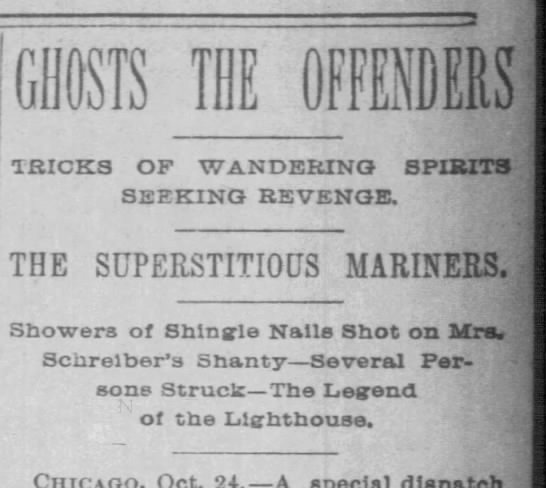
This little poltergeist report appeared in the “Memphis Avalanche,” October 25, 1888:


Chicago, Oct 24 — A special dispatch from San Antonio Texas says: The people of Brownsville are greatly excited over the bombardment of a residence near that town by invisible hands, Last Friday night the light-keeper’s house at Point Pabel, occupied by Mrs Schreiber, widow of the late keeper, was struck by a shower of shingle nails.  The occupants paid little attention to it until the next night when about dark the shower of nails began again, this time more vigorously than before, varied by an occasional oyster shell and clod of dirt. 


People gathered, but could not tell where the missiles came from.  Last night the bombardment was continued, brick-bats being added to the shells and nails and every now and then an old scrap of iron or copper casting. Mrs Krountze, Judge Lightburn, and several others were struck and bricks rolled through the house or entered at a window. A crowd collected and a deputy sheriff from Brownsville who was sent down to investigate made a careful search but could discover no source from where the shower of missiles came. 


The superstitious mariners at the Point insist that ghosts are the offenders and that it is because this light, which is of great use to commerce, was put out by order of the lighthouse board through some difficulty in acquiring title to the land. As it is not in operation they firmly believe a legend started, that during the war it was put out one night by a light keeper in league with wreckers, and a schooner was enticed ashore, and stoutly maintain that the ghosts of the drowned sailors are kicking up the present trouble as a mark of their disapproval of the absence of this needed beacon. About ten years ago the house of County Clerk Glanenecke in Brownsville was similarly bombarded.


It was reported elsewhere that Mrs. Schreiber, weary of the spectral assault, moved in with a neighbor, but the bombardment merely transferred itself to that house.  I couldn’t find any other follow-ups to the story.


Monday, November 9, 2020

The Haunting at No. 16

Waterdales as it looks today


Poltergeist activity is usually clearly centered around one person: most often a child or teenager.  However, what makes the following case unusual is that the paranormal activity did not appear to be fixated on any individual, but on a house.

No. 16 Waterdales is a small, semi-detached residence in Northfleet, a town about twenty miles from London.  The house was built in the 1930s, and for years showed no sign of being anything other than the common run of unassuming council houses.  That all changed very suddenly and dramatically in 1962, when Mr. and Mrs. Sidney Maxted and their three young children moved in.


The first sign that something unusual was going on came only a short time after the family moved in.  When the couple was downstairs, they began hearing sounds like footsteps in the front bedroom, which was located directly above the living room.  It was as though someone was pacing back and forth over their heads.  The Maxteds did their best to persuade themselves that the sounds were merely caused by residents of the adjacent house.  Just the sort of thing that happens when two homes share a party wall.  Nothing to be concerned about.


Then the Maxted children began hearing scratching noises under their beds at night, and invisible hands yanking off their bedcovers and slapping them.  The disturbances became so frightening, the children insisted on sleeping in their parents’ room.


The Maxteds were far from happy at No. 16, but felt they couldn’t afford to give up housing that was both inexpensive and convenient.  They rapidly changed their minds thanks to one night in February 1965.  Around 2 a.m., Mrs. Maxted got up to change the diapers of her youngest child.  After dealing with the baby, she was startled to see a small child coming into the bedroom.  Assuming it was her four-year-old, Linda, she called the child’s name.  As the figure approached her, it suddenly increased in size, until it became a giant form looming ominously over her.  When she screamed, the thing instantly disappeared.


The Maxteds did not wait around to see what else the house had in store for them.  The following morning, they gave their notice and moved out.


The town council allocated the home to another young family:  Eric and Margaret Essex and their baby.  Eric had heard of what the Maxteds had experienced, but felt the need to have a good home outweighed the risks of possibly sharing it with a ghost.


Trouble for the new residents started out the same way it had with the Maxteds:  with the sound of mysterious footsteps in the upper bedroom.  As the days went by, the family was also troubled with strange and unpleasant moldy smells throughout the house.  They would also sometimes hear a low-pitched hum echoing through the rooms.


As had been the case with the previous tenants, the couple did their best to ignore these disturbances until they were confronted with something too frightening to overlook.  One night in August 1966, Eric was awakened by the now-familiar sound of footsteps, but this time located in the hallway and on the staircase.  When he went to investigate, he saw and heard nothing.  After he returned to bed, he began hearing a weird whistling sound.  Then the bed started shaking violently.  When he sat up, he was confronted by the figure of a woman in a long dress, glowing with an orange light.  A woman lacking her head.


The family fled the next morning, vowing they’d sooner live on the streets than go anywhere near that house again.


After word got out about this new horror, the council found they had a hard time finding tenants for No. 16, especially since neighbors continued to hear uncanny sounds emanating from the empty house.  Margaret Harrison, who lived in the adjoining house, often heard heavy footsteps going up and down the stairs next door.  One night, she heard a loud booming sound, as if some heavy object was thudding around the house.  The pounding noise then hit the hall ceiling, which was directly above her bedroom, followed by a noisy scraping sound.  It was as if something underneath her was trying to scratch or claw its way up into her room.  She was so frightened by the experience that she too moved out.


What makes this reported haunting even stranger is that it appears to have ended as inexplicably as it began.  A house that had been tenanted without incident for nearly thirty years suddenly became the site of paranormal terror.  Then, after about four years, it ended.  The house still stands today, with no further reports of any unusual activity within its walls.  This relatively obscure case is an excellent example of how the more one looks at poltergeist reports, the more difficult it becomes to find a “one-size-fits-all” explanation for the phenomenon.

Friday, November 6, 2020

Weekend Link Dump


"The Witches' Cove," Follower of Jan Mandijn


We're proud to say that for the first time, the Link Dump will be sponsored by some of our friends from across the pond!


California's haunted Whaley House.

It's now believed that man's best friend is man's oldest friend.

A Trotskyist spy vs. Joseph Stalin.  Guess who lost.

Eastbury Manor House and the Gunpowder Plot.

The murder that led to the legal Brady Rule.

A Satanic castle in North Carolina.

How Paris celebrated All Saints' Day in 1887.

How the condemned were prepared for the guillotine.

An English recipe for gunpowder.  It's probably best not to try this at home.

Guys, here is something you definitely should not do with a pin.

A reluctant countess.

A look at putting on plays in the 16th century.

More on the Black Loyalists of the Revolutionary War.

A famous UFO event in New Zealand.

Were Neanderthals and humans at war?

Ice Age mining camps.

The biggest heists of Butch Cassidy and the Sundance Kid.

How to dress like a Victorian maid.

Pepys on the Great Plague of 1665.

The strange Giant's Causeway.

The latest on Denisovan DNA.

A very weird hole in Bulgaria.

The life and mysterious end of Edward V.

The Golden Age of movie theaters.

The hermit of the Hollywood Hills.

The scandalous Madame Moustache.

Three ghost stories from old newspapers.

Burke and Hare's final victim.

A brief history of the Abominable Snowman.

A brief history of ballpoint pens.

The strange case of the Eriksson twins.

A photographer is haunting Europe's abandoned castles.

A handy guide to becoming a werewolf.

Life at sea in the 1860s-era Royal Navy.

The ghosts of Western Kentucky University.

Three much-photographed cats.

An apple pie bites the dust.

That's a wrap!  See you on Monday, when we'll visit a haunted council house.  In the meantime, this week in Russian Weird provides our musical selection.


Wednesday, November 4, 2020

Newspaper Clipping of the Day

Via Newspapers.com


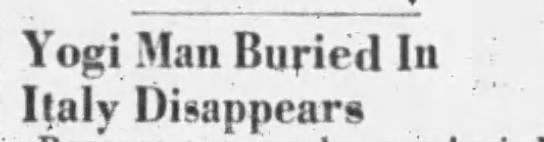
This bizarre little news item appeared in the “Paterson Morning Call” on January 2, 1957:

Because a man who was buried alive there several months ago has vanished, residents of Sulmona, Italy, are giving a wide berth to one part of their town.


Raoul Hinay, 50, a Hungarian who had learned Yogi in India, visited Sulmona with a concert troupe and agreed to demonstrate his unusual powers by being buried alive before witnesses.  His hands were firmly tied, he was placed in a coffin and lowered into an 18-foot grave which was then filled with earth.  He was to remain buried for eight hours.  Witnesses included a doctor, judge, and the local police chief.  Eight hours later the coffin was brought up with the seals apparently intact.  The lid was removed.  The ropes were there but Raoul was gone.  No tunnel or other way out was in evidence--and the Hungarian never has been found.


I haven’t found any other source for this story, so it’s anyone’s guess how much--if any--of the story is true.


Monday, November 2, 2020

The Murders at Oddingley


“Justice delayed is justice denied” is an oft-quoted legal maxim.  However, I can think of few instances where this saying was more vividly illustrated than with an otherwise-commonplace murder which took place in the village of Oddingley, England. 


Our story opens on the morning of June 24, 1806.  Two men named Thomas Giles and John Lench were walking on a lane just outside of Oddingley when they heard a gunshot, followed immediately by a cry of “Murder!”  When they ran in the direction of these sounds, they encountered a man--a stranger to them--trying to hide in the field.  When they confronted him with the words, “Villain, what have you been doing?” the man replied, “Me?  Nothing.”  Then he dropped the bag he had been holding and ran off.


Not far from where this strange character had been lurking, Giles and Lench found something burning on the ground.  Closer inspection revealed it was a man.  After extinguishing the flames, Giles ran for help while Lench went in pursuit of the man they had seen.  Lench was able to nearly catch up with the stranger when the man put his hand in his pocket menacingly and threatened to shoot Lench if he came any closer.  As he himself was unarmed, Lench had little choice but to watch the miscreant make his escape.


When the County Magistrate, Reginald Pynder, arrived on the scene, he recognized the victim as Oddingley’s rector, George Parker.  Although the unfortunate Parker was still alive when Pynder saw him, he died a short time afterward without being able to identify his attacker.


Parker had been murdered in a particularly brutal fashion: he had first been shot, then clubbed over the head before being set on fire.  The bag his killer left behind was found to contain the gun used to slay the rector.


Although Parker was known for his kindly and helpful acts toward his parishioners, he was a far from liked man in certain circles.  He did not get a regular salary, instead depending on tithes from the villagers for his livelihood.  As he was a tight-fisted man very fond of money, he was most insistent on collecting these payments from the wealthier residents.  These tithes were usually paid from any produce or livestock owned by landowners.  However, the war with France had caused the value of such goods to soar, meaning that Oddingley’s landowners were paying Parker more than they thought was fair.  When they asked Parker to take their tithes in cash instead, Parker refused.  The rector’s popularity did not increase when he insisted that Oddingley’s farmers build him a barn, and then went on to complain about the cost of the dinners these men regularly held.  In short, Oddingley’s richest residents saw Reverend Parker as a very costly pest.


Giles and Lench described Parker’s murderer as of medium height, with balding dark brown hair and a black beard.  He wore a long blue coat with metal buttons.  This fit the description of one Richard Hemming, a carpenter who was already suspected of having committed several robberies.  Now, he was wanted for murder.  Unfortunately, although several people reported seeing Hemming at various places in the area, the police were unable to find him.  It was presumed he had managed to escape to America, although his wife Elizabeth maintained that he would never have gone away without telling her.


As Hemming was the only suspect in Parker’s killing, his disappearance necessarily left the murder investigation at a standstill.  The inquest returned the inevitable verdict of “Murder against some person or persons at present unknown,” and life in Oddingley went on  Hemming was eventually nearly forgotten by everyone except, one presumes, his wife and three children.


In January 1830, an old barn at Oddingley’s Netherwood Farm was demolished.  A laborer digging up the barn’s foundations found himself uncovering an old boot, still containing a skeletal leg.  When the site was excavated by police, they unearthed a man’s complete skeleton.  Buried with it were remnants of clothing and a few minor personal effects.


Everyone immediately recalled the long-missing Richard Hemming.  His wife was able to identify the boots and the items buried with the body as having belonged to her husband.  (As a side note, in one of life’s curious coincidences, the laborer who found the skeleton was Elizabeth Hemming’s brother.)


At the time Hemming disappeared, the owner of Netherwood Farm was one Thomas Clewes, so he naturally became the top suspect in the murder.  During the third day of the inquest into Hemming’s death, Clewes interrupted the proceedings by stating that he wished to make a statement.


Clewes then began singing like the proverbial canary.  He said that back in 1806, he and five other landowners, Captain Evans, John Barnett, Joseph Taylor, and William and George Banks, decided that something had to be done about Reverend Parker’s unseemly zeal for picking their pockets.  That “something” they settled on was murder.  The group paid Hemming--known as an unsavory sort who’d do anything for money--fifty pounds to kill the rector.  They even provided him with the gun to do the deed.  


Unfortunately for them, Hemming proved to be a dud as a hit man.  When the men learned that he had been caught virtually red-handed, they knew they had to prevent his arrest, as Hemming would surely seek to defend himself by saying he had been a mere hired gun.  The conspirators told Hemming to hide in Clewes’ barn while they made a plan to get him out of the area.  Hemming found out just too late that their “plan” was to have Joseph Taylor bash his head in with a mallet.  The men then quickly buried the body just outside the barn.  Clewes--who professed to have had no foreknowledge that Taylor would turn to murder--went on to say that over the years, the other men would give him money and other gifts to insure that he never “split” on them.


By the time of Clewes’ confession, Joseph Taylor, William Banks, and Captain Evans were dead.  (It was said that in the last few years of his life, the latter was tormented by terrible visions of...something.)  The surviving members of the alleged murder ring were arrested and charged with being accessories after the fact in the murders of both Hemming and Parker.  Clewes received an additional charge of having aided and abetted the killing of Hemming.


At their trial, the defense attorneys seized on a surprise legal complication: they pointed out that under English law as it had stood in 1806, the men could not be tried as accessories after the fact when the actual murderer had never been tried and convicted.  Legally, they said, it had not been proven that any murder had occurred at all.  This conundrum got the charges against Barnett and George Banks temporarily dropped, leaving Clewes as the sole defendant.


Those witnesses to the double murders who were still alive told their stories.  To the great displeasure of the defense counsel, Clewes’ confession was read out in court.  At the end of the trial, the judge summed up the unusual business as concisely as possible.  He advised the jury that they must reach their verdict only on the evidence heard in court.  The evidence dealing with Parker’s murder had been heard only because of its relation to the killing of Hemming, which was the only case under their consideration.  The judge went on to say that the only evidence against Clewes was his confession.  While this implicated him as an accessory after the fact, the judge was of the opinion that it failed to show that the defendant participated in, or even encouraged, the murder of Hemming.


Given the legal complexities involved, it is small wonder that the jurors were a bit confused.  They initially returned a verdict of “Guilty as an accessory after the fact,” but when the judge pointed out to them that Clewes was being tried for murder, they immediately delivered an acquittal.  The prosecution then said that they would not bother proceeding with their case against Barnett and Banks.


It is rare that murderers return home to a hero’s welcome, but such was the case in our story.  Most Oddingley residents were of the opinion that by ridding the world of Reverend Parker and Richard Hemming, the defendants had performed a notable public service.  A large party was thrown in their honor, and the three men remained esteemed local worthies to the end of their days.  When Clewes eventually became landlord of the Fir Tree Inn, he proudly decorated the walls with press cuttings about the murders.  The Fir Tree (popularly known as the “Murderer’s Bar,”) is still in existence, an unofficial monument to one of England’s strangest murder trials.


Friday, October 30, 2020

Weekend Link Dump


“The Witches’ Cove,” Follower of Jan Mandijn 


This week’s Link Dump is sponsored by representatives of Halloween Cats United!


A murderer leaves an enigmatic message behind her.


That time AC/DC went hunting for the Loch Ness Monster.  Using fireworks.  And, yes, adult beverages played a major role in our story.

Murder tips from Burke and Hare.

The murder of an early film director.

Nothing like a little arsenic to liven up a Halloween party.

How the battle of Agincourt became the stuff of legend.

A monument to a murdered prostitute.  (Who had a pretty cool nickname.)

A famed medieval manuscript comes home.


Campaign advice from Davy Crockett.


British etiquette rules from the 1930s.

A future Senator is terrorized by a haunted gate.


A study of light pollution.

Witchcraft and the murder of Charles Walton.

Pagan bureaucrats vs. Christianity.

Did "cavemen" really live in caves?


Books bound in human skin.  One of the many, many things which leave me baffled about our species.

What we have here is the definition of “overkill.”

The unusual path followed by a Russian princess.


A Bronze Age mass death: battle or massacre?

Light bulbs and planned obsolescence.

That time Malaysia was invaded by miniature aliens.

The weird side of vintage Halloweens.


How Princess Margaret inspired daily horoscopes.

Aboriginal legends of body-snatching monsters.

Archaeology looks at the Salem Witch Trials.


A collection of medieval ghost stories.


Some of the strangest things caught in amber.

A brief history of face masks.

A brief history of werewolves.

A tunnel built by the Knights Templar.

An ancient civilization in Saudi Arabia.

Water is on the sunny parts of the Moon.  Just don't expect to drink it any time soon.

The New York Yacht Club's cat mascots.


Brain surgery from 5,000 years ago.


The first excavation of the Great Pyramid.


The rotten Mary Ann Cotton.


And we're done for the week!  See you on Monday, when we'll look at a tale of two murders.  In the meantime, here's something from the Renaissance.