"...we should pass over all biographies of 'the good and the great,' while we search carefully the slight records of wretches who died in prison, in Bedlam, or upon the gallows."
~Edgar Allan Poe

Friday, October 9, 2020

Weekend Link Dump


"The Witches' Cove," Follower of Jan Mandijn


This week's Link Dump features entertainment by the Strange Company Choir!


What the hell was the "Wow!" signal?

What the hell is the Yonaguni Monument?

A notorious mid-air collision.

Tourists visit Rotterdam and are generally not impressed.

The theory of serial universes.

Victorians and magic mushrooms.


John Evelyn catches a cold.

When medical students turn to body snatching.

Madame Restell, the wickedest woman in New York.

The final segment about George Bridgetower, violin prodigy.

The English law of forfeiture in 19th century India.

The newly-discovered grave of an Anglo-Saxon warlord.

The strange story of the surgeon and the smugglers.

The life and lore of Queen Boudica.

A Hungarian poisoning gang.

How chloroform caught a murderer.

300,000 years ago, humans were using fire to forge tools.

The story of the original Siamese twins.

Victorian London's most popular ghost.


A "slippery quean" has a lucky escape.

A 2,000 year old vitrified brain.

The first 20 years of Plymouth Colony.


When writers of fiction really bring their characters to life.

The man who helped start a notorious (and quite deadly) feud.

This week in Russian Weird looks at ancient skull cultists.  And a magical cat for sale.


A historically significant prehistoric massacre.


A brief history of polymaths.

A brief history of the James/Younger gang.

New Jersey's most cursed road.

A 1,200 year old temple has been discovered in India.

Agnes Sorel, the first official French royal mistress.

How a lost boy became the "hero of the fells."

An eyewitness account to a guillotine execution.

Renaissance Europe sure loved merpeople.

When you get mixed up with both Nazis and Communists, things are almost guaranteed not to end well.

A Versailles in a rainforest.


A babysitter's dreadful murder.

A 250,000 year old Denisovan tooth.


The Fortean side of Tenerife.

A review of a new book about the Vikings.

An unusual time-slip story.

Adultery, murder, and a Cuban con artist.

And we come to the end of our week!  See you on Monday, when we'll look at a mysterious death and a possible miscarriage of justice.  In the meantime, here's some early American music.


Wednesday, October 7, 2020

Newspaper Clipping of the Day

Via Newspapers.com


Most people, I suppose, want to be remembered after they die, but not, I’d wager, by being immortalized as the Lizard Lady of Akron.  This rather gruesome case was recalled by the “Akron Beacon Journal,” on December 8, 2003:

The strange case of Lovie Herman puzzled doctors for more than a decade.

Many physicians examined the Akron native during her short, troubled life, but each diagnosis seemed to conflict with the previous one, and the treatments did little to comfort her.


The 20-year-old woman weighed less than 90 pounds even though she stood 5 feet 6 and had a hearty appetite. She suffered stomach pains, hemorrhages and occasional blackouts, and had great difficulty breathing. Her skin grew splotchy and her lips turned purple.


At one time or another, health experts suggested that the mystery illness might be tuberculosis or typhoid fever or heart trouble or a respiratory problem.


Or maybe it was something else entirely.


When Herman lost her struggle shortly after midnight on Dec. 9, 1910, the reported cause of death jolted the medical community and sent a shock wave through Northeast Ohio.


It was the stuff of nightmares.


Dr. Alex J. McIntosh, Herman's attending physician, certified that his patient had succumbed ``due to stomach trouble caused by lizards in the stomach poisoning the entire system.''


Newspaper reporters snapped to attention. Did he say lizards?


``There is absolutely no question about the lizards being found in the girl's stomach, for I have the two largest ones preserved in a bottle in my office,'' McIntosh said.


He also reported finding a batch of eggs in a tiny ball.


The green reptiles had been in her system a long time, he said. Herman's family told him that she had taken a dip in a ``cool, refreshing spring'' near Millersburg a dozen years earlier, and it must have been there that the girl accidentally swallowed tiny lizards or possibly their eggs, he said.


A few days before Herman's death, McIntosh said he had given the woman a strong dose of medicine under the assumption that she was suffering from a tapeworm. That's when, he said, she could feel the reptiles ``crawl up her throat.''


``They are each 3 ½ inches in length,'' he said. ``One lizard is as well formed as any I have ever seen. I also extracted several smaller lizards from Miss Herman's stomach, but I have kept only the two largest ones. The head, mouth and tail on both are to be plainly seen.''


The weird tale sent the local media into a feeding frenzy. Bold headlines screamed out from the front pages.


``Two Lizards In Stomach Cause Death,'' the Akron Beacon Journal reported.


``Live Lizards, For 13 Years In Girl's Stomach, Slowly Poison To Death,'' the Akron Press countered.


Lova J. Herman, known as ``Lovie'' to her family, had been sick since she was a child. She was treated at a Chicago sanitarium for suspected tuberculosis, but she wasn't cured. She then moved to Cleveland with her mother, Ellen, to be treated at Lakeside Hospital for suspected heart troubles.


McIntosh, a Cleveland physician, deduced that Herman was suffering from a parasite because of her abnormal appetite. After making the shocking discovery of the lizards, he said, he withheld food from his patient for a few days in an attempt to starve any remaining reptiles.


Then he gave her another dose of medicine.


``... Miss Herman was thought to be improving, but at midnight Thursday she died in her mother's arms just after remarking that she thought she was going to recover,'' the Akron Press reported.


Her body was transported to Akron for a funeral service at her brother Harvey Herman's home at 896 St. Clair St.


Seventeen doctors attended a postmortem exam at the house, including McIntosh, Summit County Coroner Harry S. Davidson, Dr. Clinton J. Hays of Akron, Dr. Edgar S. Menough of Cleveland and Dr. William S. Chase of Akron.


``The postmortem proved the previous diagnosis correct,'' McIntosh announced. ``The lizards had eaten almost through the walls of the stomach and a few small ones as thick as a broom straw remained.''


But he was quite alone in that professional assessment.


Other doctors harrumphed loudly at his assertions.


Davidson, who had grown up on a Jefferson County farm, had been skeptical from the start.


``We found nothing in the stomach,'' he said. ``The organ was in a congested condition, and the girl's heart was twice its normal size. The condition of her heart, I believe, was the cause of death.''


An air-breathing reptile would suffocate in the stomach and couldn't escape the gastric acids, Davidson told reporters.


``Dr. McIntosh at the postmortem failed to enlighten 16 other physicians present, except when we questioned him closely,'' he said. ``The only thing I could see was that the stomach was inflamed and congested. That could be caused by the action of the heart.''


Cuyahoga County Coroner Max A. Boesger agreed that lizards couldn't survive in a stomach for any length of time. ``Tapeworms live inside the human body because that is their natural habitat,'' he said. ``Lizards do not like being there.''


Cleveland Health Officer Clyde E. Ford flatly refused the death certificate that McIntosh had written.


``I will not accept such a certificate because I do not believe that her death was caused by poisoning produced by lizards in the stomach,'' Ford said. ``It is too absurd to discuss. It is simply impossible.''


Eli and Ellen Herman trusted their daughter's doctor, though, and voiced support for him.


``Dr. McIntosh was too interested in Lovie's recovery and showed too much kind attention during her illness to invent any mythical story,'' Ellen Herman said. ``We believe Dr. McIntosh in spite of Dr. Ford, Coroner Davidson or anyone else.''


The family may have been on the doctor's side, but medical science was not.


Confronted with allegations that his claims were false, McIntosh held a closed-door meeting at Ford's Cleveland office on Dec. 13, 1910, and completely retracted his lizard story.


The Beacon Journal buried the headline ``Lizard Story Fake'' deep inside the paper.


Today, the lizard story is regarded as an urban legend, along with similar folk tales about snakes, frogs and other frightful creatures invading the human body and wreaking havoc.


Lovie Herman's 1910 death certificate can be found on file at the Ohio Historical Society in Columbus.


The cause of death has been scribbled out.


Monday, October 5, 2020

The Phone Call From the Future

Assia Smaguine Riley, via https://issuu.com/lesliehindman/docs/sale_338


“Crisis apparitions”--cases where ghosts of the recently deceased supposedly visit loved ones to announce their passing--are quite common.  However, the following account is an unusual twist on the genre.

John Powell Riley was a successful electrical engineer.  During the 1950s and 60s, he was married to a beautiful Russian socialite, Anastasia “Assia” Smaguine.  They spent much of their married life in Geneva, Switzerland, where they socialized a great deal with the local community of Russian exiles.  Among the most popular of this colony of “White Russians” was a small family whose last name Riley discreetly declined to provide.  It consisted of a woman named Tamara, her 25-year-old daughter Mara, and Tamara’s mother Baboussia.  

Mara--the breadwinner of the family--was an exceptional young woman.  She was a gifted linguist who worked as a translator for the United Nations.  Mara was beautiful, charming, and kindly, well-loved by everyone who knew her.

Eventually, Riley’s marriage to Assia ended when she left him for her first love, a Frenchman named Pierre Saunier.  He moved back to America, losing contact with Mara and her family.  Despite the divorce, Riley and Assia remained on very friendly terms, and spoke often on the phone.  (The two eventually remarried in 1998.)

Some years passed.  Then, early one morning, Assia phoned.  She was sobbing.  “Oh, Johnny,” she gasped, “something terrible has just happened.  Mara died."

Riley was shocked.  As far as he knew, the young woman had been in perfect health.  Assia explained that while Mara had friends over for lunch, she choked on an olive pit, dying before help could arrive.  She had married only a month before.

Riley felt a lingering sadness over the tragic event.  To have such an fine person, with so much to live for, die suddenly in such bizarre circumstances, made him question what life was really all about.  He shared the story of Mara’s sad end with friends, and they all endeavored to find any sort of logic and reason in the ways of this world.

In an article he wrote in 1995 for “Fate Magazine,” Riley mused, “One thing seems certain.  We live in a world of consequences where the physical laws of the universe prevail without exception.  Not even God rescinds them.  You can be the best person in the world, but if I push you off a cliff, you will fall to your death and all your goodness will not save you.  If you absentmindedly step in front of a speeding car, nothing in your character will have any bearing on the inevitable outcome.”

A far more elegant way of saying “S--- happens.”

Riley and Assia did not discuss Mara again.  Then, about a year later, she phoned him.  He could instantly tell she was very upset.

Assia said, “Oh, Johnny, something terrible has happened.  Mara died.”

The confused Riley replied.  “I know that, darling.  She choked on an olive pit.”  He reminded Assia that she had told him the news a year ago.

Assia stated that this was impossible.  Mara had died just the day before.

Friday, October 2, 2020

Weekend Link Dump


My apologies for the Strange Company HQ staff. The publishing of a new post always makes them a bit rowdy.


What the hell is Australia's tektite field?

Who the hell were the Pilgrims?

This week, we may have hit peak Russian Weird.

The Cleveland Torso Murderer.  Despite the headline, I think a lot of people have heard of him.

A recently discovered Nazi shipwreck might--might--contain looted treasure.  Or it might not.

19th century oratory.

The saga of Springheel Jack.

The case of the anomalous 115,000 year old footprints.

The ghosts of Dent's Palace.

Some vintage Cockney Cats.

A case of formal facial mutilation from Anglo-Saxon England.

Was Charles Lindbergh behind his son's kidnapping?  (I've read a lot about the Lindbergh case--it's one of my top historical rabbit holes--and while I'm convinced Hauptmann was innocent, I'm agnostic on the Lindbergh-did-it theory.  On the other hand, ol' Charles really was a cold bastard.)

Did Neanderthals live in caves?

An engineer trained his cat to be a firefighter.  If you know any engineers, this will not surprise you.

More from our "Pushing back human history" file.

How Looty the Pekingese went from Beijing to Queen Victoria's court.  

A woman who was...how can I put this?  Twins from the waist down. With illustrations.  Yup, it's Thomas Morris time again.

A 13 year old serial killer.

17th century autograph collecting.

How Victorian Parisians enjoyed their Sundays.

Why sparrows and cricket games just don't mix.

Frank Sinatra and the Bobby Sox riot.

The fall of the Hearst magazines.

A missing woman's unusual reappearance.

Yet another case where a wife goes missing after--according to the husband--storming off after a fight with him.  No comment.

Victorian female detectives.

The history of the smallpox vaccine.

The strange case of the Baghdad batteries.

I've mentioned this before, but here's another reminder that crows are damn smart.

Homosexuality in 17th century England.

Royal mourning fashion.

That time we tried to fight the Japanese with radioactive foxes.

More on George Bridgetower, violin prodigy.

A tribute to Paddy, heroic wartime pigeon.

The bizarre Shoebox Murder.

An Immanuel Kent joke book reads pretty much the way you'd think.

A couple's mysterious murder.

The history of mashed potatoes.

Virginia City, silver mining boomtown.

Witchcraft werewolf trials in the Netherlands.

How Agatha Christie stayed relevant.

The man who owed his life to a beetle.

The mummy in the tree.

A world-traveling cat.

The tragedy of the bookseller's son.

A notorious UFO abduction story.

Reconstructing the face of an ancient child mummy.

Alan Turing and the fairy circles.

That 's all for this week!  See you on Monday, when we'll answer one very weird phone call.  In the meantime, here's a pleasant bit of Haydn.


Wednesday, September 30, 2020

Newspaper Clipping of the Day


Via Newspapers.com


It’s time for the sound of Mystery Bells!  The “St. Joseph Weekly Gazette,” December 8, 1892:


Baltimore. Md., Nov. 30.-The good Sisters of the convent of Notre Dame, near this city, have been mystified and frightened by the singular antics of the door bell.  It rings by day and it rings by night. It is one of those big brass bells that can be heard all over the convent and in the parsonage of St. Anne’s church adjoining, where its almost incessant jingling during the midnight hours disturbs the rest of Rev. W. E. Bartlett. 


On Saturday, November 5, the mysterious bell-ringing began.  At first, the lay Sisters thought that mischievous boys were jerking the bell-pull and running away. One Sister watched in the hallway and another stood under the bell In the rear of the house. The bell rang, but no one pulled the knob. At night, when the sisters retired, the bell rang again.  It continued to ring at short intervals all night, and deprived some of the sisters of sleep. The bell rang all day Sunday, and could be plainly heard in St. Anne's church during the celebration of high mass. 


The sexton, Joseph Helmcamp, traced the bell wire from the door to the bell, but found nothing wrong.  While this examination was going on the bell kept ringing. Finally the sexton cut the bell wire. This failed to stop the bell from ringing. No electric wires of any kind are about the house. It was finally decided to detach the wire from the bell entirely. This was done, but it did not stop the bell from ringing. Indeed, the bell rang more violently than ever, as if rejoicing from being freed from the wire. 


Rev. William E. Bartlett. pastor of St. Anne's church, was called in. He examined the bell carefully, but could not solve the mystery. "Take it down," was the next order. The bell was removed and was hung up for two days in Father Bartlett's house, but did not ring there. It was then replaced in the convent, whereupon it began to ring again violently. 


The assistant pastor examined the bell.  "Take it down," said he, "and I'll put it up so that it won't ring." The bell was taken down and put up by Father Bartlett.  Then it rang so violently that the steel spring attached was stretched straight out, and the bell oscillated with such force that it beat against the ceiling. 


The priests were completely mystified. More than a score of the members of St. Anne's church were called in to examine the strange antics of the bell, but none could discover the cause. The bell rang so violently at night that Sexton Helmcamp was called in to remove it so that the Sisters could sleep. 


He has since placed it in position every morning and removed it at night. The lay Sisters can not be induced to remain in the kitchen when the bell begins to ring. 


Every Sunday since November 5 the worshipers at St. Anne's church have heard the noisy bell while at mass. Every part of the bell has been carefully examined, as well as the pieces used to attach it to the ceiling. The bell wire was also inspected minutely. It was suggested that the trouble might have been caused by a rat or a mouse. This could not be possible, because the bell rang when absolutely detached from the bell wire. Last Sunday during Vespers the bell raised such a racket that Father Bartlett left the sanctuary several times to stop it. 


The bell continues to ring violently. The investigation is still in progress, but the problem is as far from being solved now as it was three weeks ago.


I haven’t been able to find when (or if!) the ringing stopped, or if they ever found the cause for this aural bombardment.


Monday, September 28, 2020

The Mob, the Mayor, and the Madonna: The Bottazzi/Gerard Disappearance


Asbury Park Press, July 7, 1968, via Newspapers.com

With some missing-persons cases, there are so few clues, it is difficult to even theorize how the victim came to disappear. With others, investigators believe they “know” what happened, but are unable to prove it. This sinister mystery below is among the latter. 

In January 1968, Rose Bottazzi of Brick Township, New Jersey, had been happily divorced for some ten years. (Her former husband, Dominick Mancino, lived in Canada and played no role in our story.) She lived with two of her children: 12-year-old Debra, and Anthony, who was 21. (A married daughter, Donna Inman, lived in Lakewood.) She was extremely devoted to her family, and was an active member of the local PTA. Bottazzi had once been a professional dancer (under the name of “Joan Mason,”) but for some time, Bottazzi had been working with a friend who owned a dry cleaning business, as a sort of apprenticeship before she opened a similar business of her own. She had already purchased the necessary equipment. 

Bottazzi was a homebody, rarely socializing or taking vacations. However, for the past seven or eight years she had been dating 56-year-old James Gerard. For the past 26 years, Gerard had worked in the delinquent accounts section of Newark’s IRS office. His job consisted of collecting overdue tax payments and hunting down people who failed to file returns. Supervisors described Gerard as “reliable, orderly, well-liked...with a clean slate of government service.” That seems to be an accurate characterization of Gerard personally as well. He was described as a quiet, likable person with no enemies. 

His relationship with Rose appears to have been based on warm companionship rather than passion. They enjoyed spending time together and going out to dinner, but there is no evidence the pair considered taking things to a more serious level. Rose’s brother Patrick described them as “two quiet stay-at-home types. He loved Rose’s cooking and would sit in front of the television set watching a football game in his spare time.” One gets the impression of a pleasant middle-aged couple happy to keep their lives in a low key. 

On January 13, James picked up Rose for a dinner date. They drove in his 1968 Chrysler Newport to Peterson’s Sunset Cabin restaurant in Lakewood. After dinner, they had a drink with the establishment’s hostess, Eileen Holland. Holland later described their conversation as “light and friendly.” Afterwards, the pair went to a bar called Tavern on the Mall. The bartender, John Vincintini, recalled nothing notable about them. They had two drinks each, and after leaving a dollar tip, left about 1 a.m. 
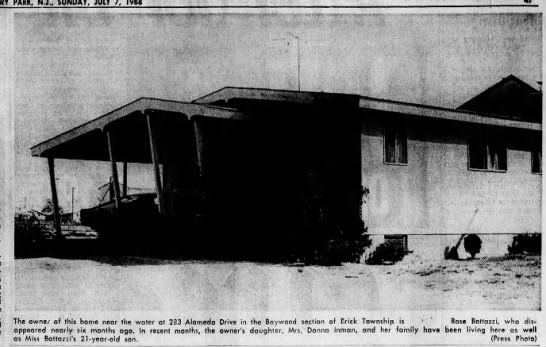
The Bottazzi home, Asbury Park Press, July 7, 1968


So far as is known, Vincintini was the last person to see either Bottazzi or Gerard, alive or dead. After exiting Tavern on the Mall, these two people--and their car--vanished completely. As both of them were of regular habits and always let relatives know where they were, their disappearance was noted almost immediately. An exhaustive search was launched. The wooded areas around Lakewood were examined. Nothing. Lagoons nearby were dragged (whenever people disappear along with their car it is shockingly common for it to turn out that they accidentally drove into some large body of water.) Still nothing. 

No one who knew either of them thought the couple might have eloped. They were just not the types to let their loved ones worry about them. And as Rose’s brother pointed out, “If they wanted to, they could have gotten married any time.” Both their bank accounts remained untouched, and neither had any credit cards with them when they disappeared. A state trooper acknowledged that this was one very unusual case. “These just are not the type of people to turn up missing,” he said. 

Which just goes to show that any type of person can turn up missing. 

In July 1968, the mayor of Brick Township, John McGuckin, began throwing around some dark hints about the mystery. He told reporters, “I believe their disappearance is no accident. There is a good possibility that criminal elements were responsible.” When asked to elaborate, he would only say, “There are definitely Mafia or Cosa Nostra elements here. I have seen Cosa Nostra figures from Monmouth County in Brick Township.” 

McGuckin’s enigmatic words took on heightened significance when investigators learned that Gerard had been a close friend of then-Newark mayor Hugh Addonizio. Not long after Gerard vanished, Addonizio--who was said to have Mob ties--was indicted on charges of bribery and extortion. Gerard had prepared at least one of Addonizio’s tax returns, and kept copies of the mayor’s financial records. It was also revealed that Gerard was a big gambler. A search of his apartment found a number of yellow legal pads filled with basketball and football odds and numbers. It was believed that Gerard was involved with illegal sports betting.  Considering his friendship with Addonizio and his job at the IRS, investigators came to the not-unreasonable conclusion that Gerard was targeted by somebody. 

“It’s not hard to think,” commented a police officer, “that with [Addonizio’s trial] coming up there could be reasons for [Addonizio’s] bookkeeper to disappear.” Bottazzi, according to this theory, was simply in the wrong place at the wrong time. A detective speculated that “whenever they left wherever they left last...there could have been someone in the back seat who said, ‘Start driving.’” Although the famous “being taken for a ride” is associated with bad gangster movies, it has been known to happen in real life to those who rub certain people the wrong way. Considering Gerard’s links to the Mafia and illegal activities, it is not impossible that someone saw him as a liability--someone who “could talk”--and these types are very good at making people disappear forever. (See under “Hoffa, Jimmy.”) 

On the other hand, the night when James and Rose disappeared was a very bad one for driving. It was one of the worst nights of that winter, with the roads being pelted with snow, rain and sleet. The four and a half miles from Tavern on the Mall to Rose’s home was a lightly-traveled, winding road surrounded by lagoons. In 1968, there were no fences, and no streetlights. In short, given the brutal weather, it would have been terrifyingly easy to skid or take a wrong turn, and plunge into deep water. Despite the fact that the lagoons along the route the pair would have traveled were searched, it still seems possible that Gerard’s car could have been overlooked, and is still resting at the bottom of one of those bodies of water. 

However, there is evidence indicating that the pair reached their destination--Gerard’s galoshes, wallet, car registration, and IRS badge were found at Rose’s house. That suggests that whatever awful thing happened to the couple took place after their trip home. (Although Rose’s daughter Debra said she slept all night without hearing anything in the house.) 

There is an eerie footnote to this still unsolved mystery. On the day Rose disappeared, she visited her married daughter Donna. Donna’s infant son, John, had been ill, and Rose was very worried about him. During this visit, Bottazzi told her daughter that her fears for the boy had been amplified by a frightening dream she recently had. In this dream, she was lighting a candle before a statue of the Virgin Mary. As she was leaving, she stumbled, but the hands of the statue came down and kept her from falling. She had been scared by the hands reaching out to her, but Mary told her not to worry. Bottazzi thought the dream was somehow connected to her grandson’s illness, although she could not say how. She invited Donna to join her and James at dinner that night, but Mrs. Inman thought she should stay with her son. 

It was the last time Donna spoke to her mother. Rose Bottazzi went on her way, little guessing that that very night, she would indeed--whether through accident or foul play--fall into the hands of the Blessed Virgin.

Friday, September 25, 2020

Weekend Link Dump

“The Witches’ Cove, Follower of Jan Mandijn 


This week’s Link Dump is here!

Ready or not!


Remembering the South Sea Bubble.

Human footprints from 120,000 years ago.

Liverpool, you have a green glowing UFO on your hands.


The baboon who worked as a railroad signalman.

I am so proud to be able to announce that this week marks the 60th anniversary of Nixon's Unfinished Sandwich.

A visit from our old friends Goss and Udderzook.   (My post is here, if you just can't get enough of those two.)


The East India Company's attempts to save enslaved children.

The folklore of white deer.

An 8,400 year old dog burial.

The ghostly drummer of Cortachy Castle.

A diplomat's mysterious death.

The wandering remains of a Hiroshima victim.


Makeup tips from WWII.


The French Revolution's most notorious prosecutor.

Pro tip: do not follow the Galley Slave Diet.

The vet who accidentally killed Charles Dickens' raven.

This week in Russian Weird looks at the time a bell was exiled to Siberia.  And the Petrozavodsk phenomenon.  And the announcement that Venus is now a Russian colony.

And what would 2020 be without a feral swine bomb?

The truth about tantric sex.  (With some NSFW art.)


19th century rules for women cyclists.

A waif and the Gates Ajar.

Why Janet Spark had a hard time resting in peace.

This article will make you very glad for the invention of toilet paper.

Apocryphal Christian texts dealing with wizard battles and demon circles.


Grover Cleveland's White House wedding.


Advertisements for the Jamestown colony.


Men are from Mars...except Tesla, of course.  He came from Venus.

The sad marriage of the Duke of Wellington.

The life of an 18th century mariner.

A 50-year-long true crime story.

A schoolgirl's unsolved murder.

A strange death in Hells Canyon.

In defense of Nero.

That's it for this week!  See you on Monday, when we'll look at a couple's unsolved disappearance.  In the meantime, here's this lovely Sephardic song.