"...we should pass over all biographies of 'the good and the great,' while we search carefully the slight records of wretches who died in prison, in Bedlam, or upon the gallows."
~Edgar Allan Poe

Friday, April 1, 2022

Weekend Link Dump


"The Witches' Cove," Follower of Jan Mandijn

Welcome to the first Link Dump of April 2022!


The caddish side of John Keats.

Tragedy at the Salvation Army.

Mysterious ancient stone jars have been found in India.

A WWI massacre at sea.

The grim and ghostly history of an Edinburgh pub.

A brief look at turf mazes.

Amy Johnson, 1930s Queen of the Air.

Here's your chance to achieve your lifelong dream of visiting Henry III's toilet!

The life of a Victorian criminal.

A Regency-era forger.

Shropshire wedding folklore.

The female detective who foiled an assassination plot against Lincoln.

A deadly diet plan.

A shocking small-town murder.

A beautiful close-up image of the Sun.

Women in medieval leper hospitals.

The current state of cloning.  No one loves cats more than I do, but the thought of having one of them cloned gives me the heebie-jeebies.

The quest for the perfect foot.

Some famous corpses that failed to rest in peace.

Sacred sites and anomalous lights.

A remarkable Victorian doctor.

Donatello, father of the Renaissance.

A Copper Age "amber man."

That time the U.S. and the Soviets were in a race to revive the dead.  And you thought the Cuban Missile Crisis was bad.

A very early "curse tablet."

Rehearsing your own funeral.  An old "Midsomer Murders" included a guy who did that.  He said proudly that his coffin had silk lining because "nylon is so scratchy."

The medieval mind of C.S. Lewis.

The heroic merchantman and the French privateer.

A medieval exorcism manual.

Early Modern English writing about the Ottomans.

A "very public and messy divorce."  For a blogger, that is the best kind of divorce.

An 18th century travel writer.

The murder immortalized by Poe.

Werewolves of Quebec.  But was their hair perfect?

Has the Dyatlov Pass mystery been solved?

That's it for this week!  See you on Monday, when we'll look at a bride's puzzling death.  

In the meantime, here's this lovely Welsh folk song:
 

Wednesday, March 30, 2022

Newspaper Clipping of the Day

Via Newspapers.com


Railroads are one of those sites that, for whatever reason, are a particular magnet for ghosts.  The following example comes from the “Minneapolis Star Tribune,” October 26, 1872:

The following wonderful and marvelous story, which comes from a source that prevents its being hooted as a canard, we clip from yesterday's Pioneer and leave our readers to await further developments:

Our readers will all remember the terrible accident which took place in a blinding snowstorm at Randall Station, on the main line of the St. Paul and Pacific Road, in March last, which caused the death of several persons. Among the victims of that terrible accident was a section foreman named Connelly. This man was very much attached to his division, and took great pride in keeping everything right and tidy, as far as his supervision extended. Although his station was located, at that time, in a sparsely settled section of the country on a treeless waste, so to speak, where especially there was nothing to break the force of the wind which at times swept over the bleak prairies with the force of a hurricane, yet so great was Connelly’s attachment to his section that he refused several more lucrative positions which were offered to him.

Upon his death by the accident above referred to, the Randall Station was given to another man, whose name is Connelly.  The latter has been employed on the road for a long time and is known to be a sober, industrious, and intelligent man, one in whose fidelity the company has the most implicit confidence, and the last man almost that any one who knows him, would suspect of being tinctured in the slightest degree with superstitious notions. For some time after assuming charge of the Division everything went along satisfactory. This state of things was not to last however. For some time past Mr. Connelly has complained that he could not sleep nights. He avers that he is visited at all hours of the night by the 

APPARITION OF HIS DEAD PREDECESSOR. 

The ghostly form appears at his bedside, and and vainly endeavors to tell his tale by unearthly motions, at times apparently entreating and anon with every appearance of anger and revenge. Several times Mr. Connelly has been thrown from his bed with great violence, and his arms and other portions of his body show the marks of rough handling. The imprint of hands and finger-nails are plainly visible, which he asserts have been left there by his ghostly visitor. To such an extent has this most mysterious visitation been carried, that Mr. Connelly has petitioned to be removed to another section, or granted permission to erect another house on a different portion of the section. He says it is not only these visitations which disturb him, but 

THE SPIRIT OF THE DEAD MAN 

prevents him from performing his duties both day and night. He has seen the awful spectacle in the daytime while at his labors, and the shadowy form has, by unmistakable motions, ordered him away. 

For a long time Mr. Connelly refrained from mentioning anything about these mysterious appearances, knowing that he would not be believed, and in all probability would be laughed at, and it is probable he never would have mentioned it, but for an occurrence which took place a short time ago. 

One evening after the labors of the day had closed, and as Mr. Connelly and the men under his charge were eating their supper, the door of the house opened noiselessly, and in the doorway, in the full gaze of all who were present 

STOOD THE AWFUL APPARITION 

of the dead man. The shadow remained long enough to make a number of demonstrations of a revengeful character, and then disappeared, apparently melting into space. An awful feeling of terror fell upon that small party of men, and for a time they were speechless, gazing into each other's faces with eyes distended with horror. They were not men easily frightened, and some of them had looked death in the face without flinching. But this 

UNEARTHLY SUPERNATURAL VISITATION 

which was recognized at once bv all as the spirit of the man they had all well known while living, was more than they could stand. When their momentary terror had subsided they commenced in awe-stricken tones to tell each other what they had seen. It was then that Mr. Connelly related his experience, and it is needless to say he was not laughed at or disbelieved. The sight had been too real and too palpable to all to admit of dispute. They had seen the veritable ghost of their former fellow workman. Since that time there have been 

MOST MYSTERIOUS OCCURRENCES 

taking place at that lonely station on the prairie. Several tools, which were known to have been put away, are missing, and various other things have taken place to hinder Mr. Connelly and his crew of men from performing their work. 

Nor is this all.  The engineer on one of the freight trains avers that several times he has seen the apparition in the night engaged on work upon the track, the same as when dead man was living. At one time it will be engaged with a crowbar, raising the rails, and making motions as though giving directions to a gang of men.

Again he has seen it standing upon the track in advance of his engine, arms stretched out as if to give warning of danger ahead, and the engineer says at such times his engine acts as if plowing its way through drifting snow, and although he pulls his engine "wide open," the speed of the train is sensibly decreased until it reaches a certain point, when it will plunge ahead as though just relieved from some obstruction.

We understand that these most mysterious doings have been reported to the officials but they, of course, are inclined to doubt the truth of the statements; but so serious has the matter become that steps have been taken to have some of the employees of the road stay at the station house a number of nights and have the matter thoroughly investigated.

The above is a statement of facts, which come to us well authenticated, and we give them as one of the most singular stories we remember of hearing. Should any more facts be developed after a thorough investigation of the matter, we shall hasten to lay them before our readers.

The first Mr. Connelly certainly proved that it’s possible to be too fond of your job.

Monday, March 28, 2022

Close Encounters of the Tourist Kind

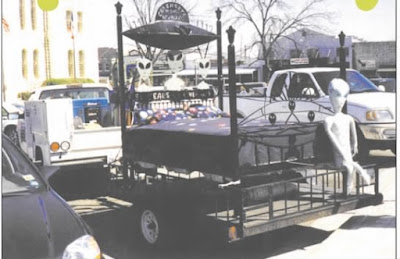
"Hood County News," August 16, 2005, via Newspapers.com. This is a bed which was built specifically for space aliens.  These people obviously had the right idea.


I’ll be the first to say that the following story is pretty “out there” even for this blog.  It sounds so much like one of the old “Coneheads” skits from “Saturday Night Live,” that, to be honest, I hesitated about devoting a blog post to it.  However, it’s such a delightfully nutty tale, I decided to share it, and all of you can simply make of it what you will.

On the morning of May 15, 1970, Dorothy Simpson was at her job at a motel just outside St. Louis, Missouri.  Everything seemed normal.  As she sat at her desk, going over billing documents, she heard a “whistling sigh.”

That did not seem normal.  And when she looked up from her paperwork, she was confronted by four people, who looked so alike they were presumably family: a man, a woman, and two youngsters, a boy and girl.  This would have been normal if not for the family’s appearance, which was, to say the least, unusual.  They were all so tiny, they could barely look over the top of the desk.  Simpson’s visitors wore elegant and obviously expensive clothes: tailored suits for the males, delicate peach-colored dresses for the females.  Their hair looked so unnatural, Simpson believed they were all wearing wigs.

The man asked her, in a strange, high-pitched voice, “Do you have a room to stay?  Do you have a room to stay?”  Simpson answered in the affirmative, and told him the price of the room.  However, the man seemed oddly befuddled by her answer.  He turned to the woman as if asking for an interpretation of Simpson’s words.  After a moment of awkward silence all around, the man took a stack of bills from his pocket and handed them to Simpson.  She noticed that some of the banknotes were of large denominations and very crisp, as if just off the printing press.  This caused her to suspect they were counterfeit, but a quick test indicated they were genuine.

Simpson took two twenty-dollar bills and handed the rest of the bills back to the man.  He was too small to reach the room reservation form, so Simpson signed for him.  He gave his name as “A. Bell.”  When he stepped forward, Simpson was struck by how odd their faces were.  They had very pointy chins, large dark eyes, virtually bridgeless noses, and lipless mouths that were no wider than the noses.  Their skin was unnaturally pale.  It was as if some alien beings dressed up as humans for Halloween, and did not do an entirely convincing job of it.

“Where are you from?” Simpson asked.

His arm shot upwards, and he replied, “We come from up there.  Up there.”

The woman, obviously irritated by her companion’s candor, pulled his arm down.  She told Simpson that they were from Hammond, Indiana.  (The motel’s manager later told Simpson that the Hammond address they gave did not exist.)  The man then signed the register, but in a very uncomfortable fashion, as if he had never held a pen before.  The family (“family?”) asked where the motel’s restaurant was, and left to get their meal.

The other employees soon noted that their humble little motel was being graced by some mighty strange guests.  Their waitress at the restaurant got a bit unnerved serving them.  Aside from their peculiar appearance, they kept studying the menu, asking questions about where perfectly ordinary foods such as milk or bread came from.  It was as if they knew nothing about human cuisine.  The woman finally ordered peas and milk for herself and the children, and peas, a steak, and water for the man.  They ate one pea at a time, using a knife to bring it to their tiny mouths, and using an odd sucking motion to swallow it.  The man’s mouth was such a small slit, he was unable to eat even tiny slices of the steak.  They all stopped eating simultaneously, after which the man handed the waitress a twenty-dollar bill.  She left to get change, but when she returned, they were gone.

The bellhop got their luggage and began leading them to their room.  When the family saw the elevator, they were obviously confused and terrified by it.  The bellhop did not have an easy time convincing them it was safe.  When he let them into their room, he turned on the lights.  The man immediately began shouting at him that the light would hurt the children’s eyes.  By this point, the poor bellhop was so unnerved that he fled without even waiting for a tip.

The next morning, the motel workers found that their, shall we say, otherworldly guests had vanished from their room.  No one had seen them leave, even though the front door was the only way they could exit without setting off security alarms.

The incident somehow reached the ears of John Schroeder, a member of the UFO Study Group of Greater St. Louis.  After he spoke to Simpson and the other four employees who had dealt with the foursome, he could only conclude that, bizarre as their story was, they all seemed perfectly sincere--and they were also obviously still a little frightened by the experience.

I suppose there’s nothing more to say.

Friday, March 25, 2022

Weekend Link Dump


"The Witches' Cove," Follower of Jan Mandijn

Welcome to the first Link Dump of Spring 2022!

To celebrate, let's all have tea in the Strange Company HQ garden.


Where the hell is Christopher Columbus?

Why we all have gotten "The Road Not Taken" wrong.

It turns out that we goofed about the name of "Machu Picchu," too.

A planned trip to the Moon...in the 17th century.

A suicide in Coalbrookdale.

The busy--and certainly unusual--life of Rose Levere.

Tommy James, the Mafia, and "the nastiest person in show business."  This story is quite the wild ride.

Madame Cama, Indian political activist.

The legendary allure of Point d’Alençon lace.

Scottish witches are being pardoned.  Albeit a bit late in the game.

The Great Zeppelin Raid.

The 1922 Wilmcote railway accident.

The Earl who was a particularly eccentric Ufologist.

Native Americans and "little beings."

The odd stories behind some famous artworks.

The other houses of Downing Street.

Some modern-day body-snatchers.

Well, this is one way to cope with burglars.

In search of consolation.

A case where sleepwalking was used as a murder defense.

That dinosaur-destroying asteroid?  It was even worse than we thought.

The bad boy and the funeral.

England's "last alchemist."

The "titans of Antarctica."

A strange 17th century sexual predator.

The trial of the "Carrick Witch."

The women of the Betty Crocker test kitchens.

A 3D recreation of a Stone Age woman.

Some charts that put time in perspective.

The myth of Agent 355.

A mountain in China is laying stone eggs.

In which the Vanderbilts throw a heck of a party.

How "well-heeled" came to mean "rich."

The disappearance of Flying Tiger Line Flight 739.

A famous early American murder case.

How to eat like Ernest Hemingway.

Tige, cat mascot of the NYPD.

The lives of two children of John of Gaunt.

A "love hoax" which did not turn out well.  They seldom do.

The case of the stolen knighthood.

That's all for this week!  See you on Monday, when we'll have probably the weirdest story I've ever had on this blog.  Yes, weirder than the garden hose that kept burying itself.  Weirder than the cookie-loving Martians.  Weirder than Puffy, Cat Hypnotist.  Buckle up.  In the meantime, here's some Vivaldi.

Wednesday, March 23, 2022

Newspaper Clipping of the Day

Via Newspapers.com


This little oddity appeared in the “St. Louis Globe-Democrat,” January 17, 1876:

A thrilling affair occurred a few evenings since near Sheridan. Our informant, who has not heretofore been a believer in ghosts or hobgoblins and who is a man of strong and steady nerve, was so unstrung by the horrid vision presented to his view that he is rather disinclined to converse on the subject. The following facts, however, were gleaned from his account of the occurrence: 

He was on his way home, on a rather dark and misty night, on horseback, and, as usual, without any thought of danger or of supernatural things, and, when some distance this side of Sheridan, he was astonished at the terror of his horse, which endeavored to turn back, and seemed wild with fright. On looking ahead, a little to one side, the rider was stricken first with astonishment, then with fear, at beholding a bright light on the bank of the lonely creek, at first gleaming brilliantly, and then gradually decreasing in intensity, until it almost disappeared, seeming to recede as if borne backward with incredible rapidity.

Stimulated by curiosity, he endeavored to approach it more closely, but his terrified horse refused to go forward, vainly struggling to turn and rush away. As the light almost disappeared in the distance the trembling animal was urged forward, and was already past the place where it had first appeared, which was some little distance from the road, when far up in a field of rising ground the light again appeared, borne by what appeared to be a human figure, clothed in white, approaching with amazing rapidity, while as it advanced, silently gliding along the ground, the light, which it seemed to carry in one hand, blazed forth with fast increasing brilliancy.

What it was like he could not exactly say, but it was something shadowy and indistinct, and yet horrible and ghastly in the extreme. Horse and rider were motionless with wonder and curiosity, but when the horrible phantom had approached within about 100 yards, terror became master, and the frightened horse sprang forward with a burst of speed that almost unseated his master, and stopped not until he was at his own stable-door, when he was quickly put within, and the man, without mentioning the matter even to his wife, hastened to bed and spent a sleepless night. 

His haggard appearance next day caused inquiry. and he was induced to give his account of the matter to an Eagle representative. It is hinted that a horrible tragedy once occurred near the haunted spot, and that the phantom is seen once every fifty years. How much truth there is in this latter statement our informant was unable to say; but he intends to leave the investigation to someone else, having had enough of ghosts for a long time to come.

Monday, March 21, 2022

Andro Man and the Fairies

Richard Dadd, "Come Unto These Yellow Sands"


Witchcraft trials were inevitably full of all sorts of quaint and curious details, but among aficionados of such things it’s often claimed that the weirdest one of all was of an Aberdeen, Scotland, resident named Andro Man.  Man’s case is unusual because he claimed to hobnob not with the bog-standard devils and witches, but with fairies.

Andro Man was about 70 years old when he became a target in what is now generally called the Great Scottish Witch Hunt of 1597.  The Aberdeen resident was accused of being “a manifest and notorious witche and sorcerer.”

That description doesn’t give the half of it.  According to Man’s testimony, when he was a boy the Queen of Elfland visited his mother’s house to give birth to a child.  Beginning around 1565, he began having a sexual relationship with the Queen.  This resulted in the birth of several children, whom he occasionally saw, but had no hand in raising.  He stated that the Queen gave him certain magical abilities, such as the knowledge of all things, and the ability to heal any disease.  (Alas, he was denied the power to raise the dead.)

Man socialized with other residents of fairyland.  At one of their meetings, he was introduced to the ghosts of James IV and Thomas the Rhymer (the latter was also a lover of the Queen.)  Man served an angel-like spirit clad all in white named Christsonday.  (Of course, Man’s interrogators believed Christsonday was the Devil, and the so-called Queen was merely one of his demons.)  Man could summon the spirit any time he wished by uttering the word, “Benedicite.”  (A Latin word meaning an invocation of a blessing.)   Dismissing Christsonday was a bit more complicated.  In order to get his spirit to leave, Man had to place a dog under his left armpit, throw the unfortunate animal into Christsonday’s mouth, and say the word, “Maikpeblis.”

According to Man, the Queen could take on any appearance she wished, have sex with any male who took her fancy, and “makes any king whom she pleases.”  He explained that “The Queen has a grip of all the craft, but Christsonday is the gudeman [husband or master of a household] and has all power under God.”  His interrogators were particularly displeased with Man’s claim that Christsonday was God’s son-in-law.

Man stated that Christsonday gave him a vivid description of the eventual Day of Judgement.  “The fire will burn the water and the earth and make all plain,” after which Christsonday will stand at the gates of Hell with a book recording the sins of every individual.  After the good have been separated from the evil, Christsonday himself will be cast into the flames of Hell.

Man described how on Rood Day [more commonly known as the Feast of the Cross Day] of 1597, he saw Christsonday come out of the snow in the shape of a stag.  Accompanying the spirit were the Queen and a crowd of elves riding white horses.  The elves looked and acted human--they were particularly fond of food, strong drink, and general revelry--but they were far stronger than humankind.  There were other humans there, but they were the Queen’s captives.  (This is a probable reference to the Scottish belief that spirits of the dead could become imprisoned in the fairy realm.)  Man often attended fairy parties and feasts, waking up the next morning in a moss, surrounded by the grass and straw that were the genuine appearance of the lavish furnishings and decorations which had decorated the fairy hall the night before.

On a more practical level, Man was taught how to protect crops and livestock.  He kept cattle from disease by placing four charm-stones in the corners of their field.  To prevent them from running away, he dipped a plough-iron in salmon water.  Before doing any ploughing, he repeated a certain charm nine times to ensure a good crop.  (He could also, if he chose, curse a crop by throwing straw into the corn and saying nine times, “The dirt to thee and the crops to me.”)  Man stated he once cured a man of disease by moving him nine times through a hank of yarn, and a cat nine times in the opposite direction.  This cast the sickness on the cat, which hardly seems fair.  This multi-talented fellow also did a spot of palm-reading.  Unlike most “witches,” his alleged activities were apparently all meant to be beneficial.  That hardly stopped the authorities from arresting him, of course.

At his trial in October 1597, Man tried to escape punishment by turning super-grass.  He not only confessed, he offered to reveal to officials the identities of other witches in the area.  For some weeks, he kept everyone entertained by visiting various localities and pointing to various residents with details about their alleged supernatural wrongdoing.  Fortunately, none of the accused were ever brought to trial.  By January 1598, the authorities had gotten bored with Man’s increasingly unhelpful line of patter.  And the expense of feeding and housing him was getting prohibitive.

So they burned him.

Friday, March 18, 2022

Weekend Link Dump


"The Witches' Cove," Follower of Jan Mandijn

It's time for this week's Link Dump!

Let's dance!


The origins of "wet behind the ears."


A man disappears while hunting deer.  (This is one of those frustrating cases where you "know" what happened, but nothing was done about it.)

The Duke of Wellington's religious beliefs.


What it's like to find you're sharing a bedroom with a bear.


In search of the burial sites of ancient British kings.

Fake news, 1659 style.


There's a "pulsing radiation source" out in space, and nobody has a clue what it is.  Well, that's encouraging.

Humans were in the Yukon 24,000 years ago.

The terrible truth behind the "Amityville Horror."

The mystery of the pterodactyl of Tombstone.


Ancient tombs have been discovered under Notre Dame cathedral.


The mystery of John Edward Despard.

A disappearance in Jamaica.


Ireland's only female patron saint.

A lighthouse haunted by a ghost that loves bread.

More on that theory that your life flashes before your eyes when you die.


Adam Beringer's "lying stones."

Why we beware the "Ides of March."

The evolution of Charles Dickens.

A very weird family road trip.

The 19th century emigration of orphans from Madras to New South Wales.

An example of why it usually doesn't pay to write thinly-disguised fiction about your neighbors.

The secret messages in famous statues.


A Victorian tale of youthful heroism.


A cat really livens up a church.

That's all for this week!  See you on Monday, when we'll look at a particularly weird witchcraft trial.  In the meantime, here's a bit of beauty for your Friday.