"...we should pass over all biographies of 'the good and the great,' while we search carefully the slight records of wretches who died in prison, in Bedlam, or upon the gallows."
~Edgar Allan Poe

Monday, November 17, 2025

The Ghost of Corpus Christi

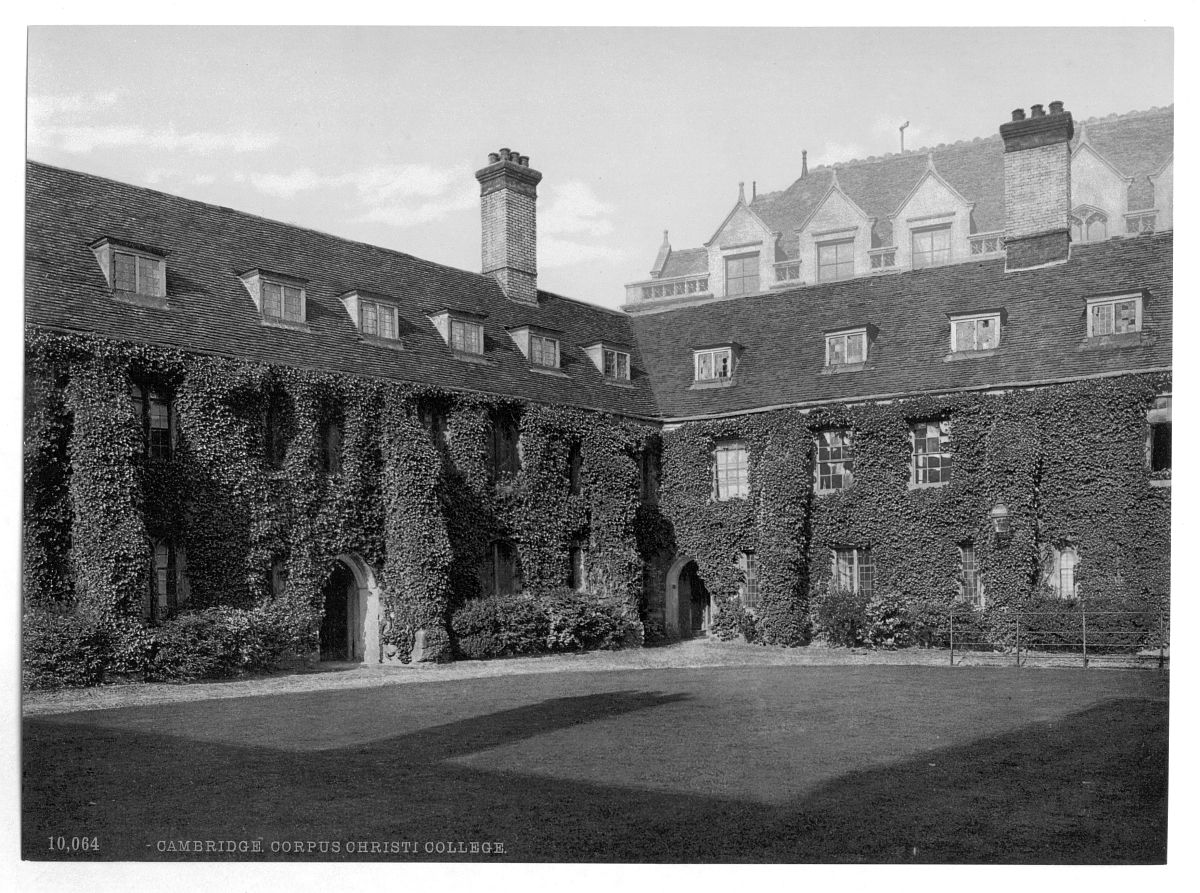
Corpus Christi College, sometime in the late Victorian era


An old and venerable British academic institution would make an ideal backdrop for a M.R. James-style haunting, and, happily for us, a little over a hundred years ago, Cambridge University was obliging enough to provide us with a corker.  On December 5, 1926, the “Sunday Express” published Lieut. Colonel Cyril Foley’s reminiscences of his encounter with a classic Edwardian ghost.  (Note: There are other accounts of this particular ghost story, but Foley’s is generally regarded as the most authoritative.)

Just about twenty-two years ago, in October, 1904, Cambridge University rocked with excitement over some psychic phenomena of exceptional interest.

The Cambridge authorities deemed it advisable at the time to suppress the publication of the facts, for obvious reasons, and no full and accurate account emanating from any of the principals in the drama has ever been published.

Of course I had, like most people at the time, heard vaguely of the occurrence, but few people knew what actually happened, and it is thanks to Mr. Shane Leslie, the author, who was one of the participants in the gruesome event, that I am able to record for the first time an accurate account of what happened.

The scene was laid in Corpus Christi College.  

About the middle of the eighteenth century it is believed that a certain Doctor Bott, a Fellow of the college, committed suicide in his rooms there, just before he was due to preach the University sermon, and these rooms have been haunted ever since.

Originally they formed part of Archbishop Parker's suite and always had a bad record. Their last occupant, a tutor of the college, is said to have crawled out of them on his hands and knees about a generation ago and the rooms were officially closed. They were opened again in the winter term of 1904.

There was at that time a Cambridge Psychical Research Society, and it happened on this particular evening of October, 1904, that three members of that society were gathered in the room of a Kingsman. I shall refer to him in the story as the Kingsman, but I am permitted to say that he was a young man of temperate habits, a very distinguished King's scholar, and about to take up Holy Orders. The other two were Mr. Shane Leslie and Mr. Wade, also an Ordinand.

They had been discussing, among other things, these very rooms when, at about ten minutes to ten an excited undergraduate from Corpus burst in upon them and implored them to go to the assistance of the occupier of the rooms who was, he said, in great distress.

He told them that the poor man was reduced to such a state of nerves that he could do no work. A face had been seen at his window from the Old Court, after the door had been "sported" and the room left empty.

Footsteps were heard in one room while the occupant slept in the other. It was a case requiring definite action. Something more than an appeal to the tutor or a consultation with the college porter. 

The Kingsman leapt to his feet.

"This is an Evil Spirit which must be exorcised," he said, "and I am going to take it by the throat. Will you two stand by me?"

They agreed to do so. He then opened a cupboard disclosing a temporary altar, from the tabernacle of which he drew a phial of holy water, and the four then set off for Corpus.

As they passed through the Great Court of King's the college clock struck ten, and it was only by doing "level time" that they got down the King's Parade and through the Gate of Corpus on the last stroke of the hour.

Their guide directed them to the ill-omened and ivy-clad rooms in a corner of the Old Court, where they were met by the pale occupant, who told them that it was impossible to stay in the rooms under prevailing conditions.

The Kingsman said, "In these cases we can only use exorcism, which Christ bequeathed to His Holy Church."

They entered the room, and the Corpus man, a young Ordinand of singular piety, produced a large Crucifix from the folds of his gown. This the Kingsman took and without preamble raised it above his head, and began to chant the terrible words of the Exorcism Service in which the fiend is personally addressed and defied.

The Corpus man had shut the door, and there was no light in the room except that given by a tiny twinkling fire.

At the termination of the Exorcism the four men remained silent. Nothing occurred, and Leslie was about to speak when the Kingsman suddenly cried, "The Thing is here!"

With nerves on edge they peered into the gloom.

"The Thing is watching me," he said. "Push me slowly forward, hold up my arms, but do not get in front of the Crucifix as you value your lives."

His companions upheld his elbows, as Aaron and Hur once supported the aching Moses.

Leslie, who had hold of one of his arms, felt it suddenly stiffen, and at the same moment the Kingsman cried out, "The Thing is pulling me, hold me tight or I shall lose the Crucifix."

Like some powerful magnet, the Evil Thing was actually drawing him out of the grasp of his companion. It was a veritable "pull devil, pull baker" situation.

It was also a terrifying one. The atmosphere of the room had become surcharged with an intangible yet all-absorbing Evil, which sapped the strength and numbed the senses. It had become a definite tussle, a combination of a tug-of-war and a Rugby scrum.

All the human competitors were bathed in a cold perspiration of fear and effort. The affair became intolerable. Fortunately the Kingsman kept his head.  There was only one thing to be done. "Push me right into the Foul Fiend," he said, and crying out "Limb of Satan, avaunt in the name of the All Holy," the whole party crashed into the ancient panelling of the room. In a state more easily imagined than described, they picked themselves up, gathered round the fire, and poked it into being.

"The Thing is gone," said the Kingsman. None of the other three dared speak.

He then took the flask of holy water from his pocket and began to sprinkle the room. Some drops fell into the fireplace with a demoniacal hiss, and the Kingsman, swinging round, pointed to the open doorway of the bedroom, and said: "The Thing is in there."

Without hesitation or assistance, and minus the crucifix, he sprang through the doorway of the bedroom. It was a courageous but unsuccessful manœuvre, for with the speed of thought he was hurled back through the doorway, and fell in a heap at their feet.

The situation was as follows: The Kingsman was crawling about on the floor, searching for the half empty flask of holy water which he had dropped in his fall. Wade was in a corner of the room holding the crucifix over the cowering Corpus man, while Leslie, on his knees near the fire, devoid of initiative, and having, as he admits, given up all hope, was praying pitifully.

They were a beaten side beaten by an innings and a hundred runs--by ten goals to nothing--devoid of cohesion and volition, prisoners of war, captured by Satan, vanquished and manacled by the powers of evil, and doomed to death.

They could only stare vacantly into the blackness of the bedroom, out of which the evil Thing was slowly advancing. Their tongues clove to the roof of their mouths. They could not cry for help.

And then, framed in the square-cut darkness of the doorway, the Thing appeared.

It bore a human shape, and was menacing, but beyond that, no one could afterwards visualize its exact aspect. But upon one point they were all agreed. It was cut off at the knees!

Crash! Crash! Crash!-something was happening outside their mentality. Crash! again, and the door was burst open and floods of light and excited undergraduates poured into the room. Their listening impatience had mastered their fear of the occult.

The situation was temporarily saved. It is easy to imagine the remarks of the uninstructed rescue party. "Where is the ghost? Does it bite?" etc., etc., but it was significant how quickly their attitude changed from gay to grave, a change not altogether due to the obvious distress of the principal actors, but rather to the inexplicable and uncanny atmosphere of the room itself.

"The Thing has ascended into the room above, and we must follow it," said the plucky Kingsman.

The four principals, leading a mass of supporters, started up a tiny flight of stairs, and entered the room of a medical student who was reading, unconscious of the terrors of the room below.

Now it so happened that he was a pronounced atheist and had been ragged in consequence some little time before. He naturally thought that this invasion was a repetition, and being of a stubborn disposition got off his anti-spiritual views first.

"This is just the room where the Thing is sure to have gone," said the Kingsman, and the undergraduates, crowding the doorway, grinned approval, while the occupant of the room proclaimed the nullity of the spirit world.

The Kingsman advanced with uplifted crucifix towards the corner of the room, and the medical student darted daringly in front of him.

The Kingsman warned him not to do so, but he persisted, and to the horror of every one fell in a heap on the floor, murmuring, " I am cold, I am cold, I am icy cold."

For the first time the unconvinced spectators were awed, for here was proof indeed-the scoffer, turned into a humble and dejected heap of clothes, huddled up in a corner and complaining that he was "icy cold."

The Kingsman, protecting him with the crucifix, soothed him back to sanity. Every spectator was struck dumb with fear and amazement. Nothing further of psychical interest occurred beyond the rather natural collapse of all three, who were conducted back to their rooms. The only wonder was that the Kingsman had borne the strain so long and so courageously.

By this time the undergraduates were thoroughly roused, and pouring down the stairs, rushed into the haunted rooms below, and completely demolished them.

Led by some brawny oarsmen, they broke up all the cupboards and tore down the ancient oak panelling.

There was the devil of a row the next morning. The Corpus authorities forbade any Kingsmen to enter their college an order which, had I been a Kingsman, I should most certainly have obeyed-and did their best to hush up the whole affair, in which latter objective they were joined by the University authorities.

The principals agreed among themselves never to divulge what they had seen and experienced while they remained undergraduates, and the whole affair died a natural death.

The rooms, or what remained of them, were closed. But, all said and done, though it goes much against the grain, as an old Cantab, to do it, I personally give the devil that fight, on points.

Friday, November 14, 2025

Weekend Link Dump


Welcome to this week's Link Dump!

Don't forget to visit the Strange Company HQ gym!


The true story behind the movie "Nuremberg."

A murderous landlord.

A medieval duke's skeleton documents his very violent murder.

Seriously, is there anything on this freaking planet that isn't a freaking front for the freaking CIA?!

The return of Istanbul's cat doors.

We may have gotten Vikings all wrong.


It turns out that Babylonians knew the Pythagorean Theorem.


The cat and dog massacres of WWII.

A mysterious ancient script.

The city of Coventry during the Wars of the Roses.

Jack the Ripper's most enigmatic victim.

Mysterious "voids" in the Giza Pyramids.

The world's oldest paranormal organization.


A 14th century poem may have fooled us about the Black Death.

In this week's 3I/Atlas news...you guessed it, it's still weird.


An ancient man who very nearly took it all with him.

The medieval royal party that came to a very bad end.

Mars exploration's "oopsie" moment.

Rewriting the history of Egypt's New Kingdom.

Exploring the secret language of animals.

William Caxton, printing press pioneer.

That's all for this week!  See you on Monday, when we'll meet an Edwardian ghost.  In the meantime, I'll bet you didn't have "piano-playing octopus" on your WLD bingo card.


Wednesday, November 12, 2025

Newspaper Clipping of the Day

Via Newspapers.com


This brief account of a man who possessed what Charles Fort would call a "wild talent" appeared in the "Grand Rapids Eagle," February 10, 1880:

A.W. Underwood, the colored man, whose breath sets combustibles on fire, was interviewed by a Courier reporter on Tuesday evening at the Dyckman house. He says he is 24 years old. When about 12 years old he held his handkerchief to his mouth and blew upon it and it took fire. He says he is unable to account for it; says that physicians have examined him and they are as much in the dark as himself. He set a piece of paper on fire at the Dyckman house on Tuesday evening last before a large crowd.

A respectable citizen of Paw Paw says that this fellow was out with them at a hunting party last summer and none of the party had any matches, and that Underwood took up both hands full of dry leaves, breathed upon them a while, and set them on fire, from which they built a fire in the woods. He seemed much exhausted last evening after his effort; says he could not endure it more than twice in one day. Parties present last evening, said they had examined his hands, had him rinse his mouth out and drink a glass of water and then saw him set paper or cloth on fire by his breath. Can "materialized spirits" do things so unaccountable?

Underwood became a subject of lively debate in the scientific journals of the day.  Doubters suggested that he hid a bit of phosphorus in his mouth, which he would discreetly spit on a handkerchief, after which the heat from his breath and hands would then ignite the chemical.  However, this theory was never proven.

As a fun side note, Underwood inspired a 1974 song by Brian Eno, "The Paw Paw Negro Blowtorch."  You never know who will pop up on this blog.

Monday, November 10, 2025

Where is Jason Jolkowski?


Often, the eeriest missing-persons cases are the ones where there is the least information about them.  One minute, someone is going about their ordinary life, the next minute…they’re gone.  And no one seems to be able to find out why.

19-year-old Jason Anthony Jolkowski lived in Omaha, Nebraska.  He is described as an intelligent, shy, pleasant young man who had a happy family life.  He had no issues with drugs or alcohol, and no enemies.  He was a part-time student at Iowa Western Community College, where he was enrolled in their radio broadcasting program.  (He had hopes of eventually becoming a DJ.)  He also worked at a local Fazoli’s restaurant, but he was scheduled to soon begin another job at a radio station, which he was said to be very happy about.

On June 13, 2001, the restaurant called Jolkowski into work early.  As his car was in the repair shop, Jolkowski initially thought of walking to work, but then he made arrangements with a co-worker to pick him up at Benson High School, about eight blocks from his home.  (The co-worker did not know where Jolkowski lived, so Jason, who had difficulty giving directions, thought it easiest for them to meet at a local landmark they both knew.)  While leaving his home, at about 10:45 a.m., a neighbor saw Jolkowski helping his younger brother Michael take trash bins into their garage.  It is presumed that he then left for the high school, although there do not appear to be any witnesses who actually saw him leave.  His route took him through an ordinary residential area, full of people going about their normal workday routines.

Some 30 or 45 minutes after Jolkowski would have left his home, his co-worker called both his family and their workplace to find out why he didn’t meet her at the high school.  The school’s security cameras showed that although the co-worker arrived on the campus, Jason never did. During that eight-block walk, Jolkowski simply vanished.

To date, the young man has never been seen again, and neither the police or a slew of amateur internet sleuths have been able to find the slightest clue what happened to him.  He probably had very little cash on him at the time of his disappearance, and none of his personal items were missing, so the idea that he left voluntarily seems extremely unlikely.  His bank account containing $650 remained untouched, and his car was unclaimed from the repair shop.

Unsurprisingly, this baffling case has attracted any number of online theories, usually involving the possibility of a stranger abducting him, or some sort of foul play involving neighbors, friends, or family members, but they all seem to be based on nothing but baseless speculation and rumor.  Every now and then, I come across a disappearance where I find myself muttering about things like alien abduction and invisible portals into another dimension.  The ongoing mystery of Jason Jolkowski is one of them.

Friday, November 7, 2025

Weekend Link Dump


Welcome to this week's Link Dump, although things are a bit hectic around here.  Most of the Strange Company HQ staffers are leaving for a brief holiday.


The once-notorious murder of Dr. Cronin.

Just George Sand being her scandalous self.

A holy miser.

A tale of floating coffins.

When too much motherhood lands you in court.  This is a very sad and bizarre case.

Neanderthals are rewriting history again.

We still remember the sinking of the "Edmund Fitzgerald."

Exploding pants.  I say no more.

A 4,000 year old labyrinth in Crete.

A mysterious underground chamber in Scotland.

The story behind a mystery tsunami in Japan.

The Roman Empire had quite a road network.

The latest archaeological discoveries in the City of David.

The difficulties of commemorating the "Glorious Revolution."

The demon dogs of New York City.

The demon cat of Washington, D.C.

The world's largest spiderweb.  Plus more spiders than I ever want to think about.

Advanced surgery in ancient Greece.

A Lieutenant General's memorial monuments.

The Italian "City of Witches."

And before you ask, yes, 3I/Atlas is still weird.

It's possible that Neanderthals were artistic.

The New York Zoo Hoax.

New York's "Lost Children's Room."

The life of Matilda of Scotland, Queen of England.

Why we no longer have "second sleep."

The "trick or treat murder."

Some particularly disturbing disappearances.

That's all for this week!  See you on Monday, when we'll look at a teenager's unusually baffling disappearance.  In the meantime, here's a fun (if badly filmed) little clip:

Wednesday, November 5, 2025

Newspaper Clipping of the Day

Via Newspapers.com


Here’s a topic I don’t think has been covered much on this blog:  Mystery Mist!  The “Louisville Courier Journal,” October 22, 1907:


Glasgow, Ky., Oct. 21--Several hundred parties arriving here today from Glasgow Junction, ten miles from here, report a strange phenomenon at that place which is mystifying the people of that unusually quiet little town and is simply inexplainable.


On the exact spot where Van Smith killed his half-brother, Bill Bartley, last May, a fine mist, amounting to almost rain, has been falling for the past four weeks; at least it has been noticed that long, but may have been falling longer.  The fact has startled the residents of that section and surrounding country, and as the report spreads interest increases.  The place on which the mist is falling is some twenty feet across and includes the exact spot on which Bartley fell when shot by his half-brother.


Among those who were at the place yesterday were J.A. Conyers, Senator J.C. Gillenwaters and Oscar Seay, who while waiting for a train heard of the strange mist and went to view the spot.  Mr. Conyers, who is well known as a recent appointee in United States Marshal George Long’s office at Louisville, and a prominent politician, was seen and when asked about the matter said that he visited the place and found something like a hundred persons gathered there, discussing the puzzling phenomenon.  He walked slowly across the place where the mist was falling and said in that time his hat was wet and the rain showed perceptibly on his clothes.  When asked how the people explained the presence of the mist, he replied that they did not explain it at all, as they knew of no explanation.  Senator Gillenwaters and Oscar Seay, a well-known Louisville travelling man, tell substantially the same story.


I wasn’t able to learn anything more about the phenomenon.

Monday, November 3, 2025

The Murderer's Angry Skull

Because it’s always fun to see people who play silly buggers with other people’s body parts get a terrifying supernatural comeuppance, let’s look at the time someone stole the skull of a notorious murderer, and almost instantly regretted it.  Consider it a cautionary tale about the dangers of causing someone to rest in pieces.


The murder of Maria Marten is one of those sordid, non-mysterious crimes that nevertheless somehow gain immortal fame.  In 1827, a young man named William Corder, wishing to rid himself of Marten, who had been his lover, killed her and hid the body in a local landmark called the “Red Barn.”  After the corpse was discovered the following year, Corder became the immediate suspect.  He was arrested in London and eventually faced trial, conviction, and the gallows.  As far as is known, Corder’s spirit rested quietly for about fifty years, until someone took a regrettable interest in his skull.


The ghostly sequel to the “Red Barn Murder” was told by British author and ghost-hunter Robert Thurston Hopkins. Hopkins, you might say, literally grew up in the shadow of the infamous murder: He spent his boyhood within the old prison at Bury St. Edmunds, where his father F.C. Hopkins, a prison official, proudly kept a framed copy of Corder’s final confession.


A close friend of Hopkins’ father was one Dr. Kilner, who had a deeper, and far more morbid, interest in the Corder case.  He owned a book about the murder that was bound in Corder’s skin, as well as the murderer’s pickled scalp.  One would think that Kilner owned enough bits and pieces of the late Mr. Corder to satisfy even the most ghoulish tastes, but such was not the case: Corder’s skeleton then resided at the West Suffolk General Hospital, where for years it had been used as a sort of celebrity anatomy display, and Kilner longed to get his hands on the skull.  As he knew that the hospital would not part with its prize, the good doctor decided that his only option was to pinch the thing.


When Kilner sneaked into the hospital one night to do his bit of body-snatching, he lit three candles.  One immediately went out.  When he relit it, the other two went dark.  As he was removing Corder’s skull from the rest of the skeleton, the candles continued mysteriously snuffing themselves out.  One would think Kilner would realize he was being warned, but he blithely replaced Corder’s skull with a ringer he had picked up somewhere, and took his stolen treasure home.


Kilner lovingly polished the skull until it glowed like a gemstone, and placed it in an ebony box which he kept in a cabinet in his drawing room.  However, he was not entirely happy.  He felt a vague unease about his acquisition, which he tried to dismiss as merely his overactive imagination.


A few days after the skull became part of the Kilner household’s bric-a-brac, a servant told the doctor that a man had come to see him.  As it was after his surgery hours, Kilner was a bit irked by the disturbance.  When he asked if the caller was someone the servant recognized, she replied that he was a stranger.  “He is proper old-fashioned looking,” she remarked, “with a furry top hat and a blue overcoat with silver buttons.”


The doctor went to his surgery, asking the servant to follow him with a lamp.  As he entered the room, he caught a glimpse of a figure standing by the window, but when the servant came in with the lamp, the room was empty.


Kilner’s servant swore that she had escorted a man into the surgery.  She surmised that he changed his mind about seeing the doctor, and left.


Not long after this incident, Kilner happened to be looking out a window of his house when he saw a man standing on the lawn.  He was wearing a beaver hat and an old-fashioned blue overcoat.  Kilner went out to confront the man, but by then the figure had disappeared.


Kilner began to have the disconcerting feeling that he was constantly being followed by…something.  At night, he would hear doors mysteriously opening, and the sound of phantom footsteps throughout his house.  Outside his bedroom door, he heard loud breathing, spectral murmurings, and sobbing, accompanied by loud bangs coming from the drawing room.  He started to have dreams where he got the sense that he was being begged to do something.


In short, Kilner knew that he had made someone very unhappy.  And he had a good idea who it was.  William Corder, understandably enough, took great offense at being turned into home décor.


Kilner was now as anxious to return the skull as he had been to steal it.  However, the skull was so highly polished that the difference between it and the rest of the skeleton would be obvious, leading to some very uncomfortable questions.  He had no idea what to do.


One night, Kilner was awakened by a sound from downstairs.  When he lit a candle and looked down over the stairs, he saw a disembodied hand over the handle of the drawing room door.  This hand turned the knob and opened the door.  Then, from the drawing room, there came a sharp noise that sounded like a shotgun blast.  When Kilner ran downstairs to investigate, he was met by a huge gust of wind which blew out the candle, and nearly knocked him off his feet.  When he managed to relight the candle and enter the drawing room, he found that the box containing the skull had been shattered into bits.  Kilner was greeted by Corder’s skull resting in the open cabinet, grinning at him.


That was enough for Dr. Kilner.  Rather selfishly, he gifted the skull to F. C. Hopkins, who was idiot enough to accept it.  As Hopkins walked home with the skull (discreetly wrapped in a handkerchief,) he twisted his ankle and fell flat on the pavement just as a female acquaintance was passing by.  He dropped the skull, which cheerfully rolled at his friend’s feet.  The woman screamed and dashed off.


Hopkins’ life subsequently became very difficult.  His injured ankle kept him bedridden for a week.  His best horse fell into a pit and broke her back.  Both Hopkins and Kilner suffered a series of personal and financial disasters that left both men shattered in spirit. Hopkins finally wised up and did what Kilner should have done a long time before:  He took the skull to a churchyard near Bury St. Edmunds, where he bribed a grave-digger to give it a decent burial. Fortunately, Corder’s spirit seemed content with this compromise, and peace returned to the lives of everyone involved.


At the end of the younger Hopkins’ account of this episode in his 1953 book “Ghosts Over England,” he noted, “if ever you come across a tortoise-shell tinted skull in a japanned cash box, leave it severely alone.”


Excellent advice.  William Corder was clearly a ghost one does not want to cross.