"...we should pass over all biographies of 'the good and the great,' while we search carefully the slight records of wretches who died in prison, in Bedlam, or upon the gallows."
~Edgar Allan Poe
Showing posts with label impostors. Show all posts

Monday, May 16, 2022

The Transformations of Ida Mayfield Wood

Ida Wood, sometime in the 1860s


During the long history of New York City, untold millions have come to the metropolis in an effort to "better themselves" and fulfill their various dreams.  Most of these hopes are doomed to failure.  Ida Mayfield Wood was one of the few success stories--and she accomplished her goals in a way few have done before or since.

Ida first came to New York in 1857.  The nineteen-year-old was a slight, pretty girl with a charm that was both dainty and sensual.  She told her new acquaintances that she was the daughter of a Louisiana sugar planter named Henry Mayfield.  Her mother, she said with a genteel pride, had been a descendant of the Earls of Crawford.

Ida wanted the wealth and social prestige suitable for such a pedigree, so her first order of business was to find an eligible man who could give them to her.  One name that caught her eye was that of 37-year-old Benjamin Wood.  The businessman was very wealthy, well-connected, (his brother, Fernando, was one of the city's mayors,) and reasonably attractive.  He was also married to his second wife, but Ida was not one to trouble about minor details.

She sent Wood a letter that, to say the least, did not beat around the bush.  "Having heard of you often," she began, "I venture to address you from hearing a young lady, one of your 'former loves' speak of you.  She says you are fond of 'new faces.'  I fancy that as I am new in the city and in 'affairs de coeur' that I might contract an agreeable intimacy with you; of as long duration as you saw fit to have it.  I believe that I am not extremely bad looking, nor disagreeable.  Perhaps not quite as handsome as the lady with you at present, but I know a little more, and there is an old saying--'Knowledge is power.'"

Wood arranged an interview with this demure young lady.  He liked what he saw, and almost immediately accepted the invitation openly offered in her letter.  Ida became his mistress, bearing him a daughter they named Emma.  After Wood's wife died in 1867, the long-time lovers were married. 

Benjamin Wood


Wood was rich and powerful enough for his new wife's dubious history to be tactfully ignored.  She became a leading figure in New York society, extolled by the newspapers as "a belle" admired for her "bright plumage and fragile beauty."  Her social circle ran as high as the visiting Prince of Wales and president-elect Abraham Lincoln.  In 1860, Benjamin was elected to the U.S. Congress, where he served until 1861.  (He won another term in 1881-83.)  In the same year he first entered Congress, Wood became editor and publisher of the “New York Daily News.”

Benjamin, unsurprisingly, was no more faithful to his new wife than he had been to the old one.  Ida was not particularly troubled by that.  However, Wood was also addicted to gambling for very high stakes.  This struck horror into the heart of his financially shrewd and prudent wife.  Characteristically, she dreamed up a novel way of turning her husband's deficit into her advantage.  She presented Benjamin with a deal:  He could gamble to his heart's content with her blessing, so long as he gave her half of everything he won, while paying for his losses himself.  In short, "heads she wins, tails he loses." His play was so important to him that he agreed to this one-sided bargain.  The practically inevitable result was that by the time Mr. Wood died in 1900, virtually every dime he had possessed belonged to his wife.  She had also purchased a controlling interest in the "Daily News," making her one of the first female publishers of a large newspaper.

After her husband’s death, Ida sold the "Daily News" for over a quarter of a million dollars.  She had valuable railroad stock.  She was set for a very comfortable and socially prominent widowhood.

Instead, Ida began to do some very strange things.  She sold all the many beautiful and costly belongings she had accumulated during her years with Wood.  In 1907, she went to her bank and demanded that the balance of her account--some $1 million--immediately be given to her.  In cash.  The bank officers had no choice but to comply and watch in stunned amazement as she stuffed the money into a bag and walked out.

She then checked into the Herald Square Hotel...and never checked out.  We  cannot know what inner demons inspired this woman who had so loved worldly matters to give up on life and turn herself into a recluse.  All she would say was that she was "tired of everything."  Joining her in this voluntary confinement were her sister Mary and her daughter Emma.  The trio never left their two-room suite and they never let anyone in.  Only twice during their long stay did they permit a maid to give them clean sheets and towels.  They never bathed.  The closest the women ever came to contacting the outside world was once a day, when through a closed door, they would ask the bellhop to bring them the same menu, which they paid for in cash:  Canned milk, crackers, coffee, bacon, and eggs.  Every so often, they also requested snuff, cigars, and petroleum jelly.  Ida would spend hours rubbing the last item on her face.  This one remaining vanity rewarded her with flawless pink-and-white skin--an ivory doll's head incongruously balanced on a bent, aged body.   Ida would explain that the three of them were destitute, and no one seeing the way they lived had any reason to doubt her word.

The three stayed together until 1928, when Emma Wood died at the age of 71.  Life--if you care to call it that--for the Mayfield sisters carried on as before until March 5, 1931, when the now 93-year-old Ida did something unprecedented during her stay at the hotel.  She opened the door, peered out into the hall, and screamed for a maid, explaining that her sister was very sick and needed a doctor.  As it turned out, Mary was beyond all help.  She was dead.

The doctor--and, soon, the undertaker--found that over the decades, the women had turned the suite into a rabbit warren filled with haphazard garbage:  Newspapers, food containers, trunks, old clothing, all the detritus of their hermit existence.

No one quite knew what to do with the remaining sister.  It seemed unconscionable cruelty to just leave Ida alone in this sad trash heap.  Morgan O'Brien, Jr., a member of a leading New York law firm, was summoned.  Intrigued by the mystery of the society belle turned recluse, he agreed to do what he could to sort out her murky affairs.

It was then that it emerged that Ida had vanished from life carrying with her a very great deal of money.  O'Brien also learned that she had some $175,000 of railroad stock, and had not cashed any dividends for years.  Ida herself was little help.  She insisted on staying holed up in her suite, where she smoked cigars, endlessly slathered petroleum jelly on her face, and refused to answer any questions, saying she was too deaf to understand anything the lawyers said.

Word quickly spread that the hotel was housing a very old and very rich woman, and, inevitably, a parade of long-lost relatives turned up holding out their palms.  First on the scene was Otis Wood, a son of Benjamin Wood's brother Fernando.  Accompanying him were his three brothers and their children.  Then came Benjamin's son from his first marriage, along with his children.  Soon, a crowd of Mayfields descended on the scene, loudly proclaiming their close blood ties to this elderly relative.  Some Crawfords joined the crowd, too, anxious to prove that they were kin to Ida through their common ancestry from the Earls of Crawford.  Before long, over a thousand people bearing the name "Wood,” “Crawford,” or "Mayfield" turned up to claim family ties with Ida--and her fortune.  Although they all claimed to be coming forward out of altruistic desires to help their dear, long-lost relative, their keen interest in her financial status was clearly their priority.  Their idea of "helping" Ida was to have her declared incompetent.  In September of 1931, they got their wish.

Ida was distraught to learn of her loss of independence.  "Why?" she wailed.  "I can take care of myself."  Much against her will, she was removed from her suite and brought to another room in the hotel.  

When her old hotel room was searched, over $700,000 in cash was found hidden here and there.  An old box of crackers was found to contain a diamond necklace. The suite proved to be a veritable time capsule.  Ida was storing 54 trunks filled with lovely 19th century gowns, exquisite jewelry, and valuable historical documents, such as a letter Charles Dickens had written to Benjamin Wood in 1867.  Ida's self-imposed squalor had been hiding a veritable Aladdin's Cave.  Ida's new-found family eagerly awaited the day when she would finally die so they could divide the spoils.

Ida herself, however, was disinclined to oblige them.  Despite her frail body, her mind remained as sharp and obstreperous as ever.  She was not the woman to go out meekly.  When food was brought to her, she would ask its cost.  If it was over a dollar, she would imperiously order that it be taken away.  On the rare occasions when her nurses and guardians would leave her alone for a moment, Ida would rush to a window and scream, "Help!  I'm a prisoner.  Get me out of here!"  In her mellower moments, she would fondly reminisce about the past, telling the nurses and reporters colorful, magical-sounding stories about her pampered New Orleans girlhood, and the fine education she had received thanks to her cultured, multi-lingual mother.

Before long, though, Ida became tired of fighting her imprisonment.  Her iron will gone, she simply gradually let go of life until she died  of pneumonia on March 12, 1932.  That left the question of who would inherit her wealth.  Although she had left a will, it left everything to her sister and daughter, who had, of course, both predeceased her.  Joseph Cox, counsel to New York's Public Administrator, was given the job of investigating Ida's lineage to see who had the best claim to be her heir.

It took Cox several years of hard work before the full truth about this strange woman emerged.  He  learned that Ida was not the Louisiana daughter of sugar planter Henry Mayfield.  Her real father was Thomas Walsh, a penniless Irishman who had emigrated to Massachusetts some time in the 1840s.  Her mother was a semi-literate woman from the Dublin slums.  "Ida" was not even her real name.  She had been born Ellen Walsh, but changed her name as a teenager, simply because she thought it sounded more elegant.  Her sister Mary, caught up in these alluring fantasies, became a "Mayfield" as well.  Oh, and Emma, "Ida's" daughter with Benjamin Wood?  She turned out not to be Ida's daughter at all, but another sister. (Benjamin Wood was apparently a willing partner in this little deception.)  The Mayfields and Woods and Crawfords were thus left out in the cold financially.  The pseudo-relatives did not take this news well.  They filed suit to get their "fair share" of Ida's estate.  The court made the reasonable ruling that, as "Ida Mayfield" was a pseudonym, the would-be heirs could go whistle for their money.  “Ida’s” estate went instead to ten living relatives of Ellen Walsh, who were stunned to learn they had a very odd--and very rich--kinswoman.  They each received about $90,000 (about $1.5 million in 2022 dollars.)  For them, at least, this sad story had a very happy ending.

Towards the end of her life, Ida/Ellen liked to tell her nurses a story from her girlhood.  One day, she went to a "gypsy seer" to have her fortune told.  After reading her palm, the fortune teller told the girl that she was going to be very lucky:  "You are going to marry a rich man, and get everything you want out of this life."

And so she did.  Although one can't help but think that in the end, it turned out to be a Faustian bargain.

Monday, February 24, 2020

Ramendra Narayan Roy: India's Tichborne

Ramendra Narayan Roy, in the days when no one questioned that he was alive.


One of the most famous court cases of the 19th century revolved around Arthur Orton’s years-long campaign to prove that he was, in fact, Sir Roger Tichborne, a wealthy young man who had disappeared in a presumed shipwreck many years before. As strange (and protracted) as the whole Tichborne matter was, it was eclipsed in both length and weirdness by a lesser-known case which played out in India not many years later.

In the early 20th century, some areas of India were ruled directly by the British, others by Indian princes (kumars) operating under British control. One of the bigger and wealthier examples of the latter was the Bhawal Estate, in what is now Bangladesh. It was ruled jointly by three princes. The middle prince, Ramendra Narayan Roy, was a bit of a lad, with the unfortunate result that he was diagnosed with syphilis in 1906. While undergoing treatment in Darjeeling, he suddenly fell seriously ill and died on May 8, 1909, at the age of 25. He was cremated the following day.

The end of his story? Hardly. Ramendra hadn’t even begun causing trouble.

In 1910, the oldest of the Bhawal princes died, and shortly afterward, the remaining prince was ruled to be unfit to manage the estate on his own. (He died in 1913.) The estate was put under the control of the Court of Wards, a legal body created by the East India Company to protect estates when the heir, for whatever reason, was incapable of acting independently.

Not long after this, odd rumors began to circulate in Bhawal. It was said that Ramendra Narayan Roy was not, as everyone assumed, a heap of ashes, but alive and well and acting as a holy man in the city of Dhaka. Ramendra’s nephew went to Dhaka to see this mysterious figure for himself. He decided that the holy man did indeed resemble his presumably late uncle, but he could not positively say it was him. The pseudo-Ramendra was brought to Bhawal to meet other relatives. After speaking with him, some were convinced that it was the prince. They were particularly impressed that he remembered the name of “his” wet-nurse, something which was not public knowledge. Others, most notably Ramendra’s widow Bibhabati Devi, were equally convinced the man was an impostor.

At this point, British officials interjected themselves into the controversy. After interviewing all interested parties, they ruled that Ramendra Narayan Roy, like Generalissimo Francisco Franco, was still dead.

The end of his story? Ha!

There were still a great many supporters for the Claimant, and they and his detractors essentially went to war. The issue of his identity became so heated that at one of the pro-Claimant demonstrations, at least one man was fatally shot. In 1930, the Man Who Would Be Ramendra went to court to establish that he was the second Bhawal prince, although the trial did not actually begin until 1933.

The first question to be addressed was the one that probably first occurred to you: How in the hell did this guy survive cremation? The Claimant’s story, in brief, is this: his wife and brother-in-law had plotted to kill him. The diagnosis of syphilis had been merely a hoax, designed as an excuse to bring him to Darjeeling. There, he was poisoned and pronounced dead. His brother-in-law arranged for him to be taken to a funeral ground to be cremated. However, a sudden hailstorm which broke out before the pyre could be lit forced everyone to flee for safety, leaving him on the funeral grounds. There, some holy men happened to come across his inert form and carried him away to safety. They nursed him back to health, but the traumatic experience caused memory loss, which for several years made him forget who he was.

Top: Photo of the prince.  Bottom: The Claimant


The case almost totally revolved around “expert witnesses” for both sides. This worked about as well as you might think. The Claimant’s handwriting witnesses swore that the plaintiff’s writing was identical to that of the prince. The handwriting witnesses for the defense swore that there was no resemblance at all. A photographic expert for the Claimant swore that photos of the plaintiff and the prince were definitely of the same person. Photographic experts for the defense told him to pound sand. Doctors who had tended Ramendra in his “final illness” were brought in. The ones who testified for the Claimant said he was really not all that sick, and could easily have survived. The ones who appeared for the plaintiff said recovery had been impossible. And so on. And so on. For more than a year, literally a thousand witnesses offered equally contradictory testimony. Then, the defense presented their case. For yet another year, they brought forth four hundred witnesses, including Ramendra’s widow, who all denounced the Claimant as a shamelessly brazen fraud. The widow of the eldest prince also believed the plaintiff was a fake. On the other hand, the widow of the third prince was of the opinion that yes, the Claimant was actually the real deal.  For every bit of evidence which proved the Claimant was the prince, another was brought forward which proved he wasn't.

In short, the trial was a confusing mess on a truly epic scale.

The legal marathon finally adjourned on May 20, 1936. The long-suffering judge took three months to study the voluminous evidence and write his report. He judged in favor of the plaintiff, and ordered that he be given his rightful one-third share of the Bhawal Estate.

The end of his story? Oh, surely you jest.

Despite this verdict, the British remained convinced the Claimant was a hoaxer, and filed an appeal, which was heard before the High Court in Calcutta in late 1938. While the case was being heard, one of the three appellate judges made what was meant to be a brief trip to England. Then--as if things weren’t complicated enough already--World War Two broke out, leaving the judge unable to return. After a year or so of hoping the world would calm down enough for him to get back to India, the stranded judge finally sent over his written judgement. It turned out that there was a split decision: one of the judges supported the appellants, while the other two (including the one stuck in England) ruled against them. For a second time, the legal system had decided that the Claimant was indeed Ramendra Narayan Roy.

The end of his story? I think that by now, you know the answer to that.

Ramendra’s widow (or, in the view of the High Court, his wife) was determined to fight on. She brought her appeal to London’s Privy Council. The ruling on her case had to be delayed until the end of the war. Finally, July 30, 1946 saw the end of this other long, messy conflict. The Privy Council dismissed her appeal, leaving the Claimant again triumphant.

For a while, at least. Before the Privy Council delivered its verdict, an astrologer told Bibhabati that she would lose her case, but that the Claimant would gain no benefit from his win. As it happened, he was quite correct. Just hours after he learned of his victory, the Claimant suffered a massive stroke which killed him two days later.

Whether or not this man was truly Ramendra Narayan Roy--something which is still debated by historians--his story was, at long last, indisputably over.

Monday, January 20, 2020

The False Dmitris; or, When the Russians Call a Period in Their History the "Time of Troubles," You Know Things Were Really Bad

Ivan the Terrible may have been, well, terrible, but it was after he died in 1584 that the pure hell really began to break loose. Ivan left numerous children by various wives and mistresses, an uncertain succession, and a royal court containing more than the average number of psychopaths. It was easy to predict this would not end well.

Ivan was initially succeeded by his oldest son, the sickly, and probably half-witted, Feodor I. However, Russia’s de facto ruler, until Feodor’s death in 1598, was his brother-in-law Boris Godunov. Among Godunov’s potential rivals was Ivan’s youngest son, Dmitri, who was only a toddler when his father died. Godunov had the boy banished to the remote city of Uglich, where he lived in obscurity for the next seven years.

In 1591, it was announced that a terrible accident had occurred to Ivan’s son. While Dmitri was playing darts with a set of long knives, he fell into an epileptic fit and—darn the luck!—just happened to land on top of one of his toys, thus accidentally stabbing himself to death with his own knife.

From that day to this, everyone has responded to this story by saying, in so many words, “Pull the other one, it’s got bells on it.” However, the crux of the tale—that little Dmitri was now no more—went unquestioned.

Well, except by some people.

About two years after Godunov had established himself as Feodor’s successor, an educated, aristocratic young man suddenly appeared to challenge Godonov’s claim to the throne. He was, he declared, really Ivan’s son Dmitri. He had survived Godonov’s attempts to assassinate him, and had been lying low in Poland ever since.

False Dmitri I, via Wikipedia


This man may now be known to history as “False Dmitri I,” but at the time, he found many people willing to believe him—whether this was because he was an unusually convincing pretender, or simply because the new Tsar Boris was such an unattractive specimen, is hard to tell. “Dmitri” gained the support of a sizable number of the boyars (the Russian aristocracy,) and went to war with the current Tsar. Boris claimed his rival was merely a runaway monk named Grigory Otrepyev, but we have no evidence other than his obviously biased word to support this.

Boris died in 1605, leaving the throne to his son, Feodor II, and the Time of Troubles was well and truly under way. “Dmitri” and his allies managed to assassinate Feodor, and this Slavic Perkin Warbeck actually found himself Tsar.

For a while, at least. Less than a year later he himself was murdered by political enemies. Be careful what you wish for, etc. One of the boyars who led the coup against him, Prince Basil Shuisky, took the throne as Tsar Basil IV.

Russia, however, had yet to hear the last of Dmitri Ivanovich. In 1607, another man (whose real identity remains unknown,) sprang out of nowhere, asserting that he was the true Dmitri. He proved just as popular as the last one—evidently many Russians were willing to follow pretty much anyone claiming to be Ivan’s son—quickly amassing an army of some hundred thousand men. He even married the former Tsarina Marina, widow of False Dmitri I.

False Dmitri II, via Wikipedia


He may well have been as successful as the previous Dmitri if he had not gotten drunk one night in 1610 and set himself up for one of his enemies—a Tatar Prince he had flogged—to murder him.

No matter how often Dmitri was killed off, he always sprang up anew, like dandelions, or Freddy Kruger, or a character in a particularly bloody soap opera (which actually isn’t a bad description of most of Russian history.) Meet “False Dmitri III.”

This last Dmitri—whoever he may have been--was unquestionably the poorest specimen of the lot. Although he did get support among the Cossacks—who pronounced him Tsar in 1612—he was quickly captured, brought to Moscow, and executed.

After this last death, Russia’s supply of False Dmitris was at last exhausted. It took a long time for his countrymen to let go of the memory of the legendary Ivan’s son, however. To this day, in a few history books, there can be seen one or two wistful hints that, well, who knows, one of those Dmitris may have been the real deal.

And who can say for certain they are wrong?

Wednesday, December 25, 2019

Newspaper Clipping of the Day, Christmas Edition

mary edens christmas disappearance -
Via Newspapers.com


Usually, my annual Christmas clipping post contains an array of varying horrors. However, this year features one story: a holiday tragedy that at one point, looked as if it had a happy ending...only to revert back to tragedy. And enduring mystery.  The “Boston Globe,” December 25, 1999:
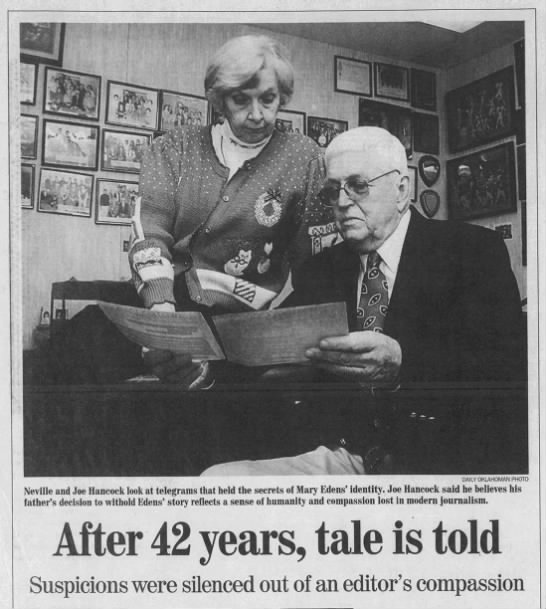
GLOBE CORRESPONDENT HOBART, Okla. - For nearly a half-century, the owners of this town's newspaper have known the truth about Lewis Edens' missing daughter and never reported it. Joe Hancock honored his father's request to keep the story out of the paper, to keep it a secret. Now, however, on the 75th anniversary of the Babbs Switch schoolhouse fire that killed 26 people, Hancock says the full story should be told.

The Dec. 24 fire at the one-room schoolhouse at Babbs Switch, a small community about 5 miles south of the county seat of Hobart, is one of the state's worst tragedies. The story is known throughout Oklahoma for several reasons: So many people died; it occurred on Christmas Eve; and little Mary Edens was never found.

For years, people speculated on Mary's fate. Then one day in 1957, a woman who said she was Mary arrived in Hobart. And that led to the tale Joe Hancock refused to tell until this week.

The story began on Christmas Eve 1924, when more than 100 parents and students crowded into the 26-foot-by-36-foot school-house. The dirt highway was slick with a light frosting of snow. Those who drove their Model Ts drained the water from their radiators to keep them from freezing.

The program began at 8 p.m. By 8:30, Dow Bolding, 16, was handing out presents. He gave a doll to 4-year-old Lillie Biggers Braun; the doll nearly was as big as she was. He gave mechanical tarantulas to Edward and Gene Bolding, his kid brothers who shared a double desk in the front row. As Dow reached for a sack of candy tied to a limb of the Christmas tree, he caused a candle on the tree to ignite the dry, brittle cedar.

Gene Bolding, 81, is one of three survivors of the fire still living. He said he remembers that as his older brother and others tried to put out the fire, they knocked over the tree, which in turn knocked over a kerosene lamp, which exploded. At that point, Bolding said, a farmer escorted him and Edward outside. But Edward had left his new spider on the desk and dashed back in for it. He never came out.

Braun was with her mother, who dropped her during the rush for the door. "Mama started out with me," she said. "I got knocked down from her, and couldn't get up. I was crawling out, going one way, toward the door. I remember the screaming above me. It was the teacher, and she was going the other way."

The teacher, Florence Terry Hill, died that night. Braun became famous as the little girl who dragged her doll to safety. But two of her brothers died in the fire. Gene Bolding lost his brothers Dow and Edward and his sister Maggie. But it was the story of Mary Edens that most intrigued those who know about the fire.

Mary, who was 3, was with her aunt, Alice Noah. Noah escaped, but died several days later from smoke inhalation. Before she died, however, she told Mary's parents that she had carried Mary to safety and handed her to someone. In the years that followed, Lewis and Ethel Edens nurtured the hope that Mary was alive.

In January 1957, a man in California began writing to a fellow Lion's Club member in Hobart. Elmont Place had seen a story about Mary, and thought a friend of his might be the missing child. After many letters, telephone calls, and a blood test, most were convinced that Grace Reynolds of Barstow, Calif, was the Edens' long-lost daughter.

Reynolds and her newly adopted infant son arrived in Hobart on Feb. 9, 1957, to a great welcome. News of the reunion made papers from California to North Dakota to Michigan. Reynolds and the Edens appeared on Art Linkletter's "House Party" television program.

Back in California, however, someone who claimed to be a sister of Reynolds telephoned a reporter at the Stockton (Calif.) Record. Dorothy Link had seen an Associated Press photo of Reynolds with her newfound parents and told the reporter she was an impostor.

The reporter sent a telegram to the Hobart Democrat-Chief, which began its own investigation. By May, the Stockton reporter had a notarized statement from Goldie More saying that she was Reynolds's birth mother. (Reynolds was Grace's married name, and she was separated from her husband when she went to Hobart.) When the reporter confronted Reynolds and asked whether she persisted in her claim, she said she was not claiming anything yet and that she was going to hire an attorney. At that point, Ransom Hancock, owner of the Democrat-Chief, took his evidence to Lewis Edens. Joe Hancock, 70, who now owns who now owns the newspaper, remembers the day well. "Dad took all this information, met with Lewis at his house, maybe in the yard," Hancock said. "Dad was really shook up having to tell him, and Lewis went through the trauma of finding out" Then Edens asked his friend for a consideration, a favor that has kept the full story about Reynolds out of the newspaper until this week.

Lewis Edens said to Ransom Hancock: “Look, my wife believes this girl, she believes she's found her daughter.” He asked that the story be withheld until his wife's death. Hancock, the editor, agreed. "Dad said, 'I just can't run that' And he didn't" Joe Hancock said.

The story remained a secret until yesterday. The Democrat-Chief published it simultaneously with the Daily Oklahoman. Hancock shared the long-secret letters and telegrams with a reporter for that paper. "We decided that now is the time to tell it" Hancock said. "Some of the people here through the years have questioned Grace's story and are suspicious of it. It's time to get that missing-baby deal put to rest; it's over. Now everybody will know for sure."

Hancock said he believes his father's decision reflects a sense of humanity and compassion that has been lost in modern journalism. "I know good and well he was right, and I don't know if I would have had the wisdom to do that" Hancock said.

"I hope we don't get away from having some feeling for the survivors," he said. "Mr. Edens knew she was a hoax. Mrs. Edens believed the story and accepted her for her daughter. I'm sure that gave her a peace that she never would have gotten."

Reynolds lived with members of the Edens family for a couple of years, then moved to Idaho and later West Yellowstone Park, where she ran a series of restaurants. Lewis Edens died in 1978 at 81, and Ethel Edens died in 1984 at 88, never learning of the secret.

Reynolds eventually remarried and today is named Mary Edens Grossnickle. Now 78 and living in northeastern Colorado, she still says she is Mary Edens and isn't bothered by the doubters. "I really don't care what they think," she said. "It just bounces off of me.” Of the notarized statement by More, Grossnickle wasn't surprised she signed it. "She was scared," Grossnickle said. "If she wasn't my birth mother, then she was a kidnapper."

Etta Henderson, who lives in Oklahoma City, is one of the Edens' daughters. Like everyone else, she believed they had found their sister in 1957. But she learned about the suppressed newspaper story sometime in the 1970s. Grossnickle's son, Lee, still contacts Henderson occasionally, and still calls her aunt.

That's fine with her; she likes Lee. She has no illusions, however, about Grossnickle. "My daddy figured it out real quick, but we did not want to hurt our mother," said Henderson, 76. "I am not saying she is an impostor. I wouldn't. But I am saying she is not my sister."
Mary Grossnickle died in 2008, insisting to the last that she was Mary Edens.  A DNA test would have resolved the dispute over her identity, but as far as I know that was never done. I suppose it suited everyone involved to let sleeping genes lie.

Monday, March 25, 2019

Portrait of a Bluebeard

"The Age," December 30, 1960, via Newspapers.com


At the resort town of Scarborough, England, sometime in the mid-1860s, a remarkably handsome and extremely charming Frenchman, Count Henri de Tourville, made the acquaintance of a well-to-do Englishwoman, Henrietta Brigham. A romance quickly developed, and the two were married. After a honeymoon touring Europe, the pair went to live with Henrietta's widowed mother at the family home of Foxley Hall, in Cheshire. They eventually had a son, William Henri.

Unfortunately, the couple did not live entirely happily ever after. The Count proved to be one of those aristocrats who were big on keeping up a glamorous lifestyle without the glamorous income to back it up. He habitually "borrowed" large sums of money from his mother-in-law. She had even paid for the honeymoon. Before long, Mrs. Brigham became weary of dispensing cash, and came to the very reasonable conclusion that the Count was merely a golddigger. She not only announced that he would get no more money out of her, but that she was going to insist he repay the substantial sums he owed.

This uncomfortable family situation found a tragic resolution one morning in July 1868. Tourville later told police that as he was cleaning a gun in the breakfast room of Foxley Hall, Mrs. Brigham asked to see the revolver. While she was examining it, the gun somehow accidentally went off, killing the poor woman instantly.

She had been shot in the back of the head.

Unsurprisingly, many people entertained some very ugly suspicions about this "accident," but the coroner's jury returned a verdict of "death by misadventure." Scotland Yard was brought in to examine the case, but DCI George Clarke, unable to find any solid evidence suggesting foul play, allowed the inquest verdict to stand.

Henrietta de Tourville did not long survive her mother. Distraught at this family tragedy--and, very likely, tormented by fears over what might really have happened that fatal morning--her health gradually declined until she died in 1871.

The Count now had Foxley Hall all to himself. To his chagrin, however, he was unable to exercise similar control over his late mother-in-law's fortune of £40,000. Shortly before her death, Mrs. Brigham made a new will that left her entire estate to her only grandchild, William Henri.

Soon after Henrietta died, a mysterious fire broke out at Foxley Hall. De Tourville easily escaped the conflagration, but his son and his nursemaid were very nearly burned alive. The Count congratulated himself on having had the foresight to heavily insure the house against fire.

It began to occur to the trustees of the Brigham estate that with a father so prone to "accidents" that happened to always benefit him financially, the odds of little William Henri making it to adulthood were small. They put the boy in the custody of a French couple who would bring him up in that country. His father was not allowed to know his whereabouts.

This was the first of a number of setbacks for de Tourville. The insurance company, muttering some unkind suspicions about the Foxley Hall fire, refused to pay up. De Tourville also learned that the will of Henrietta's father William Brigham, who died in 1864, decreed that if Henrietta died childless, the estate would pass to the children of William's brother. As Henrietta's son was out of the country, these Brigham cousins insisted on taking possession of the inheritance.

It finally began to occur to the Count that he had worn out his welcome in Cheshire, and he left the area for new pastures.

He soon met a widow named Madeleine Miller. Miller was considerably older than the Count, but she possessed a fine house in London, a number of valuable possessions, and a private income of £7,000 a year.

De Tourville found her irresistible. After they had known each other for only a few weeks, he persuaded Madeleine to marry him. His next step was to have her make out a will leaving him nearly everything she possessed. After that, he sweet-talked her into taking out a substantial life insurance policy in his favor.

I trust you will not be particularly shocked by what happened next. In July 1876, the Count took his bride on a romantic tour of the Austrian Tyrol. On July 16th, while the newlyweds were staying in the village of Trefoj, near the Stelvio Pass, they hired a carriage so they could take a tour of the famed mountain scenery. The hotel staff strongly urged them, for their own safety, to take along a guide, but the Count cheerfully waved off their warnings. He and Madeleine set out with their driver.

When they reached a secluded spot high on a narrow mountain pass, the Count told the driver that they no longer needed the carriage. He and his wife would walk the rest of the way.

An hour later, de Tourville returned to their hotel...alone. Alas, he sighed, while standing on the edge of a cliff, his wife had taken a bad step and fallen to her death. A search party found her body the following morning.

The police officer in charge of this latest tragedy was no fool. He did not like how the Count's face and hands were covered with deep scratches, suggesting de Tourville had been in a violent struggle.

Despite the suspicious nature of this latest addition to the Count's remarkable number of personal losses, the inquest into Madeleine de Tourville's death ruled that she had merely been the victim of a terrible accident.

After he had buried Madeleine, the Count wasted little time returning to claim the house and money he inherited from her--not to mention the life insurance money. Within only a few days of his arrival in London, he was participating in the social circuit, charming one and all and undoubtedly keeping a private list of all the wealthy and unattached women he encountered.

De Tourville was oblivious to the fact that at long last, Nemesis was on his trail. Soon after he left Austria, a Herr Markreiter, an avid mountaineer who was very familiar with the area where Madeleine was killed, went to the police. He had read about the tragedy in the newspaper and was convinced it was impossible for her to have died in the way described by her husband. The slope from the roadside where she allegedly fell was a very gradual one. If she had fallen on it, she would merely have rolled for a short distance, sustaining no serious injuries. The staff at the hotel where the de Tourvilles had stayed stated that the couple had clearly been on bad terms. It was also noted that the Count had given different people completely differing versions of how Madeleine had died. When the Austrian police recalled how the not-so-grieving husband hit the financial jackpot by her death, they--a bit late in the day--realized they very likely let a murderer go free. They immediately applied for his extradition from England. When DCI Clarke learned of the request, he was more than happy to track de Tourville down and arrest him. The Count was attending a high society dinner party at the time, which must have made it a memorable meal for all present.

During his fight to avoid extradition, a curious detail was revealed: The suave "Count de Tourville" was, in reality, a former Parisian waiter named Henri Perreau. Despite the fact that Madeleine's money enabled her widower to hire the finest lawyers money could buy, a magistrate ordered his extradition. In January 1877, de Tourville/Perreau unwillingly sailed to Austria.

After his exit from Foxley Hall, Perreau had improved his leisure time by training as a barrister. He evidently reasoned that the more he knew about the law, the easier it would be for him to break it. With his usual brash self-confidence, he insisted on representing himself at his trial.

There is that old saying about lawyers who represent themselves having fools for clients, but given the evidence against him, it is doubtful that the greatest barrister in Europe could have saved Henri Perreau. By the time DCI Clarke showed up in the courtroom--carrying Mrs. Brigham's skull--in order to argue that her death had been not accident, but murder, it was all over for the self-made Count. Perreau was found guilty and sentenced to death. However, the sentence was commuted to eighteen years with hard labor. After an attempt to escape his first prison, he was transferred to the severe, high-security Karlau Prison in Graz, where he was put to work in the local salt mines. By the time Perreau died there in 1890, he was very possibly regretting that they had not quickly hanged him. His son, William Henri was about twenty at the time his father died. Contemporary news reports stated that he took his mother's surname and, when he reached his majority, inherited her property.

"Saint Paul Globe," February 21, 1890, via Newspapers.com


After Perreau's conviction, it emerged that the law had probably underestimated his body count. It was said that shortly before his first wife Henrietta died, she had swallowed ground glass. Her husband had been alone with her at the time. Some years earlier, while working as a waiter in Paris, Perreau befriended a rich Englishman named Cotton, who was unwise enough to hire him as his manservant. During a visit they made to Istanbul, Cotton mysteriously disappeared. No trace of him was ever found. Immediately after Cotton vanished, Perreau unaccountably had enough cash to return to England and adopt his persona of "Count de Tourville," sophisticated aristocrat.

The story of this now-forgotten Bluebeard has a curious postscript that gives him a notable place among the ranks of serial killers. It is a story related by Agnes, Lady Goring in "Lord Halifax's Ghost Book" (1936)

One night, Lady Goring had a peculiar and vivid dream. She saw an old house that was unfamiliar to her. She sensed that she was visiting this house for an important purpose, but she did not know what it was. She fixated on one room,that was decorated in a striking and unusual style. Lady Goring saw an elderly woman dozing in an armchair by the fire. Then, she saw a man quietly enter the room. He crept up behind the woman, and shot her through the head. After the woman collapsed, he tried to arrange the pistol so it would look as if it had fallen from her hand. After arranging the gun and the woman's body to his satisfaction, the man left the room. Lady Goring saw this room and the face of the murderer so clearly that they became fixed in her memory.

Some time after that, she and her husband sought to rent a house in the country. They visited various properties, including an old manor in Cheshire. The minute Lady Goring entered the house, she realized it was the house in her dream. The dining-room, she knew, was the place where she had seen a murder. When she asked the caretaker about the house, he said that the previous owners had been a man, his wife, and his mother-in-law. Sadly, the older lady had accidentally shot herself, after which the house was vacated.

Unsurprisingly, the Gorings did not take the house, and Lady Goring does not appear to have sought any more details about her "dream house." However, months later, she was walking down Regent Street, when she was shocked to see a man's photograph in one of the shop windows. She recognized him as the man she had seen commit a murder. When she went into the shop to ask who he was, she learned that he was "Tourville, who was then being tried for the murder of his second wife in the Tyrol."

One way or another, murder will out. Sometimes.

Monday, November 7, 2016

The Self-Made Countess


In 1857, a woman possessing the grand name of "Lady Amelia Matilda Mary Tudor Radcliffe" suddenly arrived in England--allegedly from Germany--and filed a formal claim to the supposedly defunct estates of Derwentwater. In her petition, she described herself as the granddaughter of John Radcliffe, only son and heir of James Radcliffe, 4th Earl of Derwentwater. Although history claimed that in 1731, John died childless at the age of 19, Lady Amelia maintained that was merely a ruse. In truth, she stated, John, in order to escape the persecution suffered by his family because of their support for the Jacobite cause, had faked his own death and moved to Germany, where he married the Countess of Waldstein in 1740. The couple had eleven children, all of whom died young with the exception of James, who became the fifth Earl of Derwentwater, and John James, who succeeded him. John James married the Princess Sobieski in 1813, fathering six children. The eldest, a boy, died unmarried in 1854. His will left his interest in the Derwentwater property to his only surviving sister: Our heroine, Lady Amelia, the rightful Countess of Derwentwater.

Lady Amelia had an impressive array of physical evidence to support her claim. She had in her possession various portraits, jewelry, family documents such as wills, deeds, genealogical records, and other heirlooms, said to be worth a total of £200,000. She added that she had originally possessed even more definitive proof of her family history, but she had sent these documents to Lord Palmerston, who refused to return them. She wrote many letters to Lord Petrie, the main living Radcliffe descendant, but he ignored her. Her petitions to the Trustees of Greenwich Hospital (who had been granted the Derwentwater estates in 1735,) were also dismissed.

The Illustrated Police News, 1869


In 1866, the undeterred Lady Amelia took her story to the newspapers. At that time, Britain was feeling a great nostalgic affection for the Jacobite "lost cause." Her romantic, if highly improbable, tale endeared her to much of the public. She was an intelligent and accomplished woman, with obvious artistic talent and an in-depth knowledge of the European peerage. Aside from her eccentric claims about her lineage, she appeared prepossessing and utterly rational. She had little trouble impressing many people as a genuine aristocrat. Many people were happy to contribute moral support--and, more importantly, money--to her cause.

Lady Amelia felt the time was ripe for action. In September of 1868, she turned squatter. With the aid of two brawny male supporters, she moved into the ruined Derwentwater mansion at Dilston. She was dressed for the occasion in a wide-brimmed straw hat boasting huge plumes of ostrich feathers and an Austrian military cloak. Hanging from her waist was a gleaming sword, the "sabre of her sires." Amelia hoisted the ancient Derwentwater banner, covered the roofless tower with a tarp, hung the walls with her Radcliffe family portraits, barred the doors, and dared everyone to make something of it.

The Countess in her castle


Until this point, the Greenwich Hospital had chosen to ignore Lady Amelia, on the assumption that she would eventually just go away. However, her virtual theft of Radcliffe property, along with the considerable popular sympathy she had attracted, forced the Trustees to act. On October 1, they sent a representative, a Mr. C.G. Grey, to forcibly evict her.

This went about as amicably and smoothly as you might imagine.

Illustrated Police News, 1868


Although they were successful in ejecting the Countess from her illegally-acquired castle--after ungallantly resorting to carrying the lady out on the chair she refused to vacate--this action backfired on them in the court of public opinion. When Amelia set up public camp on the road outside Dilston, she seemed to many to be a martyr, a distressed gentlewoman cruelly oppressed by heartless bureaucrats.


This support encouraged Amelia to press her campaign even harder. She insisted on collecting rent from tenants on Radcliffe lands. Early in 1870, she actually succeeded in auctioning off livestock and other property belonging to the Greenwich Hospital. On one occasion, some two thousand of her advocates set off a riot.

On September 27, 1871, Australia's "Sydney Evening News" carried a delighted description of the Countess on her travels:
The Countess of Derwentwater is a character. Recently she took a steamer at Jersey City for Liverpool, and the goods she carried with her wore thus inventoried :-One guitar, with two strings ; two old cane-seated chairs, one with two legs ; three empty four-gallon demijohns, uncorked two peacocks and a black-and-tan, in a box ; two broken children's cribs of mahogany, one without rockers ; one cross-breed hound of English birth ; one champagne bucket, covered with dust ; one broken painter's easel ; three rickety deckchairs, with varnish scraped off; one bag of tin ware; one six by three pedestal, without statuette, cracked ; four plain square Irish chests, two painted rod and two black, locks broken and hanging, each marked in white letters, " Countess D. ;" two mammoth chests, cross-tied with half-inch clothes-line, with same mark ; those contained the Countess' numerous hats ; fifteen very ancient-looking trunks, tied across the sides and double-knotted at the back ; one tray for mixing dough ; two tin berth room trunks ; one bundle loose clothing ; two portable hat racks, rather worn ; six cases of mysteriously packed bottles, supposed to be ale ; Huge crates of sauces, mixed pickles, and catsups, put up in every conceivable shape ; one copper-coloured work-box done up in oil ; seven heavy treble-twilled English travelling shawls tied with twine; thirteen gray woolen blankets made in form of" shake down;" seventeen packages of files of newspapers. The Countess wore on this occasion a green silk dress, a white crape shawl, a pair of white silk gloves, etc. When the labourers took hold of the box containing the lady's favourite peacocks and the black-and-tan, the curious crowd pressed down on the countess until her lace-trimmed bonnet took a peep skyward, and her costly shawl swept the rough boards of the pier. “Handle 'em gently; they’re my only loves!" she sharply cried, as she broke through the jeering crowd, and reached the foot of the gang plank. "This remarkable woman," says the Suit, “has a fine estate in the north of England, in the county of Cumberland, called Derwentwater. She has always been noted for her eccentric manner and antiquated notions. Her wardrobe is said to consist of over two hundred rich and elaborately trimmed dresses, girted with gold lace, fringes, and parti-colored velvets. She wears no diamonds, and but one plain finger ring adorns her hands. She claims to have among her apparel robes worn by some of the belles of the time of William the Conqueror, and when she travels, those are part of her personal luggage, carefully packed in the fifteen trunks mentioned, which are as antiquated as the dresses. Her appearance indicates an age not beyond forty, though possibly older. She will visit Scotland and Wales before returning to her home."

The Hospital Commissioners filed suit for the return of their property. Although Amelia contemptuously dismissed the writs she received as "scurrilous pieces of wastepaper," the court, predictably enough, agreed. Amelia was fined £500, plus costs. As she had no money, she was declared bankrupt and her prized collection of "family relics" was sold at auction to meet the debt. The sale earned only £275.

The Countess was hardly through fighting. In 1872, she was infuriated when one of the Derwentwater estates was purchased by a Joseph Laycock. In retaliation for this insult, she gave shooting rights over the property to various members of her dwindling band of supporters. This caused them all to be hauled before a magistrate. Although Amelia felt her august presence--regally attired in black velvet and a green tartan scarf--would intimidate the court into submission, her unlucky adherents were all fined.

Soon after this episode, an elderly man named Milburn put his cottage and the five acres of land he owned at the Countess' disposal. She arrived at her new little kingdom in a carriage drawn by four horses, accompanied by scarlet-coat postilions. She wore a gown of black and white satin, with a fetching hat adored with yellow streamers. She gave onlookers a speech promising many favors for her supporters once her claims to the Derwentwater estate were finally accepted.

Once again, the authorities felt the need to swat at this human fly buzzing around their heads. They sent her a notice of bankruptcy, which, as was her habit with all official documents that did not suit her, she ignored. This brought on a writ for her arrest. After considerable difficulty, the baliffs managed to bring her into custody and she was lodged in Newcastle jail. When she faced a judge one month later, her stubborn refusal to answer any questions about her finances caused her to be charged with contempt. She remained imprisoned until July 1873, when the court felt enough pity for her to allow her release.

Amelia's parade of legal setbacks, combined with her increasingly erratic behavior, began to turn her public image from a heroine into a laughingstock. Although her spirit was unbroken and her attempts to raid the Derwentwater lands continued, fewer and fewer people paid her any attention. She eventually died of bronchitis in 1880, penniless and virtually alone. Defiant to the end, her coffin was inscribed, "Amelia Mary Tudor Radcliffe, Countess of Derwentwater."

The Countess' autograph


Modern-day researchers have had little trouble dismissing the valiant "Lady Amelia" as an impostor. Many of her "family relics" have been established as clumsy and obvious fakes. She herself likely painted her "family portraits." No genealogist has been able to find any record of her supposed mother and grandmother. She never provided any truly convincing proof of her identity.

Still, however, a certain mystery lingers around this curious woman. If she was not Amelia Radcliffe, rightful Derwentwater heir, who was she? What inspired her to stage such an elaborate, outlandish hoax?

We have no idea.