"...we should pass over all biographies of 'the good and the great,' while we search carefully the slight records of wretches who died in prison, in Bedlam, or upon the gallows."
~Edgar Allan Poe
Showing posts with label dogs. Show all posts

Monday, April 27, 2026

A Dog's Life

In the not-so-good old days, it was not rare for animals to be put on trial for crimes, usually witchcraft or murder, and summarily executed.  As dreadful as these events were, one at least has the comfort of knowing that in modern times, we have rejected such barbarism.

That assumption, unfortunately, is not entirely correct.  In 1930s America, newspapers eagerly covered the grim story of a dog who faced a death sentence for first-degree murder.

On July 4, 1936, 14-year-old Maxwell Breeze and some friends were celebrating Independence Day by going for a swim in the Erie Canal in Brockport, New York.  A nine-month-old part-Airdale, part German Shepherd dog named Idaho decided to join in the fun.  The animal leaped into the canal and swam over to Maxwell, clinging to the boy’s back.  Tragically, the dog’s weight was too much for the boy.  Before anyone could come to his assistance, Maxwell, unable to free himself, drowned.

Maxwell’s parents, in their shock and grief, refused to see their son’s death as a horrible accident, but as a homicide.  They insisted that Idaho was a dangerous animal who had to immediately be shot.  The dog’s owner, Victor Fortune, indignantly refused.  He stated that there was nothing vicious about his pet.  Idaho had certainly not meant harm to young Maxwell, or anyone else for that matter.  The Breezes responded by bringing a civil suit against Fortune.

On July 20, all interested parties met to give testimony before Police Justice Homer Benedict.  Donald Duff, one of the boys who was swimming with Maxwell that fatal day, told Justice Benedict that the dog had “Just tried to climb on Max’s back.”  When asked if Maxwell had been playing with Idaho before going into the canal, Donald replied, “No.”  

Donald went on to say that when Idaho climbed on top of Maxwell, the boy became frightened and yelled, “The dog’s after me.  Help.”  Another boy named Paul Hamlin swam out to rescue Maxwell, but Idaho began trying to climb on him.  By the time Paul had extricated himself from the dog, it was too late for the Breeze boy.

A young man named Daniel Houghton testified that on two separate occasions while he was swimming in the canal, Idaho had assaulted him as well.

Victor Fortune, acting as his dog’s informal lead defense attorney, countered by saying that Idaho was just a mischievous, but well-meaning dog.  Victor’s father George asserted that Idaho had not even been the dog in the canal with Maxwell.  He asserted that at the time of the drowning, he and Idaho had been sitting on the Fortune front porch.

Since the tragedy, Idaho, in accordance with New York state law, had been boarded at the Rochester Dog Protective Association, in order for veterinarians to judge for themselves whether or not the dog was violent.  Mary Foubister, the Association’s secretary, asked Justice Benedict for a two-week postponement of the legal proceedings so that they would have time to fully evaluate the animal.  He agreed.

By this time, the fight over Idaho’s life had generated nationwide newspaper headlines.  Editorials were published arguing the pros and cons of the case.  One paper described the dispute as “the most spectacular case involving a dog in the history of criminal law.”  Local entrepreneurs began selling copies of the dog’s paw prints at $100 a set.  Idaho became so famous, the shelter that was serving as his temporary prison had to hire a bodyguard for him.  It was feared that someone would try to steal the four-legged celebrity.  When a Moscow, Idaho resident named Carl Hoisington heard of the story, he became convinced that Idaho was the same dog who had been stolen from his brother-in-law in Idaho Falls.  Victor Fortune, however, insisted that Idaho had been one of a litter of puppies that he had cared for while working at a Civilian Conservation Corps camp in Salmon, Idaho.  Since we hear nothing more of Mr. Hoisington and his dognapping claims, it is presumed that he was proved to have been mistaken.  Another side issue arose when it was speculated that another local dog, a three-year-old named Rex, was actually the canine who had been responsible for Maxwell’s death.  However, this effort to provide Idaho with an alibi does not appear to have been taken very seriously.

Dog lovers across the country had sent Fortune unsolicited cash donations, which were used to hire the services of a real lawyer, one Harry A. Sessions.  In the meantime, dog experts at the shelter subjected Idaho to a series of tests to determine his potential for viciousness.  They concluded that he was just a friendly, playful puppy who didn’t know his own strength.  Under a veterinarian’s supervision, a local newspaper reporter named Martin Gagie joined Idaho in the canal for an experimental swim.  Afterwards, Gagie stated, “Idaho enjoys the water immensely.  I am convinced he meant no harm when he played tag with me in the murky waters of the canal.  However, he weighs fifty pounds and, even in play, is rough.  I got several scratches, but there was no hint of viciousness as he pawed me.  He was just a big, rough puppy enjoying a swim to the utmost.”  It was pointed out that Maxwell’s body bore no scratches or claw marks from the dog.  This suggested that Idaho did not force the boy under water.  It was theorized that perhaps Maxwell drowned because he became panic-stricken, or simply developed a cramp.

Maxwell Breeze’s mother Anne was not convinced.  She wrote to a newspaper, “My boy Maxie is dead, the victim of a dangerous mongrel dog.  I believe that dog was Idaho, and I demand that he be killed.” she wrote.  She added angrily, “If the people of this country who are not parents continue, as they have in this case, to place the life of a mongrel dog above the life of a happy, healthy child, then it is time that all mothers give up the task of bringing up children.”

Both sides in the dispute met again before Justice Benedict on August 5.  Over three hundred journalists and curious spectators joined them.  Idaho himself--thankfully unaware that his life was on the line--seemed bored with the proceedings.  He napped through most of the hearing.

After listening to all the testimony, Benedict did his best to mix justice with mercy.  Instead of the death penalty requested by the Breezes, he decreed that Idaho should be returned to his owner to serve a sentence of twenty-six months of house arrest.  He warned Fortune that if the dog was not confined, Idaho would be killed by a peace officer.

"Palm Beach Post," August 16, 1936, via Newspapers.com


The crowd was overjoyed by the verdict, with the notable exception of Anne Breeze.  Maxwell’s mother snapped to reporters, “They’re going to let that dog around loose and it’ll kill someone else.  That dog killed my poor son, the only thing that I had.  If I had a gun, I’d shoot it myself.”

In accordance with the court’s order, Idaho spent the next two years chained up in Fortune’s yard.  During this period, he made two brief escapes, but both times he returned home on his own before Victor and his mother even had a chance to run after him.  

Idaho may have been a dangerous swimming buddy, but he was at heart a Good Boy.

As a result of a petition filed by the Rochester Dog Protective Association, on September 19, 1938, New York Supreme Court Justice William Love signed a court order giving Idaho a full and unconditional pardon, 12 days before his sentence ended.  Sadly, the dog did not enjoy his freedom for long.  On January 12, 1939, Victor’s brother Jack took Idaho with him for a hike near Route 31.  While doing so, Idaho began chasing after a cat.  He ran into the highway, where he was fatally struck by a car.  The hit-and-run driver was never identified.

Anne Breeze probably celebrated the news.

Monday, February 8, 2021

The Dead Dog Wars

What do you get when you mix Swedish feminists, English medical students, anti-vivisectionists, a dead terrier, and crowd-funded memorials?

Answer: Some Strange Company-level mayhem.


Our story begins in 1903, with two Swedish anti-vivisectionists, Louise Lind-af-Hageby and Leisa Schartau.  Since 1876, England had strict regulations regarding the use of animals for scientific experiments, so the two activists enrolled in the London School of Medicine for Women to make sure the institution was following the rules.


One day, the pair attended a lecture by Dr. William Bayliss, where the aim was to show that salivary pressure was unconnected to blood pressure.  To demonstrate this, Dr. Bayliss electrically stimulated a living dog’s salivary gland.  In order for this to be legal, the dog would have to be anesthetized, and could not be experimented on more than once.  According to the two Swedes, these rules were flagrantly ignored.  They claimed that the dog--a small brown terrier--was conscious during the procedure, and a scar on his body proved he had previously been operated upon.  They added with righteous disgust that when the poor dog tried to escape, the other medical students burst into laughter.


The Swedes brought their charges to a prominent anti-vivisectionist lawyer, Stephen Coleridge, who repeated their allegations in a public speech which was widely reported in the newspapers.  "If this is not torture,” Coleridge thundered, “let Mr. Bayliss and his friends...tell us in Heaven's name what torture is."  When Bayliss heard of this, he sued Coleridge for libel.  The four-day trial opened on November 11, 1903.


One of the witnesses, a professor at University College London named Ernest Starling, admitted that he too had performed a demonstration on the terrier, but he insisted that the dog had been anesthetized during both procedures.  It would, he stated, have been impossible to perform these demonstrations on a conscious animal.  It was also learned that the unfortunate terrier was later killed by a medical student who did not have a license to perform euthanizations.  (A particularly horrific detail: the student had not even bothered to chloroform the dog to death, instead dispatching the animal with a knife through the heart.)


Despite these damaging admissions, the defense was doomed when Coleridge admitted under oath that he had not made any attempt to verify the women’s accusations before making them public.  The jury ruled in favor of Dr. Bayliss, awarding him damages equivalent to over five hundred thousand dollars in modern U.S. currency.  However,  this was hardly the end of the controversy.  Rather, you could say it was merely the beginning.


Coleridge set up the early 20th century version of a GoFundMe to raise the court-ordered payment, which was wildly successful.  (Bayliss donated it all to his university for medical research, which must have irritated Coleridge and his supporters no end.)


The anti-vivisectionists then decided there should be a memorial to the dead terrier.  They planned to build a fountain with a statue of the martyred pup, with the inscription, “In memory of the Brown Terrier Dog done to Death in the Laboratories of University College in February 1903, having endured Vivisection extending over more than two months and having been handed from one Vivisecteur to another till Death came to his Release.  Also in Memory of the 232 dogs vivisected at the same place during the year 1902.  Men and Women of England, how long shall these things be?”


In other words, put that in your pipe and smoke it, Bayliss.


These activists had a hard time finding a local council willing to take such a controversial monument, but in 1906, Battersea, famed for its dogs’ home, agreed to host the statue.  Among the guests at the great unveiling was George Bernard Shaw.


Via Wikipedia


Local medical students--perceiving, quite correctly, that they were being insulted to their faces--did not take this quietly.  Night after night, bands of medical students would try to destroy the monument, only to be confronted by equally angry crowds of trade unionists, feminists, and animal lovers, all of whom identified with the helpless, abused terrier.  Confrontations between the two sides grew so violent that a standing police guard was assigned to the statue.


More and more people joined the sides either supporting or opposing the statue.  The climax was reached on December 10, 1907, when hundreds of pro and anti-canine forces clashed in Trafalgar Square, in what has gone down in history as the Brown Dog Riots.  400 police were needed to quell the battle.


Following the melee, Battersea Council decided the statue was more trouble than it was worth.  In 1910, they had the monument destroyed.  (Public sentiment was still so strong that it was thought necessary to deploy a guard of 120 police to protect the workmen.)  Today, all that remains of one of England’s more unusual statues is a sad little mound and a nearby sign that reads--accurately enough--”No dogs.”  The lingering effects of this canine cause célèbre are illustrated by the fact that as late as 1985, a new statue of the dog was erected in Battersea Park, paid for by anti-vivisection groups.  (The British Medical Journal condemned the memorial as “libelous.”)


Dog Memorial 2.0, via Wikipedia


RIP, nameless little brown terrier.  Although all earthly trace of you is gone, you certainly have not been forgotten.


Wednesday, June 3, 2020

Newspaper Clipping of the Day


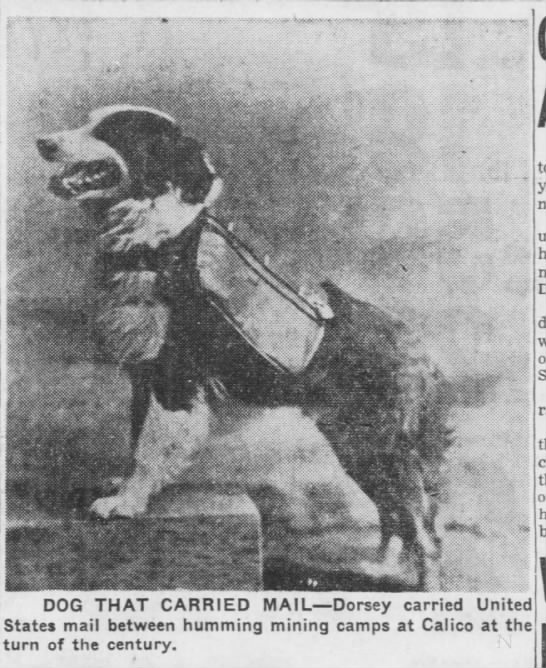
“Neither snow nor rain nor heat nor gloom of night stays this collie dog from the swift completion of…”

No, no, don’t interrupt me. I’m reciting that motto correctly. The following item from the “Morning Astorian” for November 19, 1885, explains why:
Dorsey is the suggestive name of a California mail carrier. He is a dog. His official wages are small and through the proper authorities he has made application to have them raised. At present he gets two beefsteaks a week. He wants his salary raised to seven steaks a week and mileage. His constituents have signed a petition to that effect, and the dog looks anxiously forward to the day when Postmaster-General Vilas shall grant his petition.

Before Dorsey was appointed regular mail carrier between Calico and Bismark, in San Bernardino county, his reputation was not the best. He is a black and white collie with sharp nose, bright, quick eyes and the usual shaggy coat. The way he came to be installed as a government employee was this: The postmaster at Calico had a brother in the mines at Bismark, to whom he wanted to send word one day. The place was three miles up the mountain, along a bare, stony road, burning with heat. It was a hot, toilsome tramp, and no one in the village offered to go. So the postmaster thought he would send Dorsey just to see how it would work. The letter was written and tied around the dog's neck, his head pointed up the Bismarck road, and he was told to "git out fur Bismark." He started, ran a few rods and stopped. But a shower of stones started him again, and that was the last seen of him in Calico that day.

The next day he returned from Bismark with an answering letter tied around his neck. He had been well treated at the mining camp, was fed well and petted on his return, and seemed very proud of his achievement. After this other letters were sent in the same way, and by-and-by the miners asked that all their mail be sent up by the dog route. There were more than he could carry, so a little mail bag with brass trimmings and the usual government lock was purchased and fitted to Dorsey's back. Now residents of San Bernardino county have grown to look upon the dog as a regular institution quite in the ordinary run of affairs.
"San Bernardino County Sun," May 31, 1957, via Newspapers.com


Dorsey knows when the stage that brings the mail is due, and on those occasions he sticks closely to the post-office. When the letters and papers have been sorted out, the postmaster says: "Dorsey, the mails are ready," and the dog stands soberly to have the bag strapped on. Then, with a sharp bark of farewell, he trots over the hills on a little trail he has worn himself. If he meets a stranger he makes a wide detour to avoid him, and when other dogs try to be friendly and get up a little fight with soft gloves. so to speak, he gravely declines and goes on his way. He will not run any risk of losing the mail. Arriving at Bismark he stops at six or seven of the principal houses in town and standing at the front door, barks until someone comes out. Only a few known friends are permitted by him to open the bag. Then at night the miners give him a big supper, and the next day he starts back for his office at Calico with letters bound for the post office.

Post Office Inspector T. F. Tracy, sent out by the government to inspect California mail facilities, reports the Dorsey dog route the most faithful and prompt in the state.
The “Dorsey dog route” continued until 1886, when the Bismark mine closed, and the collie was forced into retirement. It was said that poor Dorsey could not comprehend why his services were no longer required.

Dorsey remains a beloved figure in California history. In 1972, Kenny Rogers recorded a song about him, which is certainly an honor not granted to too many mail carriers.

Wednesday, November 7, 2018

Newspaper Clipping of the Day

Most dogs bring home bones or dead rats. However, one canine finally had the bright idea of turning herself into her own ATM. Meet Dumpy (or Duchess Dumpy, to give her full name.)

"Reno Gazette-Journal," September 20, 1938, via Newspapers.com


A follow-up to our little tale appeared in the "Battle Creek Enquirer," July 23, 1939:

Dumpy was a handsome crossbreed. Her father was a registered Doberman Pinscher. Her dam was a registered Irish setter. She belonged to Mrs. Harvey C. Stiles, of Granary Cottage, San Jose Mission, San Antonio, Texas.

Always, from puppyhood, she had been clever and original, as befitted the offspring of two such breeds. But not until July 9, 1938, did she develop the amazing trait which was described in so many newspapers at the time.

On that day, Dumpy came home from her usual daily walk; carrying a crumpled strip of paper daintily between her jaws. She laid the paper at Mrs. Stiles' feet, then stepped back waiting to be thanked for her gift.

Instead of thanks, the dog was greeted with a stare of blank amazement. For the strip of paper was a $1 bill.

The bill was badly mussed up and it was crusted with fresh earth. Yet, undeniably, it was a dollar bill, and apparently a good one. Mrs. Stiles' family and one or two neighbors came in to see the treasure trove Dumpy had brought home. Many were their exclamations of wonder.

Next day, she came back from her walk with another dollar bill, similarly rumpled and dirt-sprinkled. And again she was met by the same chorus of astonishment. Day after day she returned from her stroll, always carrying one of the soiled dollar bills she had found somewhere. This continued, week after week.

People tried craftily to trail Dumpy on her daily rambles and to find out whence she got the money. But always the wise dog gave them the slip; using the cunning of a wolf, to elude her followers. And every day she brought home a dollar bill.

Never for a long while did she bring a bill of any other denomination, never more than a single bill. Mrs. Stiles took a handful of this cash to the nearest bank to have experts decide whether or not it was counterfeit currency, and to tell her if it was marked or "wanted" or if it were "hot money."

The bills were proven genuine. Nor were they marked, nor on any list of "wanted" money. And the mystery deepened.

The story reached the newspapers. Reporters tried to shadow the dog, on her walks. But she dodged them as easily as she had eluded the neighbors. And still the money came in, always a dollar a day. The press notoriety was quite enough to have warned anyone who might have hidden the cash in a supposedly safe place where the dog had happened to find it, and to have given him full opportunity to remove what was left of the hoard.

But it was not removed. No neighborhood miser-stories were revived which might have given a clue. No, the money came daily from the earth--as was attested by the crumbs of fresh dirt sticking to it--and only Dumpy knew where in the earth it came from. Within a few months, $166 had been amassed. And the regular flow of dollars did not cease nor slacken. How large the treasure may be by the time you read this if Dumpy is still living and if the hoard has not been exhausted I don't know. Nor if, by that time, the mystery may have been solved.

Now for a letter from Mrs. Stiles. She wrote me:

"I will gladly tell you in detail about Dumpy. So far, everything printed about her finding money is absolutely true; not even exaggerated. Since July 9, she has been bringing me one dollar a day, except once when she was poisoned and again when she had seven puppies.

"The puppies, born November 30, 1938, I named Penny, Nickle, Dime, Two Bits, Four Bits, Six Bits and Dollar. I called them The Currency Family.'

"The money brought home to me by Dumpy was all in singles; except, for several days, later on, five $5 bills; one of them a day. We have followed her, again and again. Always she goes toward an old gravel pit. But always she manages to give us the slip.

"I keep on feeling sure each day's dollar will be the last. But it never is. When she began bringing money home to us we thought some one was giving it to her, though we couldn't guess why anybody would do such a thing.

"So we notified the authorities. It was verified. That is how it got into the newspapers. And since then we have about as much privacy as Cobb's goldfish. But Dumpy's daily deed is doing much good, as I'll explain.

"I decided that the money brought home by her was a Godsend and thus must be used for charity. I spent part of it for a Jersey cow, whose 12 quarts of milk a day I give to the Bexar County Tuberculosis association to be distributed among TB children.

"In Dumpy's name also, I gave out many baskets of food for Christmas. And the money paid me for her pups (one of them, 'Two Bits,' sold for $25) goes to the Dumpy fund, to help the unfortunate.

"This Dumpy fund is really worthwhile. For there are many who need help, in this region. Other contributions have been added to it by generous people."

So, Dumpy s treasure trove consists not only of a dollar a day, but also of a good deed a day which is worthy of the best Scout traditions. When the first details of the mystery were printed, a year or more ago. I wondered what was going to be done with the money.

It adds to one's faith in human nature to hear that it is put to such splendid use. Mrs. Stiles writes me that not one penny of the treasure is used otherwise than for charity. If ever the secret of the hidden fortune is made known to me, I'll tell you about it. Until then, as far as I can learn, there is no hunt as to the source of the money. As to Dumpy's continuing to bring it home, day after day, for such a long time well, to me, there is no mystery at all about that part of the story.
The last news item I've been able to find about Dumpy was in September 1939, where they indicated that the dog was still bringing home the dough. I cannot find when--or if!--the parade of bills ceased, or if they ever found Dumpy's hidden store of loot.

In any case, I'm showing these articles to my cats. It's about time they started earning their keep.

Monday, February 13, 2017

The Most Amazing Dog


...Because let's face it, smart-mouthed Nazi dachshunds are what this blog is all about.

In the 1930s, a dachshund named Kuno von Schwertberg--remembered in history by his nickname, "Kurwenal"--lived in Weimar, Germany with his owner, the equally impressively-named Baroness Mathilde Freiin von Freytag-Loringhoven.


The Baroness was a devotee of what was known as "New Animal Psychology"--essentially, the belief that animals had latent intellectual and communicative abilities equal to humans. This school of thought was highly fashionable in Nazi Germany, where they thought of dogs as more "human" than Jews or other non-Aryan races. The regime even created a special "dog college" where they hoped to train mastiffs to work as four-legged concentration camp guards.

Mathilde saw her dachshund as the perfect evidence for this theory. Kurwenal, she informed the world, was able to both read and carry on conversations. He communicated by barking the number of times necessary to correspond with a consecutively numbered alphabet. It was, for matters of convenience, a phonetic alphabet, but it got the job done. (Kurwenal once expressed frustration with the cumbersome system. He wished he could talk like a parrot.) He could also tell time.

Kurwenal displayed a sophisticated taste in literature. While one would assume his favorite reading would be "Lassie" stories or novels where cats meet a hideous fate, our hero showed an easy familiarity with Shakespeare and proclaimed that Goethe was superior to Schiller. He also had a taste for zoology books. (Sadly, the dachshund disliked music, which he decreed was "very disgusting." He could not bear singing, either. Something to keep in mind if you are in the habit of crooning lullabies to your dog.)

This was one opinionated dachshund. He was fond of pink roses and large cheeses, (Kurwenal was quite chubby,) and would chat about his desire to eat cats. He had an eye for pretty women that, curiously, did not extend to females of his own species. When he was once asked if he would like to become a father one day, he snapped, "No!" (One scientist suggested that the dog's superior intellect had caused his "private parts" to atrophy.)

Kurwenal never bothered to hide his impatience with what he considered to be silly questions or frivolous wastes of his valuable time. One one of his birthdays, he was treated to a visit from children belonging to the Nazi's animal protection organization. When the children began reading a long poem in his honor, Kurwenal quickly grew bored. After only a few stanzas, he interrupted by barking out "No more poetry!" The birthday boy was presented with a large teddy bear. The giver said placatingly, "Now, does this bear not look very nice?"

"No!" Kurwenal responded. "He looks horrible!"  He also advised the youngsters that he planned to vote for Paul von Hindenburg rather than Hitler, and, oh, to have seen the faces of everyone present when he did.

Kurwenal--who liked to describe himself as "intentionally witty"--was the dog world's first stand-up comedian. When he heard rumors that wartime economy might lead to sausages made of dog meat, he protested, "the Christian religion prohibits killing!" When one Swiss investigator tried to trick Kurwenal into showing himself to be a fraud, the dog yelped contemptuously, "I answer no doubters! Go bother the asses instead!"

One senses that Kurwenal was the canine Tobermory.

The loquacious hound was studied by several scientists, with predictably varying results. The zoologists Ludwig Plate and Max Muller declared that the little canine's talents were all completely genuine. Muller wrote, "The thought-communicating red dachshund...barks, in his number alphabet, utterances of a surprising, even weird, depth of thought. The constant association of the dog with his teacher enables him to display an answer to questions, sequences of thought which surprise us extremely. This dachshund lives in the intellectual sense, more in man's sphere than in the animal's." Physiologist Otto Renner, on the other hand, was convinced that Kurwenal was merely following subtle cues provided by his owner. [Cf. Lady the Wonder Horse.]

As was the case with Lady Wonder's owner, the Baroness was casual about her pet's talents. "There's nothing mysterious or freakish about the things these dogs do," she once commented. "The truth is that these dogs have an intelligence similar to humans, but much lower in degree. Except for the fact that they are given their first lessons at a very early age, there is no undue pressure put upon them to make them learn.

"I give Kurwenal dainties when he performs especially well, but that's all the encouragement he gets. I never try to force him to do things as circus dogs are forced. It's simply that I worked very hard training him and tried to be very patient."

Kurwenal died late in 1937. "I am not afraid of dying," he barked out on his deathbed. "Dogs have souls and they are like the souls of men." He was buried in the Baroness' Weimar town house. The residence is now an office building, but the grave of the dachshund once known as "the most amazing dog in the world" is still preserved. The epitaph on his tombstone (translated from the German) reads:

"KURWENAL
The wisest and noblest of all dogs.
The world-famous mathematician, thinker, and writer."

Wednesday, September 14, 2016

Newspaper Clipping(s) of the Day


Chris Woodyard's outstanding collection of morbid delights, "The Victorian Book of the Dead," featured the sad end of Alice Knott, murdered by her "evil-dispositioned" parrot, who had the habit of "pulling the tips off the gas burners with his strong beak and inhaling the gas until it stupefied him." While this was nothing but fun and games for the bird, one night it was death for his mistress.

This memorable tale left me wondering if this was a once-in-lifetime sort of event, or if there were other tales of people gassed to death--intentionally or not--by their pets. Just a short browse through the old newspapers left me convinced that our beloved furry and feathered friends are in league to kill us all.

Let's kick things off with the soulmate of Miss Knott's bird, Dolly the Parrot of Death. This story comes from the "La Crosse Tribune," September 25, 1947:

Jersey City, N.J.--Her pet parrot who turned on a kitchen stove gas jet was blamed today for the death of 66-year-old Mrs. Fannie Stewart.

Mrs. Stewart, a widow, was revived by police rescue squad workers but died later at the Jersey City medical center of what hospital authorities said was cerebral thrombosis.

She had told rescue workers that her parrot, Dolly, flew about her Beacon avenue home at will and had turned on the gas jets once before when it alighted on the kitchen stove. Mrs. Stewart, however, said she had discovered the escaping gas before any damage was done that first time.

Neighbors who detected gas seeping from Mrs. Stewart's home summoned the rescue squad yesterday.

Dolly's mug shot.


The "Dundee Courier," April 7, 1948:
Mr. John Blackman returned to his home in Crewys Road, Charles Hill, Cricklewood, to find his wife was missing.

He thought at first she must be shopping or with neighbours.

There was a strong smell of gas. He went upstairs. In the bathroom he found his 56-year-old wife, Susan Maria, dead.

At the Hendon inquest yesterday a gas official said the geyser safety device was faulty, and a bird had built its nest in the flue pipe.

Verdict--Accidental death from coal gas poisoning.

Sadly, there was at least one case where the tables were turned on our homicidal birds. The "Perth News," April 21, 1928:
Melbourne, Saturday.--That a mouse should cause a parrot's death seems incredible, but such a thing happened in the flat of Mr. and Mrs. P.R. Garvie, Mary-street, St. Kilda, this week.

Mrs. Garvie was accustomed to leaving the parrot's cage in the kitchen overnight to protect the bird from cats.

On Thursday night a mouse crept from its hiding place, and in its search for food climbed a gas pipe, leading to the copper. The tap on this pipe was very loose. It turned under the weight of the mouse, and the room was filled with gas. In the morning when Mrs. Garvie entered the kitchen she found her pet bird and mouse lying together dead in the bottom of the cage.

I suppose it should not be a surprise that cats excel at creating DIY gas chambers for their owners. They were, by far, the leading practitioners of this particular animal hobby. This next brush with death comes from the "Virginia Recorder," July 22, 1938:
Des Moines.—Less than 24 hours after three young women of Des Moines received a cat as a mouser, the animal brought death close to the girls by turning on a gas burner as they slept. The girls are the Misses Lavona and Evelyn Hove, sisters, and Miss Helena Adair. They occupy a basement apartment in the rooming house of Mr. and Mrs. Harry Bougher.

A few days ago the girls heard a mouse in their room. Learning of this, Miss Adair’s mother offered the cat as a solution. The three girls promptly installed the cat in the apartment and named her Tippy. It was about 1 a.m. when the girls retired. Tippy was lying curled up in a corner, apparently content. A little before 6 a.m. Bougher went to the house furnace in the basement. When he returned to his quarters a few minutes later he told Mrs. Bougher there was a strong odor of gas in the basement.

“I can smell it up here,” Mrs. Bougher replied. “Say—l wonder if it can be coming from the girls’ apartment? You know it’s right below this room.” The couple hurried to the basement, knocked on the apartment door, but received no answer. “I thought right then that they were dead,” Mrs. Bougher said. “The gas was so strong it almost knocked me down,” she said. “I yelled several times and then one of the girls answered. Mr. Bougher ran into the room and opened the windows. “We found that one of the burners on the stove was about half-way open. That’s where the gas was coming from.” The three girls were aroused and taken to the Bougher apartment. None suffered any apparent ill effect. Neither did Tippy. All three girls were certain the gas had not been on when they retired. And certainly, they said, the burner had not been half-way open for five hours. This left Tippy as the only possible suspect. “I guess it was a pretty close call,” said Miss Lavona. “After this,” added Miss Adair as she stroked the cat, “Tippy is going to have to sleep out nights.”
I found no follow-ups to this story, but I'm guessing Tippy got her body count in the end.

Same goes for this cat recorded in the "Sydney Herald," April 28, 1931:
Wellington (N.Z.) Monday. Left inside a Wellington house to catch mice, a cat jumped on the gas stove during the night, in search of some fish that had been left there, and turned on a gas jet, and as a result the occupants of the house were nearly asphyxiated. The mother and three children were overcome by fumes, and the others became violently ill. One member of the family had awakened earlier, smelt the gas, and turned off the tap, without telling the others.

"San Francisco Call," November 1, 1913:
A pet cat in the home of Edward Clarkson, Brooklyn, disconnected a rubber tube from a gas stove in the kitchen, causing the death of Mrs. Ida Clarkson from asphyxiation. Clarkson was asleep at home, as also was his wife. He was removed unconscious to the Holy Family hospital.
"Perth Times," March 25, 1934:
A pet cat is believed to have been responsible for the death of its 90-year-old owner, Mrs. Margaret Kingston, who was found in a gas-filled room at her home at York-road, Hove, England.

Mrs. Kingston loved her cat--a Persian--so much so that every night she took it to bed with her.

It is believed by the police that while she was lying asleep the cat brushed against a gas-jet, turning on the tap.

When they entered the room Mrs. Kingston was dead in bed. Her daughter Mrs. Moorhead, and the cat were lying on the floor unconscious.

Mrs. Moorhead and the cat recovered after the police had applied oxygen to both.

The "Western Press," August 13, 1931:
Mr. J. Lewis, of Frazer Street, Bedminster, Bristol, had his moustache and eyebrows singed when an explosion occurred in the gas stove at his home yesterday.

The force of the explosion broke panes in the kitchen window and damaged the ceiling.

Mrs. Frazer expressed the opinion to a reporter that the cat must have turned on the gas in the oven.

When her husband lit the gas on top of the stove, he smelt an escape, and opened the oven door, a loud bang being the result.

[Note: You know you have one heck of a slow day in Bristol when J. Lewis' singed moustache is headline news.]

A rare instance of a would-be killer cat's change of heart was reported in the "Columbia Missourian," March 15, 1929:
Cats usually come under the category of "dumb animals" but "Rags," a persian cat belonging to Mrs. N. A. Dysart, 208 South Eighth Street, has proved the exception. About three o'clock yesterday morning Mrs. Dysart was awakened by "Rags" jumping upon the bed and then racing into the hall. The cat continued this until she finally awakened her mistress enough to know that something was wrong and that the cat was trying her best to tell her.

Mrs. Dysart followed the animal out into the hall where gas fumes were so heavy that it was almost impossible to breathe. She succeeded in getting the window open and making her way into the kitchen from which the gas seemed to be coming. Groping though the dark until she located the light switch, she found that one of the gas jets was on.

"Rags" was in the habit of getting upon the stove to catch mice that were making their home there. In so doing she had accidentally turned on the gas and sensing that something was wrong sought to warn her mistress of the accident.

The "Meriden Morning Record," March 2, 1912:
Newton, Mass., March 1.--The cat in the household of Louis Andrews at Newton Upper Falls could not control its curiosity as to the shutoff on the gas range in the kitchen early today. The consequence was that four of the occupants of the house were rendered unconscious by escaping gas and were not revivied for several hours.

When the excitement was all over a searching investigation revealed that the cat, which had been asleep in the kitchen, had turned on the gas.

Mr. Andrews is in doubt whether the family pet became despondent and contemplated suicide or hit the gas cock in a playful mood. The cat suffered no ill effects from the gas.

"Playful mood," my eye. Mr. Andrews had yet to learn that a few days earlier, the cat secretly took out life insurance policies on the entire family.

I kid, I kid.

You don't have gas in your home, you say? You're immune from having your darling pet asphyxiate you in your sleep?

Ahem.

The "Yorkshire Post," July 19, 1933:
The prowling of a cat in the cellar of the house of Mr. Bower, Hillhouse Lane, Huddersfield, nearly resulted the family being gassed by ammonia fumes. Mr. Bower, who is a grocer, had a carboy of ammonia In the cellar underneath on which stood some ginger beer bottles. It is thought the cat, walking along the shelf, knocked over a ginger beer bottle on top of the carboy. The glass was broken, and ammonia fumes spread rapidly over the house while the cat made her escape.

When Mr. Bower realised what had happened, he called the fire brigade, who it found Impossible to get inside the house without the aid of masks. So far had the fumes spread that the ordinary gas mask was no use, and a special one had to secured. This was attached a box containing several different kinds of chemical crystals to counteract the effect of different gases. The mask had not previously been used against ammonia fumes by the Huddersfield brigade, but Sergeant Hutton, who went to the cellar to carry out the carboy, felt no effect from the fumes.

You dog owners must be feeling pretty smug right now. No lethal birds or treacherous cats for you. No worries!

Read on.

"Kalgoorlie Miner," October 9, 1948:
London, Oct. 8--A dog, by jumping on a gas cooker and turning on the tap, caused the death of his master, 53-year-old Ernest Herbert Gibbons, who was found gassed in a first floor bedroom of a house in the London suburb of Cricklewood.

Gibbons was in bed and evidently asleep when the dog jumped.

Here is a particularly incriminating story from the "Sunderland Echo," December 30, 1933:
A dog belonging to John Carter, of Hull, accidentally turned on a gas tap in the room where its master was sleeping.

The dog then went to another room where its play awakened the man's brother.

John Carter was found unconscious from the effects of the gas fumes.

"Gloucester Citizen," January 30, 1939:
A pet dog found unconscious on a kitchen floor is thought to have been the cause of a gas tragedy in which a man, his wife and a child lost their lives at Manchester during the week-end.

The dead people were: William Edward Webb, aged 52, a railway worker, Jane, his 51-years-old wife and Roy, aged 6, their adopted son.

Policemen who were called by neighbours to their house in Eltham-street, Levenshulme, found Mr. Webb and Roy dead in bed in the back bedroom. Mrs. Webb was in the front bedroom.

The house was full of gas which had escaped from a tap on the scullery boiler, which was turned on slightly.

The dog revived after treatment.

The only theory as to the cause of the tragedy is that the dog, which was allowed to run about the house during the night, had brushed against the tap and turned it on.

The lesson to be learned from today's post? Keep the catnip, gourmet bird seed, and caviar dog biscuits handy, my friends. Maybe we can bribe them into sparing us.

Monday, September 21, 2015

Why Billy Hansbrough Failed to Rest in Peace

On May 4, 1905, the "Louisville Courier-Journal" carried a moving obituary notice for an eight-year-old named Billy Hansbrough. It was placed by the two people closest to him, William and Ada Hansbrough. The opening lines read, "Two hearts are grief-stricken, a once happy home is lonely and desolate, for death in its terrible mission entered the home of Mr. and Mrs. Hansbrough Saturday, April 22, at 4:30 o'clock, and took their little ray of sunshine from them."

The column (which included a handsome portrait of the deceased,) paid 124 lines of tribute to the "brown-eyed, sweet-faced" Billy, adding, "The suddenness of Billy's death has left desolation in its path." Billy was "their companion wherever they went, their comfort in sorrow, their little protector in the lonely hours of the night, and as he grew deeper in their lives and hearts, their love for him became dearer."

"Their little child and sunbeam" first showed signs of illness on April 13, when he refused to eat. William and Ada had sat up all night with him, keeping "warm flannels to his little cold body...When morning came he seemed better, and took his usual little walk...and then got up in his chair at the table." However, he still had no appetite. Billy was so perturbed, he ran away from home for three days. William and Ada "made every effort in human power" to find him. Finally, he returned, "so changed from their little bright-eyed darling they could hardly recognize him."

The notice went on to say, "After a loving greeting...he went through all the rooms of his happy home, where his toys and playthings were, then got up on his little bed, and they gave him his rag doll; he was so happy to be home again."

Billy's physician was summoned at once, but nothing could be done. "Neither love, medicine, nor prayers could save that precious life." Finally, after "a pitiful little moan," he "passed away for ever."

The mourning couple held a wake, attended by all the deceased's many friends and loved ones. Then, an undertaker was called in to embalm the little body. A beautiful and expensive casket was ordered. With "trembling hands," the Hansbroughs placed Billy inside the coffin, with "the little doll he loved so well by his side."

The Hansbroughs described the funeral of their beloved in Cave Hill Cemetery. "While a little bird in a tree above them was singing they laid their darling, their Billy, to rest in his little grave in the family graveyard" in a space between those reserved for Ada and William. "As they turned from that little grave they knew it would be their only comfort while they lived" that they would eventually rest in peace forever with him. "I believe his death will kill me," said Mrs. Hansbrough plaintively. "Oh, my baby Billy, if I only had you back for a while."

This was no ordinary family tragedy. The Hansbrough choice of resting place for "their darling" was destined to cause a great deal of legal trouble.

Because, you see, Billy was a dog.


The cemetery's board of directors had allowed this unusual burial on the condition that "no mound or marker" be placed over the grave. However, the Hansbroughs violated this agreement by raising a mound over Billy's resting place. They also talked of putting up a monument. All this was too much for the villain in our little tale: a fellow plot-owner named Henry Hertle. Hertle--obviously not a believer in the "man's best friend" motto--seemed to take it as a personal insult that he should be asked to share cemetery space with a dog. In January 1906 he filed a lawsuit aimed at forcing the Hansbroughs and Cave Hill Cemetery to exhume Billy and bury his remains elsewhere. Hertle's suit accused the Hansbroughs of "keeping and maintaining a nuisance." Cave Hill was a cemetery intended only for the use of "members of the white race." Mr. Hertle huffed that he was "greatly humiliated in thinking that the bodies of those who were near and dear to him lie near the buried dog and in the contemplation that of the probability that when he dies, his body will also be buried beside that of a dog."

Personally, I can think of far worse company--such as, say, the likes of Henry Hertle--but never mind.

Although the lawsuit argued that Cave Hill had violated its own rules by allowing the dog funeral, the defense made the point that the cemetery's charter said nothing specifically forbidding dogs to be buried there. In any case, how does one prove that a decently--and expensively--buried fox terrier constitutes a "nuisance?"

The two sides argued the matter in court for over a year. Finally, in the spring of 1907, the court ruled that Billy should be allowed to continue resting in peace. The judge ruled that plot owners should not be allowed to pick and choose who should be buried in cemeteries. Otherwise, it would prevent the burial of anyone who might be personally objectionable to any other individual. "The injury done here is to the living plaintiff, who expects to be buried in his lot at some future time. It consists in his distress of mind in contemplating his daughter's present burial and his own prospective interment in a lot adjoining that in which Billy lies buried. If this be an injury to person or property, it is too incapable of being measured to invoke action by the court. If the claim of right here asserted be permitted to control it would prevent the burial of any one -- a murderer or a suicide, for instance -- whose grave might be objectionable to neighboring lot owners.

"That matter is in control of the cemetery company. An unburied dog, either alive or dead, may be a nuisance per se, but a dead dog, well buried, as in this case, is not a nuisance per se, and can not become one." In short, if Billy's grave was all right with the cemetery company, it was all right with the judge.

Well, it wasn't all right with Henry Hertle. He filed an appeal. In December 1907, the state court of appeals agreed with his anti-canine spirit and overruled the circuit court's decision. One of the judges wrote, "If the body of a dog may find sepulcher on the lot of its owner in Cave Hill Cemetery, why might not the owner of a horse, or bull, or donkey, also bury his favorite on his therein, if his fancy should take this freakish direction? Where would or could the line be drawn if not at the body of a dog?" The tribunal ordered that Billy must be buried elsewhere.

Unfortunately, I do not know what happened after this. I presume the exhumation was carried out, but history is silent on Billy's ultimate resting place. According to Findagrave.com, Mr. and Mrs. Hansbrough are both interred in Cave Hill.

I'd like to think William or Ada managed to sneak Billy in with them.


Wednesday, April 8, 2015

Newspaper Clipping of the Day

via Newspapers.com


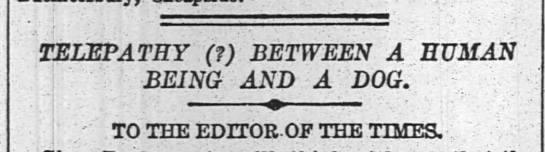
This account of a tragic case of alleged "animal telepathy" described by the noted writer H. Rider Haggard appeared in the "London Times" for July 21, 1904:


Ditchingham, July 11th.

Perhaps you will think with me that the following circumstances are worthy of record, if only for their scientific interest. It is principally because of this interest that, as such stories should not be told anonymously, after some hesitation I have made up my mind to publish them over my own name, although I am well aware that by so doing I may expose myself to a certain amount of ridicule and disbelief.

On the night of Saturday, July 9, I went to bed about 12:30, and suffered from what I took to be a nightmare. I was awakened by my wife's voice calling to me from her own bed upon the other side of the room. As I awoke, the nightmare itself, which had been long and vivid, faded from my brain. All I could remember of it was a sense of awful oppression and of desperate and terrified struggling for life such as the act of drowning would probably involve. But between the time that I heard my wife's voice and the time that my consciousness answered to it, or so it seemed to me, I had another dream. I dreamed that a black retriever dog, a most amiable and intelligent beast named Bob, which was the property of my eldest daughter, was lying on its side among brushwood, or rough growth of some sort, by water. My own personality in some mysterious way seemed to me to be arising from the body of the dog, which I knew quite surely to be Bob and no other, so much so that my head was against its head, which was lifted up at an unnatural angle. In my vision the dog was trying to speak to me in words, and, failing, transmitted to my mind in an undefined fashion the knowledge that it was dying. Then everything vanished, and I woke to hear my wife asking me why on earth I was making those horrible and weird noises. I replied that I had had a nightmare about a fearful struggle, and that I had dreamed that old Bob was in a dreadful way, and was trying to talk to me and to tell me about it. Finally, seeing that it was still quite dark, I asked what the time was. She said she did not know, and shortly afterwards I went to sleep again and was disturbed no more...

Thinking that the whole thing was nothing more than a disagreeable dream, I made no enquiries about the dog and never learned even that it was missing until that Sunday night, when my little girl, who was in the habit of feeding it, told me so. At breakfast time, I may add, nobody knew that it was gone, as it had been seen late on the previous evening. Then I remembered my dream, and the following day enquiries were set on foot. 
To be brief, on the morning of Thursday, the 14th, my servant, Charles Bedingfield, and I discovered the body of the dog floating in the Waveney against a weir about a mile and a quarter away...

On Friday, the 15th, I was going into Bungay to offer a reward for the discovery of the persons who were supposed to have destroyed the dog in the fashion suggested in Mr. Mullane's first certificate, when at the level crossing on the Bungay road I was hailed by two platelayers, who are named respectively George Arterton and Harry Alger. These men informed me that the dog had been killed by a train, and took me on a trolly down to a certain open-work bridge which crosses the water between Ditchingham and Bungay, where they showed me evidences of its death. This is the sum of their evidence:

It appears that about 7 o'clock upon the Monday morning, very shortly after the first train had passed, in the course of his duties Harry Alger was on the bridge, where he found a dog's collar torn off and broken by the engine (since produced and positively identified as that worn by Bob), coagulated blood, and bits of flesh, of which remnants he cleaned the rails. On search also I personally found portions of black hair from the coat of a dog. On the Monday afternoon and subsequently his mate saw the body of the dog floating in the water beneath the bridge, whence it drifted down to the weir, it having risen with the natural expansion of gases, such as, in this hot weather, might be expected to occur within about 40 hours of death. It would seem that the animal must have been killed by an excursion train that left Ditchingham at 10.25 on Saturday night, returning empty from Harleston a little after 11. This was the last train which ran that night. No trains run on Sunday, and it is practically certain that it cannot have been killed on the Monday morning, for then the blood would have been still fluid. Also men who were working around when the 6.30 train passed must have seen the dog on the line (they were questioned by Alger at the time and had seen nothing), and the engine-driver in broad daylight would also have witnessed and made a report of the accident, of which in a dark night he would probably know nothing. Further, if it was living, the dog would almost certainly have come home during Sunday, and its body would not have risen so quickly from the bottom of the river, or presented the appearance it did on Thursday morning. From traces left upon the piers of the bridge it appears that the animal was knocked or carried along some yards by the train and fell into the brink of the water where reeds grow. Here, if it were still living,—and, although the veterinary thinks that death was practically instantaneous, its life may perhaps have lingered for a few minutes,—it must have suffocated and sunk, undergoing, I imagine, much the same sensations as I did in my dream, and in very similar surroundings to those that I saw therein —namely, amongst a scrubby growth at the edge of water.

Both in a judicial and a private capacity I have been accustomed all my life to the investigation of evidence, and, if we may put aside our familiar friend "the long arm of coincidence," which in this case would surely be strained to dislocation, I confess that that available upon this matter forces me to the following conclusions:

The dog Bob, between whom and myself there existed a mutual attachment, either at the moment of his death, if his existence can conceivably have been prolonged till after 1 in the morning, or, as seems more probable, about three hours after that event, did succeed in calling my attention to its actual or recent plight by placing whatever portion of my being is capable of receiving such impulses when enchained by sleep, into its own terrible position. That subsequently, as that chain of sleep was being broken by the voice of my wife calling me back to a normal condition of our human existence, with some last despairing effort, while that indefinable part of me was being slowly withdrawn from it (It will be remembered that in my dream I seemed to rise from the dog), it spoke to me, first trying to make use of my own tongue, and, failing therein, by some subtle means of communication whereof I have no knowledge telling me that it was dying, for I saw no blood or wounds which would suggest this to my mind.

I recognise, further, that, if its dissolution took place at the moment when I dreamt, this communication must have been a form of that telepathy which is now very generally acknowledged to occur between human beings from time to time and under special circumstances, but which I have never heard of as occurring between a human being and one of the lower animals. If, on the other hand, that dissolution happened, as I believe, over three hours previously—what am I to say? Then it would seem that it must have been some non-bodily but surviving part of the life or of the spirit of the dog which, so soon as my deep sleep gave it an opportunity, reproduced those things in my mind, as they had already occurred, I presume, to advise me of the manner of its end or to bid me farewell.

There is a third possibility which I will quote, although the evidence seems to me to be overwhelmingly against it, and, for the reasons already given, it is inherently most improbable—namely, that the dog was really killed about half-past 6 on the Monday morning, in which case my dream was nothing but a shadow of its forthcoming fate.

Personally, however, I do not for a moment believe this to have been the case, especially as the veterinary's certificate states that the animal's body must have been "over three days " in the water at the time of its discovery.

On the remarkable issues opened up by this occurrence I cannot venture to speak further than to say that,—although it is dangerous to generalise from a particular instance, however striking and well supported by evidence, which is so rarely obtainable in such obscure cases,—it does seem to suggest that there is a more intimate ghostly connection between all members of the animal world, including man, than has hitherto been believed, at any rate by Western peoples; that they may be, in short, all of them different manifestations of some central, informing life, though inhabiting the universe in such various shapes. The matter, however, is one for the consideration of learned people who have made a study of these mysterious questions...Further, I may say that I shall welcome any investigation by competent persons.

H. Rider Haggard.