"...we should pass over all biographies of 'the good and the great,' while we search carefully the slight records of wretches who died in prison, in Bedlam, or upon the gallows."
~Edgar Allan Poe
Showing posts with label Egypt. Show all posts

Wednesday, August 31, 2022

Newspaper Clipping of the Day

Via Newspapers.com


In this week’s news item from the past, meet Mr. and Mrs. Ralph Chesley Ott, a couple who provided definitive proof that no love lasts forever.  “Hull Daily Mail,” August 28, 1912:

A courtship which, according to the principals, began 5,000 years ago on the banks of the Nile, culminated yesterday in the St. Louis Divorce Court, U.S.A., when Mrs. R. C. Ott brought a suit for a divorce from her husband and the custody of their two children. 

Mr. and Mrs. Ott both believe in reincarnation, and they declare that their shattered romance had its inception in a former existence once when both were Egyptians. Mr Ott is an artist, and his wife was an artist's model when he married her in 1910, after his return from Egypt, where he went for local colour, to reproduce Egyptian architecture, for a wealthy patron. 

Mr. Ott declares that he had strange dreams in Egypt, and that when after his return he met his future wife, he knew her immediately as Princess Amneris, Pharaoh's daughter, who was his love 5,000 years ago. 

"We first met," he says, “during our previous incarnation in the Queen's Chamber of the great pyramid. Then we used to meet in the palace gardens, and wend our way to the Nile, where she loved to throw sweetmeats to the sacred crocodiles. I recall the great tragic night when Pharaoh discovered us. There were torches and guards, and I was seized." 

Mrs. Ott said: "I remember how we went to the river together and fed the crocodiles.  I remember our first meeting in the pyramid. I had accompanied my father on a tour of inspection, and looking into the Queen's Chamber, I saw the handsomest man in the world. 

"We fell in love at once. That evening he came into the royal gardens, and our love, which has lasted through centuries, began.

“I have beautiful recollections of nights in the royal barge, and I vividly recall my father's anger when we were discovered together. It must have been Isis. Egypt's great goddess, who watched over us all these centuries, and finally brought us together." 

Mrs. Ott now alleges that her reincarnated husband, soon after their twentieth-century wedding, began to throw crockery at her, and became insanely jealous, often insulting her in the presence of guests. She wants the 5,000-year-old romance terminated.

Trying to revive old love affairs is usually a bad idea.

Monday, July 18, 2022

The Egyptologist and the Angry Cat God

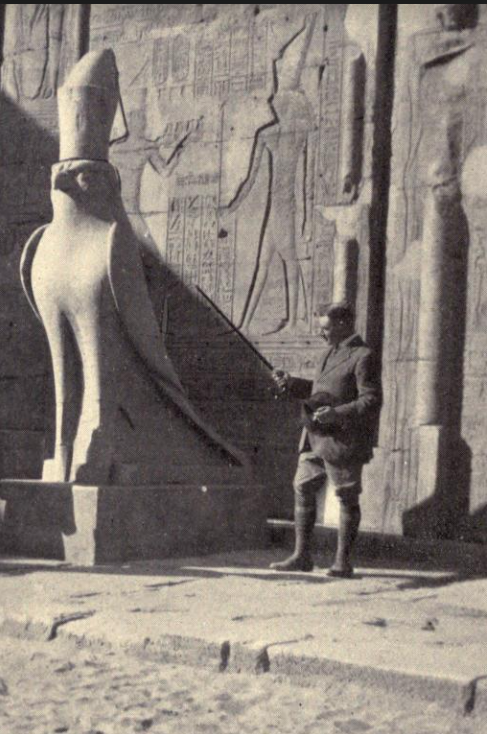
Arthur Weigall at the Temple of Edfu


I love tales of ancient curses.  I love tales of sinister ghost cats even more.  Show me a story that combines the two, and I’m in Blog Nirvana.  The following is an excerpt from Egyptologist Arthur Weigall’s 1923 book, “Tutankhamun and Other Essays.”

The large number of visitors to Egypt and persons interested in Egyptian antiquities who believe in the malevolence of the spirits of the Pharaohs and their dead subjects, is always a matter of astonishment to me, in view of the fact that of all ancient peoples the Egyptians were the most kindly and, to me, the most loveable. Sober and thoughtful men, and matter-of-fact matrons, seem to vie with the lighter-minded members of society in recording the misfortunes which have befallen themselves or their friends as a consequence of their meddling with the property of the dead. On all sides one hears tales of the trials which have come upon those who, owing to their possession of some antiquity or ancient relic, have given offense to the spirits of the old inhabitants of the Nile Valley. These stories are generally open to some natural explanation, and those tales which I can relate at first hand are not necessarily to be connected with black magic. I will therefore leave it to the reader's taste to find an explanation for the incidents which I will here relate.

In the year 1909 Lord Carnarvon, who was then conducting excavations in the necropolis of the nobles of Thebes, discovered a hollow wooden figure of a large black cat, which we recognised, from other examples in the Cairo museum, to be the shell in which a real embalmed cat was confined. The figure looked more like a small tiger as it sat in the sunlight at the edge of the pit in which it had been discovered, glaring at us with its yellow painted eyes and bristling its yellow whiskers. Its body was covered all over with a thick coating of smooth, shining pitch, and we could not at first detect the line along which the shell had been closed after it had received the mortal remains of the sacred animal within; but we knew from experience that the joint passed completely round the figure—from the nose, over the top of the head, down the back, and along the breast-so that, when opened, the two sides would fall apart in equal halves.

The sombre figure was carried down to the Nile and across the river to my house, where, by a mistake on the part of my Egyptian servant, it was deposited in my bedroom. Returning home at dead of night, I found it seated in the middle of the floor directly in my path from the door to the matches; and for some moments I was constrained to sit beside it, rubbing my shins and my head.

I rang the bell, but receiving no answer, I walked to the kitchen, where I found the servants grouped distractedly around the butler, who had been stung by a scorpion and was in the throes of that short but intense agony. Soon he passed into a state of delirium and believed himself to be pursued by a large grey cat, a fancy which did not surprise me since he had so lately assisted in carrying the figure to its ill-chosen resting-place in my bedroom.

At length I retired to bed, but the moonlight which now entered the room through the open French windows fell full upon the black figure of the cat; and for some time I lay awake watching the peculiarly weird creature as it stared past me at the wall. I estimated its age to be considerably more than three thousand years, and I tried to picture to myself the strange people who, in those distant times, had fashioned this curious coffin for a cat which had been to them half pet and half household god. A branch of a tree was swaying in the night breeze outside, and its shadow danced to and fro over the face of the cat, causing the yellow eyes to open and shut, as it were, and the mouth to grin. Once, as I was dropping off to sleep, I could have sworn that it had turned its head to look at me; and I could see the sullen expression of feline anger gathering upon its black visage as it did so. In the distance I could hear the melancholy wails of the unfortunate butler imploring those around him to keep the cat away from him, and it seemed to me that there came a glitter into the eyes of the figure as the low cries echoed down the passage.

At last I fell asleep, and for about an hour all was still. Then, suddenly, a report like that of a pistol rang through the room. I started up, and as I did so a large grey cat sprang either from or on to the bed, leapt across my knees, dug its claws into my hand, and dashed through the window into the garden. At the same moment I saw by the light of the moon that the two sides of the wooden figure had fallen apart and were rocking themselves to a standstill upon the floor, like two great empty shells. Between them sat the mummified figure of a cat, the bandages which swathed it round being ripped open at the neck, as though they had been burst outward.

I sprang out of bed and rapidly examined the divided shell; and it seemed to me that the humidity in the air here on the bank of the Nile had expanded the wood which had rested in the dry desert so long, and had caused the two halves to burst apart with the loud noise which I had heard. Then, going to the window, I scanned the moonlit garden; and there in the middle of the pathway I saw, not the grey cat which had scratched me, but my own pet tabby, standing with arched back and bristling fur, glaring into the bushes, as though she saw ten feline devils therein.

I will leave the reader to decide whether the grey cat was the malevolent spirit which, after causing me to break my shins and my butler to be stung by a scorpion, had burst its way through the bandages and woodwork and had fled into the darkness; or whether the torn embalming cloths represented the natural destructive work of Time, and the grey cat was a night-wanderer which had strayed into my room and had been frightened by the easily-explained bursting apart of the two sides of the ancient Egyptian figure. Coincidence is a factor in life not always sufficiently considered; and the events I have related can be explained in a perfectly natural manner, if one be inclined to do so.

Monday, August 9, 2021

Egyptian God Theater Critics Are the Worst Theater Critics

Joseph Lindon Smith, via the Smithsonian Institution


While virtually everyone has heard of the alleged “Curse of Tutankhamen's Tomb,” there are a number of “curse” stories related to ancient Egypt that are much more obscure.  The old Egyptians lived in a world where what we would call “magic” was a part of everyday life, and according to some people, they didn’t hesitate to use it...even many centuries after their death.  One such account was recorded by an artist named Joseph Lindon Smith.  It was published in the posthumous collection of his writings, “Tombs, Temples, and Ancient Art.”  Smith started his career as a portrait painter, but after visiting Egypt in 1898, he became fascinated by the country’s antiquities.  His exquisite paintings of Egypt’s archaeological past caught the eye of Egyptologists, who hired him to make copies of the fragile wall paintings in newly-excavated tombs.  

In 1909, Smith was working on recent excavations in the Valley of the Kings.  With him were his wife Corinna and two of their closest friends, archaeologist Arthur Weigel and his wife Hortense.  One day while exploring the area, Joseph and Arthur came across a natural amphitheater in the Valley of the Queens.  Smith loved amateur theatricals--he even had a small theater behind his home in America--so this discovery gave him an idea: he and his wife and friends would put on a play.

And not just any old play, either.  Smith was surely one of the most ambitious playwrights in history.  He and Arthur Weigel wrote a play aimed at interceding with the Egyptian gods to remove a curse which had been put on the heretical pharaoh Akhenaten, which had condemned him to be a restless, wandering spirit for all of time.  They hoped that the performance would lift the curse and enable the pharaoh to finally find eternal rest.

The quartet scheduled their play for January 26, the presumed anniversary of Akhenaten’s death.  They held a dress rehearsal on the 23rd.  The play opened with the god Horus (Smith) offering to grant the spirit of Akhenaten (as portrayed by Hortense) a wish.  The pharaoh asked to see his mother, Queen Ty, who was played by Corinna.  As Hortense raised her arms in supplication, a peal of thunder and a flash of lightning struck near them.  Akhenaten asked his mother to bring him comfort by reciting one of his hymns to the sun god.  The instant Corinna began the hymn, a wind came up which was so violent, she was unable to be heard.  Corinna, feeling it would not be queen-like to retreat, tried to finish her poem, but when the performers began being pelted with sand, rain, and hailstones the size of tennis balls, most of them were forced to flee to the shelter of a nearby tomb.  Corinna, however, insisted on standing dramatically on her rock, reciting the long hymn to the very end.  When her husband finally persuaded her to leave the stage, she was soaking wet, but elated that she had managed to defy both the elements and the ancient priests of Amun.

Soon afterwards, the quartet got a lesson in what happens when you defy Egyptian deities. Corinna began feeling pain in her eyes, and Hortense had intense stomach cramps.  That night, both women had the same dream: they were in the temple of Amun, the Egyptian king of the gods.  The statue of the god suddenly came to life and hit them with his flail; Corinna was struck over her eyes, Hortense on her stomach.  By the following morning, Corinna’s eyes were so painful that she was brought to a eye specialist in Cairo.  The doctor found that she had one of the worst cases of trachoma (an eye infection which often causes blindness) that he had ever seen.  The following day, Hortense was also hospitalized.  She had to undergo a stomach operation which nearly killed her.  Most of those who had attended the rehearsal also fell ill in various ways.  Fortunately, everyone eventually recovered completely.

Our thespians were left in that state known as “sadder but wiser.”  Their performance was permanently cancelled.  Akhenaten would just have to resolve his afterlife issues on his own.

Monday, November 4, 2019

The Case of the Haunted Necklace

The Scotsman, May 15, 1920, via British Newspaper Archive


This week's post is a cautionary tale: if you wish to give someone jewelry, turn to a local store or your favorite home shopping channel. Do not nick the item from an ancient tomb.

Odds are good the recipient will not thank you.

In December 1913, a lady in Edinburgh (whose name was never given in the published reports) was gifted with a necklace from an old friend who was in Cairo. This friend explained that it had come from an ancient tomb in her vicinity. It was a simple piece of work, consisting of a string of glass beads. The Edinburgh woman did not think much of the bauble, so she put the necklace away and soon forgot about it.

In the spring of 1920, the woman was browsing through her jewelry boxes when she came across the Egyptian relic. Deciding that it was of no intrinsic value, she put it in the wastebasket in her bedroom.

She was soon to learn what happens to people who treat vintage Egyptian bling with scorn. That evening, as she reached for some slippers that lay beside the wastebasket, she suddenly got the oddest sensation. It was exactly as if some invisible hand was clutching her wrist. Then she began hearing peculiar sounds: whirrings and rustlings, all seeming to emanate from the wastebasket. Mice? She searched the basket. No, no mice. Just that necklace.

The jewelry was beginning to spook her. The woman picked up the necklace and threw it in the hall outside her door.

The following day, she had lunch with her brother, described in the public prints as a doctor, a member of the Royal Scottish Academy, and a person of "unimpeachable solidity of character and status." She told him of her odd experiences of the past night. In the bright light of day, she was able to pass it all off as a fine joke. However, the doctor had his curiosity piqued. Without telling anyone, he brought the necklace to his own bedroom, and put it under his pillow.

During that night, his rest was interrupted by loud tappings on the wall, and other unidentifiable sounds. He found out later that the people in the next flat were wondering why the good doctor chose the middle of the night to nail pictures on his wall. At one point, he felt a movement as if a hand had made a sudden grasp at the beads lying under his head. From time to time, the necklace seemed to be moving under the pillow. The next night, he was rudely awakened when his bed began shaking. For the next five nights, he continued to experience similar disturbances. Just to see what, if anything, would happen, the doctor gave the necklace to a friend. This friend, after getting the same dose of ghostly medicine, passed the jewelry on to someone else. Who quickly chose to give it to yet another person. All these people reported the same experiences noted by the doctor and his sister. In addition, several of them suddenly awakened in the night suffering from palpitations, cold sweat, and a strong feeling of unidentifiable terror. One investigator placed the necklace in the bedroom of a friend, without informing this person it was there. The friend woke up feeling the same palpitations and sense of fear.

Word of this haunted necklace reached the ears of J.W. Herries, a reporter for "The Scotsman." He managed to persuade the doctor--who feared the public would think he had lost his marbles--to give him an account of the strange happenings. Herries published a series of articles about the necklace--with, as he had promised, all the names of people involved discreetly veiled--and this unprepossessing string of beads became one of the most talked-about objects in Scotland.

Herries obtained permission to do a little experimenting of his own with the necklace. He took it to the Royal Scottish Museum, where experts told him it was made of blue ware beads--now gone green with age--and was about 3,000 years old. They said it was a common enough object of the time, with nothing visibly distinctive about it. Herries noted that the object had a "curious snaky, almost live, feeling when held in the hand."

Herries took it home, without telling anyone in the household he had the now-notorious necklace in his possession. When everyone else had gone to bed, he brought the necklace to the dining room and put it on the mantelpiece. Then he settled down with a book. After about fifteen minutes, he suddenly noticed a "curious rustling sound" in the sideboard. When he approached the sideboard, the noises ceased. Then, a knocking sound came from the other end of the sideboard. This was followed by what seemed to be the sound of someone moving around in the hallway. He quickly opened the door and turned on the hall light, but no one was there, and everything was now completely silent.

Herries was shocked to realize that there might actually be something to this spook business. Sure, he had heard similar stories from people whose veracity he completely trusted, but to have such things happen to you personally was something else altogether.

He went back to his book and did his best to forget about the necklace's presence. It was not long before the sideboard began making noises again. This time, it was a series of taps along its side. Then he heard a loud "ping" on a tray standing on the sideboard.

Herries decided he needed a witness. He put the necklace in his pocket, and went to the bedroom he shared with his wife, who was still awake. Without telling her, he managed to place the necklace on her dressing-table, where she could not see it. Instantly, the electric light began to dim, and then slowly return to its usual brilliance. It did this over and over.

"What on earth is wrong with the light?" Mrs. Herries asked. Herries mumbled something about faulty circuits. The light kept waxing and waning until they finally turned it off. The night was disturbed by the usual tappings and rustlings, all coming from the dressing-table.

The next morning, he finally admitted to the household that they were under the same roof with an apparently haunted necklace. By this time, Herries had developed a healthy aversion to the thing, and would have happily brought it back to its owner, but his family was thrilled by the news, and insisted on keeping it for awhile.

The Herries household had the necklace for a week. During that time, nothing of particular significance happened, although they did periodically hear curious and inexplicable noises. The necklace continued to be passed around to various amateur investigators. One was an architect named James Dunn. Dunn was a light-hearted fellow who took possession of the necklace simply as a lark. He found the whole story very funny.

After his first night with the necklace, Dunn stopped laughing. For whatever reason--possibly the necklace wanted to teach this joker that it was not to be mocked--Dunn had the most striking experiences of anyone who dealt with the object. No sooner had he fallen asleep, that he was startled awake by a huge bang on the middle of the room, exactly as if a very heavy object had been dropped. When he turned on the light, he saw nothing there. This was followed by loud taps on the wall, and "an extraordinary trundling and clashing sound." It sounded as if heavy stone balls were being rolled back and forth across the floor. Dunn's dog fled the room in terror, and could not be persuaded to return.

As is generally known, Arthur Conan Doyle had a strong (and at times overly trusting) belief in the occult. When he heard about the necklace, he was naturally intrigued. He told Herries that some believe that the ancient Egyptians had the power to create "spirit entities" to guard their tombs. He suggested that the necklace came from a burial place that had been under the protection of one of these spirits, who was naturally annoyed by the necklace being removed from its tomb. Herries found this "a most fantastic theory," but he admitted he had no better explanation.

As for the necklace itself, its owner grew to hate the very sight of the thing. She gave it to her brother, making him promise to never bring it under their roof again. One day, the doctor was traveling to Loch Leven. He happened to have the necklace in his pocket, and was wondering what in the world to do with it. Then he had a thought: why not just throw the damned thing in the loch and be done with it.

So that is what he did. And it still is there today.

There was one sequel to our little tale. Soon after the doctor dumped the necklace, a young Edinburgh woman believed she had developed the facility of "automatic writing." Her parents, hard-headed Scots skeptics, were alarmed by this, and brought in the family doctor to have a discreet look at her. Without telling the girl that everyone present feared she was barmy, they asked her to show the doctor her new talent. The girl chatted with the doctor and her mother, while her right hand began writing sentences on paper, seemingly without her noticing. When the trio examined what she had written, it initially looked like gibberish. There were clear letters joined in groups, but there were no intelligible words. Then, the mother had the bright idea to try reading the letters backwards, which, much to their astonishment, formed a clear message. It was about the Egyptian necklace. It stated that the object had been dropped into the water, which pleased whoever was communicating with them.

So the necklace is now resting in peace. If anyone fishing in Loch Leven should happen to accidentally bring up a humble string of glass beads, they would be well advised to throw it back.