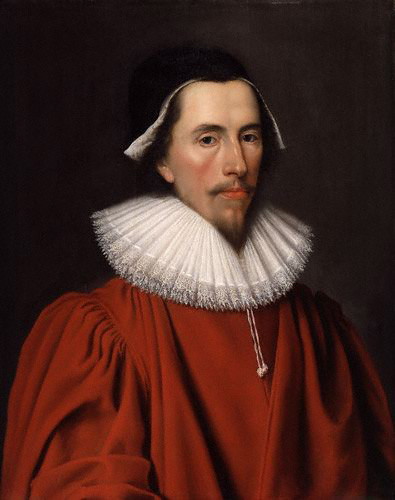
%2C_1st_Baronet_by_William_Dobson.jpeg) |
| Sir Edward Dering, by William Dobson |
This week, we look at a love story. Albeit, a love story that reads more like one of Shakespeare’s more robust comedies.
Edward Dering (1598-1644) was a distinguished figure. He had the distinction of being born in the Tower of London, as his father was then deputy-lieutenant of the site. After he graduated from Cambridge, Dering devoted himself to antiquarian studies and the collection of manuscripts. In 1619, he was knighted by James I, and in 1626 became a baronet.
This is all well and good, but the scholarly Sir Edward would not be entering the hallowed halls of Strange Company HQ if it were not for a curious courtship he entered into. He left a detailed record of his wooing in his diary, and, happily, the document has been preserved for the edification of historians who delight in seeing a dignified British aristocrat making a thorough fool of himself.
By 1628, Sir Edward had been twice widowed, but he felt ready for a third try at matrimony. The lady of his choice was Elizabeth Bennett, the young widow of a prominent London mercer. Mrs. Bennett was extremely rich, well-connected, and far from lacking in personal charms. Naturally, Sir Edward found himself facing a great deal of competition for her hand.
To the extreme amusement of Londoners--who seemed to have viewed the fight to marry Mrs. Bennett as a grand sporting event--the three leading suitors were named Finch, Crow, and Raven. Sir Sackville Crow had been Treasurer of the Navy, but he was soon kicked out of office (due to, in the words of 19th century historian John Timbs, “an unfortunate deficit of which he was unable to give a satisfactory account.”) After this humiliation, it was felt that Sir Sackville was out of the matrimonial running.
Raven--a London physician--came to an even more ignominious end. Having failed to win Mrs. Bennett’s heart through the conventional methods, he thought it a good plan to hide himself in her bedchamber, and after she had retired for the night, awaken her to pop the question yet again.
This worked out as well as any sane person would think. Mrs. Bennett screamed to raise the roof, the servants rushed in and seized the intruder, and poor old lovesick Dr. Raven found himself in the custody of the parish constable. The following day, the Recorder (who, as yet another of Mrs. Bennett’s suitors, must have felt his day was made,) charged Raven with “flat burglary” and ordered him to prison. At his trial, Raven was found guilty of the lesser charge of “ill-demeanor,” and ordered to pay a fine and a short term in jail.
This Recorder, Sir Heneage Finch, was of finer mettle than his imprudent rivals. He was a prominent lawyer, Speaker of the House of Commons, and owned a house so grand it eventually became the royal Kensington Palace. Sir Edward probably saw him as his main rival.
 |
| Heneage Finch |
Our hero commenced his courtship on the morning after Dr. Raven was told “Nevermore.” His first diary entry, on November 20, was unpromising: “I adventured, was denied. Sent up a leter, which was returned, after she read it.”
When sentiment fails to work, try bribery. The following day, Sir Edward wrote, “I inveigled [George] Newman [one of Mrs. Bennett’s servants] with 20s.
November 24: “I did re-engage [Newman,] 20s. I did also oil the cash-keeper, 20s.”
November 26: “I gave Edmund Aspull [the oiled cash-keeper] another 20s. I was there, but denied sight.”
On November 27, Sir Edmund finally saw some results from his expenditures: “I sent a second letter,
which was kept.” Wisely striking while the metal was hot, on that same day he “set Sir John Skettington” upon one Matthew Cradock, Mrs. Bennett’s cousin and trusted adviser. Sir Edmund rounded off his busy day by having Cash-Keeper Aspull over to dinner, which I assume was a lavish one indeed.
However, the following day brought a setback: “I went to Mr. Cradock, but found him cold.” Sir John’s diplomatic efforts had clearly fallen flat.
On November 29, Sir Edward recorded that he had seen Mrs. Bennett at the Old Jewry Church, “both forenoon and afternoon.” On December 1, he was able to boast that he had sent the widow a third letter, “which was likewise kept.”
During this period, Mrs. Bennett had more serious problems than pesky suitors. A man named Steward had, through judicious bribery, acquired the wardship of her four-year-old son Simon. She was currently in negotiations with him to buy this wardship, but he refused an offer of 1,500 pounds in cash. Steward had suggested they settle the dispute by--you guessed it--getting married. Although the widow was naturally repulsed by this blatant extortion, she felt it was wise to string him along until she was able to recover custody of her son. On December 5, Sir Edward described a conversation he had had with one Loe, a confidante of Mrs. Bennett’s, about the matter. Loe told him “that Steward was so testy that she durst not give admittance unto any, until he and she were fully concluded for the wardship--that she had a good opinion of me--that he [Loe] heard nobly of me--that he would inform me when Steward was off--that he was engaged for another--that I need not refrain from going to the church where she was, unless I thought it to disparage myself.”
Accordingly, the following Sunday Sir Edward went to St. Olave’s church, where the widow was also among the attendees. As he exited, George Newman whispered to him, “Good news! Good news!” Later that day, Newman called on Sir Edward with the information that Mrs. Bennett “liked well his carriage, and that if his land were not settled on his eldest son there was good hope.” Such encouraging words earned Mr. Newman another twenty shillings. That evening, as Sir Edward dined with Heneage Finch, he got even better news: Sir Heneage sighed that he had despaired of ever winning the widow’s favor, and even offered to help Sir Edward succeed where he himself had clearly failed.
The course of true love, as has been said a million times, never runs smooth, and such was the case with Sir Edward. Just when things were looking so promising, on New Year’s Day he, for unrecorded reasons, got into a huff, and demanded that Mrs. Bennett return his letters. When she did so--with a rather insulting speed--he instantly regretted his little fit of temper. He enlisted a friend named Izaak Walton (who himself gained fame as a biographer and author of “The Compleat Angler,) to act as go-between to calm these suddenly troubled waters. After all, as Sir Edward noted on January 9, “George Newman says she hath two suits of silver plate, one in the country and the other here, and that she hath beds of 100
l the bed!”
Dreams of those enticing suits of silver plate and lavish beds inspired Sir Edward to ramp up his wooing. One day, as George Newman walked through Finsbury Fields in the company of Susan (Mrs. Bennett’s nursemaid) and the widow’s small son, they were accosted by Taylor, Sir Edward’s landlord. Taylor convinced the trio to come by for a visit. Our diarist “entertained the child with cake, and gave him an amber box, and to them, wine. Susan professed that she and all the house prayed for me, and told me the child called me ‘father.’ I gave her 5s, and entreated her to desire her mistress not to be offended by this, which I was so glad of. She said she thought she would not.”
Izaak Walton was dispatched to have a chat with Matthew Cradock. Mrs. Bennett’s cousin told him that he would do his best, if Sir Edward “would be ruled by him.” Although all this seemed hopeful, Sir Edward knew the game was far from over. His many rivals all had their own agents seeking to influence the widow, leaving him practically sleepless with anxiety. It was time to get God on his side. A relative of Sir Edward’s, the Dean of Canterbury, was enlisted into the fight. The Dean sent one Dr. Featley, a prominent London clergyman, to use his famed eloquence on Mrs. Bennett. When Sir Henry Wotton, running into Sir Edward in the Privy Chamber, gave him a knowing look and wished him “a full sail,” Dering must have felt that the prize was virtually his at last. The race was nearing the finish line!
Indeed it was, and it proved to be a contest with a surprise ending. After all those shillings, all that cake, all those envoys, Elizabeth Bennett announced that she was marrying...Sir Heneage Finch. Evidently Finch had been her choice from the beginning, but for whatever reason--perhaps because they found these multiple courtships to be capital entertainment--the pair had elected to keep their betrothal a secret.
Shortly after Elizabeth and Sir Heneage wed in April 1629, Sir Edward found his third wife. She was Unton, a daughter of Sir Ralph Gibbs. His marriage to “my ever dear Numps” (as he addressed her in his letters) proved to be a very successful one. As for the Finchs, they also lived in great contentment until Sir Heneage’s early death in 1631.
So here you have something which is probably a first for this blog: a happy ending!


