"...we should pass over all biographies of 'the good and the great,' while we search carefully the slight records of wretches who died in prison, in Bedlam, or upon the gallows."
~Edgar Allan Poe
Showing posts with label funerals. Show all posts

Wednesday, July 16, 2025

Newspaper Clipping of the Day

Via Newspapers.com


I suppose all I can say is, some mighty weird things happen at funerals.  The “Democrat and Chronicle,” August 15, 1901:

Larned, Kan., Aug. 14.--A bolt of lightning saved a child from premature burial at Hanston, twenty miles from this city. The 5-year-old daughter of Samuel McPreaz, a rancher, apparently died on Saturday morning. Funeral services were arranged, the body prepared for burial, and no one noticed a sign of life remaining in the little body. Yesterday the funeral services were held and the procession started to the cemetery.

A storm was gathering at the time. On the way to the cemetery a bolt of lightning struck the hearse, burst open the metallic coffin in which the body was incased, knocked down both horses and stunned the driver. When the frightened mourners reached the hearse the little girl was sitting up crying for her mother. 

For a few moments the persons who witnessed the occurrence were too frightened to move, but finally the little girl was taken up and driven back to the house as fast as possible. Her parents believe the bolt was sent as a miracle and the people of the vicinity speak in whispers of it.

Physicians declare the little girl was in a cataleptic condition and the shock revived her, but many residents believe she was dead and came back to life. Telegrams from Hanston say she is recovered and feels no ill effects from being incased in the coffin for twenty-four hours. The lightning destroyed one side of the hearse and melted a portion of the coffin. Persons living in the vicinity of Hanston, who were in the funeral procession, tell many strange stories in connection with the occurrence. Some of them say that just the flash of lightning a peculiarly soft, mellow light appeared in the sky, which was so pronounced in its difference from sunlight as to attract attention and occasion comment, and that while the atmospheric conditions were being discussed the clap of thunder and the flash of lightning riveted their attention upon the strange scene which followed.

It is also said that the lightning, after passing through the metallic coffin, passed along the running of the hearse and burned the ends off the leather traces so that when the horses struggled to their feet they were unhitched from the vehicle that contained the broken coffin and the resuscitated child. What is thought to be one of the strangest features of the occurrence and which strengthens the belief of those who contend that it was a manifestation of the divine power, is that nobody was killed or even seriously hurt by the lightning. 

Mr. and Mrs. McPreaz are well-to-do ranch people, who live in the vicinity of Hanston. They have three other children, two girls, and a boy. They were raised in the Catholic faith, but have not been attendants at church for several years, as there is no Catholic congregation in that neighborhood. Mrs. McPreaz has been prostrated since the return from the cemetery, almost hysterical at times, and it is feared her mind is affected.

Wednesday, August 19, 2020

Newspaper Clipping of the Day

Via Newspapers.com


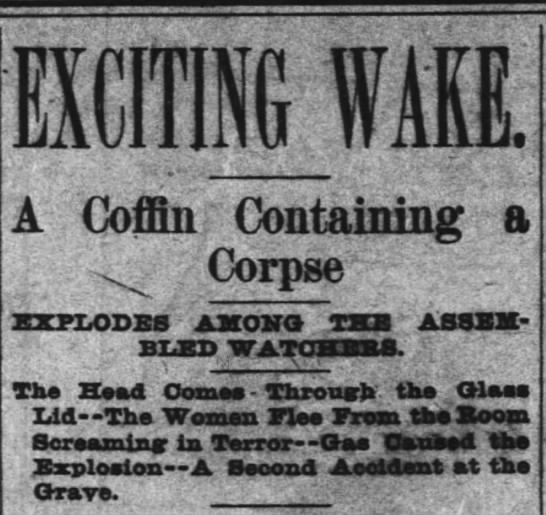
When you see the words “exciting” and “wake” in the same headline, you can make a guess that someone is not resting in peace. Fortunately, funeral services, however weird, seldom get as ghastly as our following tale. From the (Huntington, Indiana) “Daily Democrat,” July 21, 1890:
Sedalia, Mo., July 21.-- A burial which was performed under the most peculiar and weird circumstances took place at Springfork, fifteen miles from this city, at an early hour.

Among the early settlers of Pettis county were a young German by the name of John Peterson and his bride. On Thursday Mrs. Peterson died of dropsy. When a girl Mrs. Peterson was slim and supple, but as years passed on she grew very fleshy, and at the time of her death was a remarkably large woman, weighing nearly three hundred pounds.

Immediately after Mrs. Peterson's death arrangements were made for the funeral. The largest casket that could be procured in the city was the exact measure required at the time of her death, but as it was not delivered until Friday morning the corpse had swollen so much that it was crowded into the narrow case with difficulty. The lid was screwed down and the remains left in that condition for burial.

The funeral services were set for Saturday afternoon, and, as is customary, a number of neighbors acted as watchers on Friday night. Just as the stillness of midnight was approaching, the watchers were startled by a loud report in the parlor, where the coffin was placed. The women screamed and ran out of the house. but the men plucked up enough courage to go into the parlor.

The sight presented was a most horrible one. The gases of the body had accumulated in the casket until their force burst the glass over the face and bosom of Mrs. Peterson. So terrific was the explosion that the body was shot forward and upward, the head protruding from the coffin. A vapor cloud, laden with the rankest of putrid orders, filled the room.

The men sent for Mr. Peterson, who, after dressing himself, went down stairs. A consultation was held and it was decided that, owing to the advanced state of decomposition of the remains of the deceased, the burial should take place at once. Half a dozen of the male watchers agreed to dig a grave in the garden near the house while the others attended to other details of the burial. The grave having been prepared, the coffin was carried to the grave, and strong ropes were placed under the casket. Just as the coffin was lowered one of the assistants let go of the rope. This threw the weight to the head of the coffin and the ropes were jerked from the hands of the men stationed there. The coffin fell with great force head downward and was burst to pieces. It was decided to fill the grave at once without waiting for another casket, and the remains were thus interred.
Cremation has a lot to be said for it.

Wednesday, October 17, 2018

Newspaper Clipping of the Day

via Newspapers.com


Novels and movies about vengeful spirits angered over their last living wishes being ignored are so commonplace, you would think everyone would be aware of the danger, but some people just can't be told. The "Frankfort Daily Review," July 20, 1909:
Sterling, Ill. Friends and neighbors throughout Whiteside county are discussing in awestruck whispers the strange events associated with the burial of Mrs. Emma Stelzer, who vowed in a death message that unless her funeral was conducted from the house of the man she loved she would send her spirit to haunt him and to vex him for the remainder of his life.

Mrs. Stelzer killed herself by taking strychnine. She left a note saying that she loved Jacob Warner, a farmer, and that she wished her funeral to take place from his home. She also commanded Warner to see that her divorced husband did not witness the burial.

Warner scoffed at the strange threats. He said he never loved Mrs. Stelzer and that he would have nothing to do with her funeral. News of the woman's threat and the man's defiance spread over the countryside. and there was intense interest in the plans for the funeral.

Mrs. Stelzer's body was taken from the morgue, where it had lain since Warner refused to admit it to his home, and was carried out to the cemetery at the head of a long cortege of carriages, containing friends, neighbors, and many who were drawn by curiosity. The pastor had scarcely begun to read the burial service when the earth around the open grave caved in.

There was a suppressed movement of alarm among the crowd about the grave. The minister sent for workmen, who repaired the damage, and the burial service was resumed. Just as the pallbearers were about to lower the casket into the grave, one side of the grave caved in again and caught the casket, holding it like a vise. It was necessary to raise the casket to remove the dirt. On the second attempt there was another cave-in, and it was necessary to remove the casket again and remove the obstruction.


There was none in the funeral assemblage that believed the woman's threat had been anything more than the distracted message of a troubled woman, but all those present were visibly impressed by the two accidents.

Warner, who laughed at the threat that her spirit would return to haunt him all his life, keeps up his air of bravado. But he has noticeably grown pale and is failing in health, and friends who saw him the other day said he was a sick man. They attribute it to his brooding over Mrs. Stelzer's vow.
I have no idea what became of Warner, but I think it's safe to say that Emma was not a woman to be trifled with. Alive or dead.

Monday, September 21, 2015

Why Billy Hansbrough Failed to Rest in Peace

On May 4, 1905, the "Louisville Courier-Journal" carried a moving obituary notice for an eight-year-old named Billy Hansbrough. It was placed by the two people closest to him, William and Ada Hansbrough. The opening lines read, "Two hearts are grief-stricken, a once happy home is lonely and desolate, for death in its terrible mission entered the home of Mr. and Mrs. Hansbrough Saturday, April 22, at 4:30 o'clock, and took their little ray of sunshine from them."

The column (which included a handsome portrait of the deceased,) paid 124 lines of tribute to the "brown-eyed, sweet-faced" Billy, adding, "The suddenness of Billy's death has left desolation in its path." Billy was "their companion wherever they went, their comfort in sorrow, their little protector in the lonely hours of the night, and as he grew deeper in their lives and hearts, their love for him became dearer."

"Their little child and sunbeam" first showed signs of illness on April 13, when he refused to eat. William and Ada had sat up all night with him, keeping "warm flannels to his little cold body...When morning came he seemed better, and took his usual little walk...and then got up in his chair at the table." However, he still had no appetite. Billy was so perturbed, he ran away from home for three days. William and Ada "made every effort in human power" to find him. Finally, he returned, "so changed from their little bright-eyed darling they could hardly recognize him."

The notice went on to say, "After a loving greeting...he went through all the rooms of his happy home, where his toys and playthings were, then got up on his little bed, and they gave him his rag doll; he was so happy to be home again."

Billy's physician was summoned at once, but nothing could be done. "Neither love, medicine, nor prayers could save that precious life." Finally, after "a pitiful little moan," he "passed away for ever."

The mourning couple held a wake, attended by all the deceased's many friends and loved ones. Then, an undertaker was called in to embalm the little body. A beautiful and expensive casket was ordered. With "trembling hands," the Hansbroughs placed Billy inside the coffin, with "the little doll he loved so well by his side."

The Hansbroughs described the funeral of their beloved in Cave Hill Cemetery. "While a little bird in a tree above them was singing they laid their darling, their Billy, to rest in his little grave in the family graveyard" in a space between those reserved for Ada and William. "As they turned from that little grave they knew it would be their only comfort while they lived" that they would eventually rest in peace forever with him. "I believe his death will kill me," said Mrs. Hansbrough plaintively. "Oh, my baby Billy, if I only had you back for a while."

This was no ordinary family tragedy. The Hansbrough choice of resting place for "their darling" was destined to cause a great deal of legal trouble.

Because, you see, Billy was a dog.


The cemetery's board of directors had allowed this unusual burial on the condition that "no mound or marker" be placed over the grave. However, the Hansbroughs violated this agreement by raising a mound over Billy's resting place. They also talked of putting up a monument. All this was too much for the villain in our little tale: a fellow plot-owner named Henry Hertle. Hertle--obviously not a believer in the "man's best friend" motto--seemed to take it as a personal insult that he should be asked to share cemetery space with a dog. In January 1906 he filed a lawsuit aimed at forcing the Hansbroughs and Cave Hill Cemetery to exhume Billy and bury his remains elsewhere. Hertle's suit accused the Hansbroughs of "keeping and maintaining a nuisance." Cave Hill was a cemetery intended only for the use of "members of the white race." Mr. Hertle huffed that he was "greatly humiliated in thinking that the bodies of those who were near and dear to him lie near the buried dog and in the contemplation that of the probability that when he dies, his body will also be buried beside that of a dog."

Personally, I can think of far worse company--such as, say, the likes of Henry Hertle--but never mind.

Although the lawsuit argued that Cave Hill had violated its own rules by allowing the dog funeral, the defense made the point that the cemetery's charter said nothing specifically forbidding dogs to be buried there. In any case, how does one prove that a decently--and expensively--buried fox terrier constitutes a "nuisance?"

The two sides argued the matter in court for over a year. Finally, in the spring of 1907, the court ruled that Billy should be allowed to continue resting in peace. The judge ruled that plot owners should not be allowed to pick and choose who should be buried in cemeteries. Otherwise, it would prevent the burial of anyone who might be personally objectionable to any other individual. "The injury done here is to the living plaintiff, who expects to be buried in his lot at some future time. It consists in his distress of mind in contemplating his daughter's present burial and his own prospective interment in a lot adjoining that in which Billy lies buried. If this be an injury to person or property, it is too incapable of being measured to invoke action by the court. If the claim of right here asserted be permitted to control it would prevent the burial of any one -- a murderer or a suicide, for instance -- whose grave might be objectionable to neighboring lot owners.

"That matter is in control of the cemetery company. An unburied dog, either alive or dead, may be a nuisance per se, but a dead dog, well buried, as in this case, is not a nuisance per se, and can not become one." In short, if Billy's grave was all right with the cemetery company, it was all right with the judge.

Well, it wasn't all right with Henry Hertle. He filed an appeal. In December 1907, the state court of appeals agreed with his anti-canine spirit and overruled the circuit court's decision. One of the judges wrote, "If the body of a dog may find sepulcher on the lot of its owner in Cave Hill Cemetery, why might not the owner of a horse, or bull, or donkey, also bury his favorite on his therein, if his fancy should take this freakish direction? Where would or could the line be drawn if not at the body of a dog?" The tribunal ordered that Billy must be buried elsewhere.

Unfortunately, I do not know what happened after this. I presume the exhumation was carried out, but history is silent on Billy's ultimate resting place. According to Findagrave.com, Mr. and Mrs. Hansbrough are both interred in Cave Hill.

I'd like to think William or Ada managed to sneak Billy in with them.


Wednesday, July 23, 2014

Newspaper Clipping(s) of the Day, Taking the "Fun" Out of "Funeral" Edition

Illustrated Police News, 1893 via British Newspaper Archive


We tend to think of funerals as a place to say goodbye to corpses, not to create a fresh batch of them. However, anyone who has done even the quickest browse through old newspapers soon realizes that your typical funeral service is more like a war zone.

Don't believe me? Here is a mere sample of what I mean:

San Francisco Call, November 16, 1899


From the "Western Morning News," Oct. 27, 1948:
Five people were killed at a funeral yesterday when a thunderbolt struck a church near Venice. They were standing near the coffin. The church was badly damaged.

Western Australian, February 22, 1950

Yet another case of a funeral rudely interrupted by a death was reported in the "Davenport Leader" on November 27, 1900:
New Haven, Conn., Nov. 26.--With hands uplifted as she was about to deliver a prayer at the grave of Mrs. Emily Parker, a dead sister, Mrs. Sarah Grumley, Chaplain of Meriden Chapter, Order of the Eastern Star, was stricken dead.

Mrs. Grumley was seventy years old and a charter member of the chapter. She was apparently in good health when she started for the grave.

When she tottered and fell with the words of the ritual upon her lips there was consternation among the chapter members at the grave. Several fainted and the funeral service was left unfinished. At the funeral of Mrs. Grumley the members of the chapter will complete the service interrupted at Mrs. Parker's grave.

From the "Derby Telegraph," July 15, 1887:
On Monday the funeral of a negress was being conducted in a graveyard at Mount Pleasant, sixty miles south of Nashville, Tennessee, when a storm came on and the crowd ran for shelter under the trees. Nine persons stood under a large oak, which the lightning struck, killing every one instantly, including three clergymen and two sisters of the girl who had been buried.

If the lightning and the grenades don't get you, the church floor will. The "Manchester Courier," March 1, 1905:
Eleven persons were killed and forty injured by the collapse of a floor at Fleet-street African Methodist Church at Brooklyn.

They had assembled to attend a funeral of the late organist. The body and chief mourners had just arrived, and were about to enter the building when the accident occurred. It was due to rotten beams.

The church was built sixty years ago.

Some of the injured jumped out of the windows.

Sometimes, rather than Acts of God or the like, what you need to watch out for is a good old-fashioned riot. From the "Argyle Liberal and District Recorder" for March 13, 1906:


Then there was this story from the "Evening Telegraph," July 18, 1936:

Three persons were killed and many seriously wounded in a quarrel which broke out over the dead body of a woman at Pernambuco, Brazil.

Just before the body was to be buried the doctor announced that he proposed to perform an autopsy.

Members of the woman's family strongly opposed this proposal, and the parties came to blows.

Gotta watch out for those Sextons:

Los Angeles Herald, March 28, 1890

And your fellow mourners:

The "Evening Telegraph," August 15, 1866:
Baltimore, August 15.--A terrible tragedy occurred last Sunday, in Queen Anne's county, Maryland, at a place called "Hatton's When and Where." It seems that a man named Cooper, a Rebel, shot and killed two men, named James F. Johnson and Josiah Ellingsworth. Both died instantly.

The affair took place at a funeral, and jealousy is the alleged cause. All of the young men named were of the aristocracy of the region, and all were Seccessionists.


And the undertakers!

Launceston Examiner, August 8, 1927


Tombstones really need to be reclassified as dangerous deadly weapons.

Queensland Times, October 27, 1904

From the "Democratic Watchman," November 15, 1866:
The Kingston "News" tells of a singular death which occurred in Belleville, on Friday. A little girl, aged ten, daughter of a widow Brennan, while in a grave-yard, was killed by a gravestone falling over upon her.
The "Edinburgh News," May 9, 1911:
The Central News Appleby correspondent telegraphs: The lad, Arthur Holmes, who pulled a headstone upon himself while climbing for a bird's nest in Longmarton Churchyard on Sunday, died this morning at his parents' residence at Longmarton. His skull was broken right across the base.

The "Evening Telegraph," June 3, 1913:
While an interment was taking place in Greenside Cemetery, Alloa, a boy, eight years of age, named Allan Henney, the adopted son of William Henney, wool-sorter, was standing upon the plinth of a grave, when the stone collapsed and fell upon him, Several of the mourners assisted in extricating the boy from beneath the stone, and it was found that in addition to his left leg having been broken in two places he was internally injured. He was removed to the County Accidents Hospital, where he succumbed to his injuries.

From the "Manchester Courier," October 5, 1901:
The death of an unknown boy was reported to the Manchester City Coroner, yesterday, which was discovered on Thursday under queer circumstances. About five o'clock a scullery-maid, employed at St. Patrick's Convent, Livesey-street, Oldham-road, noticed a tombstone had fallen down in the old cemetery. She went to ascertain the cause, and was horrified to find it resting on the right arm, shoulder, and right side of the face of a boy aged about 12 years, who was quite dead. It is presumed that the boy was climbing over the wall into the cemetery--a common practice--and caught hold of the tombstone, which is near the wall, and which must have collapsed.

However, if you really want to talk death traps--both figuratively and literally--let's talk coffins. This following image from the November 9, 1872 "Illustrated Police News" depicting the sad-but-ludicrous death of a man named Henry Taylor who attended just one funeral too many has become justly famous on the internet. However, his tragic fate was just one of many. Go too near a coffin, and you may well wind up in one:


The "Anaconda Standard," April 5, 1912:
San Francisco. April 4--Whether a pallbearer who was fatally crushed beneath the coffin at a funeral service died accidentally within the meaning of the terms of an insurance policy is the question to be solved by the superior court here in a suit filed today. The suit was brought by Mrs. Rose Rock, widow of Joseph F. Rock, who died shortly after he had been crushed beneath the falling coffin of his friend, James Murphy, June 30 last.

The "Columbus Herald," February 7, 1894:
Birmingham, Ala., Feb. 7.--Tuesday afternoon at Double Springs, near here, the body of Mrs. Amanda Harris was being lowered into the grave, Geo. Gillas, one of the pallbearers, had hold of a strap when it broke, throwing him into the grave. As he fell his head was pinioned between the head of the coffin and the grave wall. The coffin box and corpse was heavy and before he could be extricated his head was crushed and death was almost instantaneous.


Billings Gazette, November 3, 1905


Sacramento Union, November 23, 1896
You don't even need to be at a funeral to fall prey to the deadly coffins. The "Cumberland Evening Times," November 19, 1912:
Raleigh, N.C., Nov. 19.--Caught in the collapse of a casket display case, George Newton, aged 70, was killed yesterday in a local undertaking establishment, to which he had gone to buy a coffin for the burial of his wife, who had died a few hours before.

From the "Medicine Hat News," January 11, 1934:
The victim of a falling coffin, the French aviation pilot Sergeant Girardin is dead at Boulay, near Metz. He was riding uphill in a hearse, with the corpse of an old man. The hearse hit a tree, the rear door flew open and the coffin fell out, landing on the flier.

The "Oakland Tribune," August 17, 1934:
A coffin killed Daniel Kilbury, 61, of Alhambra. He died last night of injuries suffered when a casket he was unloading from a truck slipped and crushed him to the pavement.

The "Stevens Point Journal," September 7, 1928:
It was a coffin that killed Stanley Gates.

Driving a truck for an undertakers' supply company, Gates was thrown to the ground when his machine and another collided yesterday. A cement coffin box, jarred from his truck, crushed him to death.

By this point in our post, you're thinking: "All right, I'll skip the funeral and simply say farewell to the dearly departed at their wake. No problem!"

Allow me a derisive snort while I present an item from the "Illustrated Police News," June 29,1867:
A Dublin paper states that a sad accident has occurred in Youghal, involving the loss of three lives and the entire destruction of the dead body of a woman, which was burned to ashes. A man who, in company with two neighbouring women, had sat for two nights by the corpse of his sister, "waking" it, on the third night sat up to a late hour, but he appears with them to have succumbed to weariness, and fallen into a deep sleep. From that slumber they never awakened, at least one would hope so, for if the sleep were broken it was only to find death imminent, and after a brief but fearful anguish to close their eyes again in death. Wayfarers returning late saw lights burning in the cottage at an advanced hour of the night. In the morning the neighbours came for the funeral, and found the house a heap of smouldering ruins. At some time in the night fire had broken out, and clasping the quick and the dead in a fiery embrace, had reduced the dwelling and all it contained to smoking ashes.


It seems that the words heard most often at a wake are not, "Rest in peace," but "Look out below!" From the "Sheffield Independent," August 15, 1874:
An accident at a wake in Dublin again demonstrates the dangerous folly of these grim festivities, which are still popular among the lower classes in Ireland. The floor of a room fell, in which thirty persons were assembled round the body of a child only two months old, and ten persons were so seriously injured in consequence that they were removed to the hospital, where they lie, some with broken legs and arms. There has been no death.

The "Western Mail," February 26, 1877:
An unusual event took place in Cardiff at about twelve o'clock on Sunday night. A front room in Ellen-street, Newtown, was the scene of a wake, the corpse being that of a little boy, whose parents resided on the premises. At the time just mentioned the room was full of a number of sympathetic friends, who, agreeably with the custom on such occasions, were occupying themselves with story-telling. Suddenly, just as the father of the deceased had given expression to the words "I'll tell the next tale," an inexplicable noise, such as might be produced by the cracking of joists, was heard, and without further warning the entire company found themselves precipitated into a cellar beneath, the candles, coffin, and corpse being tumbled together among the people. The confusion was something extraordinary, and it took some time for the melancholy party to grope their way to the upper part of the building fortunately none were hurt, and the corpse having been removed to another room, it was decided to adjourn the wake.

The "Worcester Journal," September 27, 1856:
On Friday night an accident occurred at a wake in Killalala, which was very nearly ended fatally. During the night the floor of an upper room in which the body was laid out and the people assembled, gave way, and fell with its living weight into a cellar beneath. A scene of terrible confusion ensued.

The "Dundee Courier," September 25, 1869:
An accident of most alarming occurred in a dwelling house in Salford on Wednesday evening. The house is of a construction similar to the greater number of the houses in back streets, which are known as single houses, consisting only of a ground floor with a large cellar underneath, and an apartment above. The ground floor in the house in question was occupied by Mrs. Rosannah Murray. Wednesday evening sixteen or seventeen people (men, women, and children) met in this house between seven and eight o'clock, for the purpose of "waking the body" of Mrs Murray's daughter, who had died some time previous. The people had not been long in the house when the floor, which consisted of stone flags, supported by couplings, or bars of timber, suddenly gave way, and fell with a tremendous crash into the cellar, a distance of seven or eight feet. The corpse, the people in the house, and all the furniture were precipitated with it. The furniture, of course, was much damaged, but, fortunately, though many of the people, especially the women, were greatly frightened and put into a state of great excitement, no bodily injuries of a serious nature were sustained. The cause assigned for the accident is that the bars which supported the floor were completely rotten.

The "Edinburgh Evening News," November 23, 1883:
While a wake was proceeding in a cottage in Dublin on the bodies a woman and a child, the flooring gave way and the assembled party were precipitated into a disused well. The people and the bodies were extricated with considerable difficulty, but fortunately no person was seriously injured.

Well, there you have it. If, after reading all this, you still persist in paying your last respects in person, don't blame me if you wind up electrocuted, shot, crushed, incinerated or beaten for your pains.

On the bright side: If you think these stories were horrifying, just wait until I chronicle what happens at those grim sinkholes of death and devastation known as wedding parties.