"...we should pass over all biographies of 'the good and the great,' while we search carefully the slight records of wretches who died in prison, in Bedlam, or upon the gallows."
~Edgar Allan Poe

Monday, August 3, 2020

The Case of the Vanishing Movie Star: A Mystery at Sea

"Philadelphia Inquirer," November 16, 1919, via Newspapers.com


Mary Ann Louisa Taylor (or, as she was known to her many fans, “Marie Empress,”) was a well-known actress of the silent film era. Her sultry good looks brought her much success in the “vamp” roles which were so popular in that period. She was also a talented singer, dancer, and male impersonator. Unfortunately, none of her films survive, so today, even among film historians, she is a largely overlooked figure. She is now only remembered--when she is remembered at all--for the peculiar circumstances of her death.

Little is known about Marie’s personal life. When she was 18, she married a dentist named Walter Herbert Horton. In 1906, after only four years of marriage, she left him in order to pursue a theatrical career. Horton--who seems to have taken the loss of his wife with equanimity--then moved to New Zealand. (As he explained in their 1918 divorce suit, “a wife did not want her husband when she was on the stage.”) Like most performers of her day, Marie supplied the press with many colorful and entirely fictitious details about her life, leaving her real history largely a mystery. 

"Philadelphia Inquirer," November 16, 1919


She became a comedienne in the music halls of her native England, where she was billed as “the girl who is making a name for herself.” This was not hyperbole. She was soon successful enough to be emboldened to try her luck in American vaudeville, where critics praised her “winning personality” and “dainty, dark beauty.” In 1915, she made her screen debut in a melodrama called “When We Were 21.” Again, she was an instant hit. Her films consistently did well at the box office, and reviewers enthused over her beauty, charisma, and acting talents. In short, Marie was well on her way to becoming one of cinema’s biggest stars. 

"Altoona Tribune," April 11, 1916


In the fall of 1919, Marie went to England to make personal appearances and negotiate film contracts with English producers. On October 16, she boarded the Cunard steamer Orduna for her return to New York. The glamorous 35-year-old actress--always dressed in black and sporting a monocle--naturally attracted a good deal of attention from her fellow passengers. She kept largely to herself, but seemed in excellent spirits. 

The Orduna


On the evening of October 26, the Orduna was two and a half hours out from its last stop in Halifax. Around six p.m., a stewardess brought dinner to Marie’s stateroom. Marie told her she wasn’t feeling very well, and wasn’t sure if she could eat anything, but half an hour later, when the stewardess returned to collect the dishes, she found that the actress had finished her meal. Marie told her to come back at about 9:30 with some sandwiches (it was apparently her habit to have a robust snack before going to bed.) The stewardess noted that Marie seemed cheerful and good-humored--as, indeed, she had been throughout the entire voyage. 

When the stewardess brought the sandwiches at precisely 9:30, she found Marie’s stateroom empty. Presuming the actress had gone out on deck, she put the food on a table and left. The next morning, the stewardess tapped on Marie’s door. There was no answer. When she entered the room, she found that the bed had not been slept in.  The sandwiches were untouched.  The only items missing from the stateroom--besides Marie--were her handbag and the jewelry she had worn the night before. When she reported this oddity to the captain, he had the ship thoroughly searched. There was no sign of Marie, and no one on board remembered having seen her. The only conclusion the passengers and crew could come to is that sometime between 6:30 and 9:30 on the night of the 26th, Marie had gone overboard--whether accidentally or deliberately, no one could say. 

The first mystery is how the actress could have gone into the sea. The porthole in her stateroom was far too small for her to fit through, and in any case it was found locked from the inside. For her to go on deck, she would have had to travel a number of well-lighted passageways and salons which, at that time, were crowded with people. The deck itself was also brightly lit, and full of passengers and crew members. Surely, it was reasoned, someone with Marie’s striking looks could not have slipped through and thrown herself into the sea unobserved? 

The second question is why Marie would have wished to drown herself. Although she seems to have not spoken much to anyone on the ship, there was nothing indicating she contemplated anything other than a successful sojourn in New York. A rack above her berth contained a number of photographs of herself which she intended to give to the press when she arrived. From Halifax, she had cabled a New York hotel asking them to reserve a room for her. She had just completed a triumphant tour of Australian music halls, and her stewardess said Marie had hinted to her that she might soon marry. 

Her disappearance was considered so inexplicable that newspapers declared that Marie was alive and well and staging an epic publicity stunt--a theory bolstered by her proven ability to pass herself off as a man. An English press agent, Walter Kingsley, coyly told reporters, “Did you ever hear of a woman registering as Miss So-and-So and later changing her room and calling herself Miss Somebody Else?” He added, “Wouldn’t it be nice if a fishing boat picked her up, or something like that happened?” The grinning Kingsley predicted that the missing woman would soon turn up “mysteriously and unannounced” in New York.  Rumors spread that Marie had managed to sneak into New York disguised as one of the ship’s male crew members. 

"Waterloo Courier," November 18, 1919


However, as the days went by with no sign of the missing actress, and her trunks remained unclaimed, it became obvious that poor Marie had gone overboard.  Was this a case of accidental fall? Suicide? Or, as some darkly suggested, even murder? It was reported that a London man named Oliver Williams was “the one person who could throw light on the mystery,” but that enigmatic statement was never expanded upon. 

Nothing remained to keep her memory alive except her films, which, eerily, continued to play in theaters for months after she was last seen in the flesh. Eventually, of course, even those faded away, and, before very long, the once-acclaimed Marie Empress was nothing but a forgotten mystery at sea.

Friday, July 31, 2020

Weekend Link Dump

"The Witches' Cove," Follower of Jan Mandijn


It's time for the Link Dump!

And tea is served!


Do you want to buy an Irish mansion inhabited by the Devil?  Of course you do.

If you want to lose what little faith in humanity you have left, contemplate the fact that somebody out there would spend $12,000 for a pizza that looks like something I wouldn't eat for free.

Maurice the Rooster and "sensory heritage."  I've long been bemused by people who flee cities for rural areas and then bitch about how rural areas aren't enough like a city.

How the Titanic foiled a kidnapping.


The naming of Mount Everest.

How the corpse of a murderer wound up doing advertising for a drug store.

How a woman wasn't murdered.

How Chicago was shaped by skunks.  Um, I mean literally, but I won't blame you for thinking otherwise.

How hurricanes have shaped history.

A grave that's become a circus shrine.

Need an excuse to move out of your house?  Here are a few suggestions.

A Portuguese writer who was "brilliantly clever but quite mad."

Anglo-Saxon medicine for the win!

The execution of Essex witches.

India has a potato-throwing poltergeist.

Vikings are being blamed for spreading smallpox.

You know the old, old story: boy meets girl.  Love blossoms.  They go live in a cave...

When cryptids meet mainstream science.

The "fasting-woman of Tutbury."

A look at Cockney Beanos.

A mass UFO sighting in Finland.


Vintage newspaper portraits of dogs.


A child is accidentally murdered by the Mob.

A Persian Prince goes on trial.

Singer Johnny Horton's fake son.

An unartful dodger.

Two words you definitely don't want to see in the same headline: "latrine" and "disaster."

De Quincey and the fine art of murder.

How Raphael probably died.  (Spoiler: his doctors were quacks.)

The murder of a major figure in early Canadian history.

The Great Long Island Tiger Hunt.

Neanderthals were sissies.

Accounts of flying trains.

And we're outta here for this week.  Tune in on Monday, when we'll look at the strange end of a silent film star.  In the meantime, here's a bit of Baroque.


Wednesday, July 29, 2020

Newspaper Clipping of the Day

Via Newspapers.com


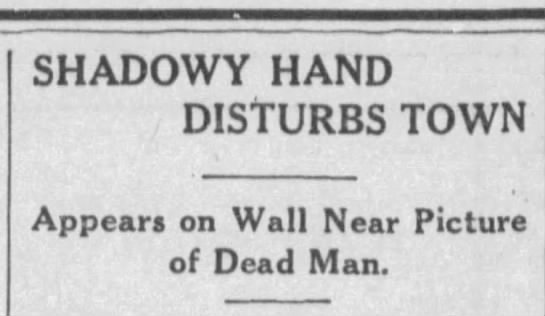
I think it’s about time a Shadowy Hand made an appearance on this blog. The “Garber Sentinel,” August 18, 1927:
Aosta, Italy—Priests and spiritualists using respectively exorcisms and mediums are seeking to probe the mystery of a shadowy hand which for some weeks now has been disturbing the family peace of a modest workman, Giuseppe Della Villa. who lives here with his wife and four children.

Some months ago a brother of Della Villa who lived in the house died, and a few weeks ago the family hung up a photographic enlargement of the deceased in the room in which he slept. The first signs of the psychic phenomenon were noted by Della Villa and his wife one night about ten o’clock. The clearly defined shadow of a hand appeared on the wall close to the photograph and the fingers opened and closed as if trying to grasp something. The neighbors were called in and the phenomenon was repeated in the presence of half a dozen people.

The dead hand was shadowed on the wall near the photograph on several other occasions, always at night time, and the parish priest was called in to pronounce an exorcism. This seems to have produced no effect on the shadowy hand, which continued to show up every other night about bedtime.

Some local spiritualists then interested themselves and brought a medium to the house. According to the medium the hand is a spirit manifestation from the dead brother who is trying to convey a message to the family. What this message is the medium does not pretend to know.
There do not seem to be any follow-ups to the story.

Monday, July 27, 2020

The Demon of the Printing-Office: An Unusual 18th Century Haunting


Poltergeist accounts tend to be surprisingly formulaic--read enough of them, and you start to think, “If you’ve seen one polt, you’ve seen them all.” For that reason, the number of unusual and bizarre details in the following story come as a welcome change of pace. This report comes from the Benedictine monk Antoine Augustin Calmet, whose informant was probably one of the exorcists involved in the case.
They write me word from Constance, the 8th of August, 1748, that towards the end of the year 1746 sighs were heard, which seemed to proceed from the corner of the printing-office of the Sieur Lahart, one of the common-council-men of the city of Constance. The printers only laughed at it at first, but in the following year, 1747, in the beginning of January, they heard more noise than before. There was a hard knocking near the same corner whence they had at first heard some sighs; things went so far that the printers received slaps, and their hats were thrown on the ground. They had recourse to the Capuchins, who came with the books proper for exorcising the spirit. The exorcism completed, they returned home, and the noise ceased for three days.

At the end of that time the noise recommenced more violently than before; the spirit threw the characters for printing, whether letters or figures, against the windows. They sent out of the city for a famous exorcist, who exorcised the spirit for a week. One day the spirit boxed the ears of a lad; and again the letters, &c, were thrown against the window-panes. The foreign exorcist, not having been able to effect anything by his exorcisms, returned to his own home.

The spirit went on as usual, giving slaps in the face to one, and throwing stones and other things at another, so that the compositors were obliged to leave that corner of the printing-office and place themselves in the middle of the room; but they were not the quieter for that.

They then sent for other exorcists, one of whom had a particle of the true cross, which he placed upon the table. The spirit did not, however, cease disturbing as usual the workmen belonging to the printing-office; and the Capuchin brother who accompanied the exorcist received such buffets that they were both obliged to withdraw to their convent. Then came others, who, having mixed a quantity of sand and ashes in a bucket of water, blessed the water, and sprinkled with it every part of the printing-office. They also scattered the sand and ashes all over the room upon the paved floor, and being provided with swords the whole party began to strike at random right and left in every part of the room, to see if they could hit the ghost, and to observe if he left any foot-marks upon the sand or ashes which covered the floor. They perceived at last that he had perched himself on the top of the stove or furnace, and they remarked on the angles of its marks of his feet and hands impressed on the sand and ashes they had blessed.

They succeeded in driving him from thence, and they very soon perceived that he had slid under the table, and left marks of his hands and feet on the pavement. The dust raised by all this movement in the office caused them to disperse, and they discontinued the pursuit. But the principal exorcist having taken out a screw from the angle where they had first heard the noise, found in a hole in the wall some feathers, three bones wrapped up in a dirty piece of linen, some bits of glass, and a hair-pin, or bodkin. He blessed a fire which they lighted, and had it all thrown in. But this monk had hardly reached his convent when one of the printers came to tell him that the bodkin had come out of the flames three times of itself, and that a boy who was holding a pair of tongs, and who put this bodkin in the fire again, had been violently struck in the face. The rest of the things which had been found having been brought to the Capuchin convent, they were burnt without further resistance; but the lad who had carried them there saw a naked woman in the public market-place, and on that and the following days groans were heard in the market-place of Constance.

Some days after this the printer's house was again infested in this manner, the ghost giving slaps, throwing stones, and molesting the domestics in diverse ways. The Sieur Lahart, the master of the house, received a great wound in his head, two boys who slept in the same bed were thrown on the ground, so that the house was entirely forsaken during the night. One Sunday a servant girl carrying away some linen from the house had stones thrown at her, and another time two boys were thrown down from a ladder.

There was in the city of Constance an executioner who passed for a sorcerer. The monk who writes to me suspected him of having some part in this game; he began to exhort those who sat up with him in the house, to put their confidence in God, and to be strong in faith. He gave them to understand that the executioner was likely to be of the party. They passed the night thus in the house, and about ten o'clock in the evening, one of the companions of the exorcist threw himself at his feet in tears, and revealed to him, that that same night he and one of his companions had been sent to consult the executioner in Turgau, and that by order of the Sieur Lahart, printer, in whose house all this took place. This avowal strangely surprised the good father, and he declared that he would not continue to exercise, if they did not assure him that they had not spoken to the executioner to put an end to the haunting. They protested that they had not spoken to him at all. The Capuchin father had everything picked up that was found about the house, wrapped up in packets, and had them carried to his convent.

The following night, two domestics tried to pass the night in the house, but they were thrown out of their beds, and constrained to go and sleep elsewhere. After this, they sent for a peasant of the village of Annanstorf, who was considered a good exorcist. He passed the night in the haunted house, drinking, singing, and shouting. He received slaps and blows from a stick, and was obliged to own that he could not prevail against the spirit.

The widow of an executioner presented herself then to perform the exorcisms; she began by using fumigations in all parts of the dwelling, to drive away the evil spirits. But before she had finished these fumigations, seeing that the master was struck in the face and on his body by the spirit, she ran away from the house, without asking for her pay.

They next called in the Cure of Valburg, who passed for a clever exorcist. He came with four other secular cures, and continued the exorcisms for three days, without any success. He withdrew to his parish, imputing the inutility of his prayers to the want of faith of those who were present.

During this time, one of the four priests was struck with a knife, then with a fork, but he was not hurt. The son of Sieur Lahart, master of the dwelling, received upon his jaw a blow from a paschal taper, which did him no harm. All being of no service, they sent for the executioner of the neighbourhood. Two of the persons who went to fetch him were well thrashed and pelted with stones. Another had his thigh so tightly pressed, that he felt the pain for a long time. The executioner carefully collected all the packets he found wrapped up about the house, and put others in their room; but the spirit took them up and threw them into the market-place. After this, the executioner persuaded the Sieur Lahart that he might boldly return with his people to the house; he did so, but the first night, when they were at supper, one of his workmen named Solomon was wounded on the foot, and then followed a great effusion of blood. They then sent again for the executioner, who appeared much surprised that the house was not yet entirely freed, but at that moment he was himself attacked by a shower of stones, boxes on the ears, and other blows, which constrained him to run away quickly.

Some heretics in the neighbourhood, being informed of all these things, came one day to the bookseller's shop, and upon attempting to read in a Catholic Bible which was there, were well boxed and beaten; but having taken up a Calvinist Bible, they received no harm. Two men of Constance having entered the bookseller's shop from sheer curiosity, one of them was immediately thrown down upon the ground, and the other ran away as fast as he could. Another person, who had come in the same way from curiosity, was punished for his presumption, by having a quantity of water thrown upon him. A young girl of Augsburg, a relation of the Sieur Lahart, printer, was chased away with violent blows, and pursued even to the neighbouring house, where she entered.

At last the hauntings ceased, on the 8th of February. On that day the spectre opened the shop-door, went in, displaced a few articles, went out, shut the door, and from that time nothing more was seen or heard of it.

Friday, July 24, 2020

Weekend Link Dump

"The Witches' Cove," Follower of Jan Mandijn


The host of this week's Link Dump has the honor of representing cats everywhere.


Watch out for cursed cars!

The Twitchell/Hill murder.  Illustrated!

Dickens was not a very nice guy, and his books show it.

Becoming a math genius, the hard way.

If you're going to fake your own death, remember that good spelling counts.

How a viral tweet revived an extinct drink.

The Victorian obsession with premature burial.

Exploring an Iron Age burial mound.

The Pentagon goes UFO hunting.

From Sea Beggar to Beheaded Beggar.

Lady Gray, foster mother to puppies.

One really freaking old butter dish.

The "Theophrastan character.”

So let's talk screaming mummies.  (And a rebuttal.)

You want to know how big the Pacific Ocean is?  This big.


Via Reddit.


Some notable goddesses.

The first Europeans on Tahiti.

London's railway of the dead.

A serial killing sorcerer.

Cattle mutilations and a satanic cult.

The strange death of a mysterious hiker.

Venus may have active volcanoes.

Samuel Taylor Coleridge, spiritualist.

Jane Austen and the Royal Navy.

The death of a doll.

Sometimes, good deeds are rewarded.

The Auschwitz "hanging of the twelve."

This week in Russian Weird visits a haunted museum.  And the world's weirdest radio station.

The history of women avoiding execution by "pleading the belly."

How an urban legend turned an accountant into the Richmond Vampire.

That time when Coney Island sent you to Hell.

A British writer's description of an early 19th century New York resort hotel.

Film of the Apollo moon landings, enhanced.

The mystery of Sweden's "sleeping beauty."

The tsunami that devastated prehistoric Britain.

The teenager who tried to assassinate Queen Victoria.

A recipe for Soviet Pizza which is just as horrifying as you'd imagine.

A visit to Waltham Abbey.

The neuroscience of nostalgia.

Blacks in Georgian England.

A fatal case of criminal neglect.

The life of Mark Twain's wife.

South Texas has a headless horseman.

How ancient humans traveled from Siberia to Patagonia.

Ancient non-human mummies.

"Screams blasted into the wilderness" pretty much says it all about 2020.

How DNA allowed a man to find his past.

The moon's mysterious lights.

The grounds of Fulham Palace.

A pioneering 18th century naturalist.

The amateur professor.

That's it for this week! See you on Monday, when we'll look at an unusual 18th century poltergeist. In the meantime, here's Fairport Convention.

Wednesday, July 22, 2020

Newspaper Clipping of the Day

Via Newspapers.com


As I have mentioned before, I have a particular fondness for Sailor Cats. This week’s post pays tribute to one of the most well-traveled of them all. The “Kansas City Times,” January 31, 1897:
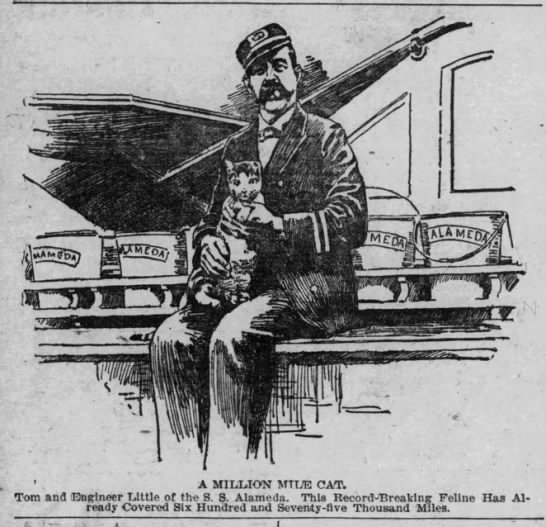
Here is a cat that is striving to make a unique record. To cover 1,000,000 miles is the goal of its ambition and that of its owner, Chief Engineer A. D. Little of the steamer Alameda of the Oceanic line.

It is the most widely traveled cat in the world. Up to the present time Tom has covered a distance of 675,000 miles during his wanderings, and both he and his master are living in the hope that he will be able to reach the million mark. Incidentally, Tom has had many strange experiences. He has been battered about and laid on the sick list more than once, but never has this prevented him from continuing his travels.

Tom has done most of his journeyings on the Alameda, on board of which Mr. Little has sailed as chief engineer for over thirteen years. The Alameda plies between San Francisco, Hawaii, New Zealand and Australia, and at every port where the vessel touches Tom is as well known as the oldest salt in the service. There are dozens of persons interested in him, and many of them keep a record of the miles he travels, adding to the score whenever the famous old feline reaches port. On the waterfront at San Francisco Tom is as well known, in fact, better, than the oldest policeman on the beat, and surely twice as well liked, and at Honolulu, Apia, Auckland and Sydney he is first favorite with all who frequent the docks.

There will certainly be a general lamentation if Tom is not spared to make his record of 1,000,000 miles, but the chances are that he will, for at present the old cat is as healthy as he ever was. It was not until Tom had been at sea for ten years that Mr. Little began to figure up the number of miles he had covered, but since that time he has kept a careful record, and at the close of the last voyage, when it was discovered that Tom had covered a distance of 675,000 miles, there was general feasting among the crew. At present the feline globe-trotter is forging his way over the ocean, adding more miles to his record, and when he left San Francisco he looked as strong as if he were still in his prime, and so the race between him and death goes on, with time having the best of it up to now.

Tom, originally, belonged to the crew of the bark Alden Bessie. He was then quite a kitten. This was about thirteen years ago. One day he crawled up the gangway of the Alameda and started to run round the deck as if he was anxious to start a record for traveling. Several of the sailors tried to catch him, but Tom would not be caught. He secreted himself in various parts of the ship until she went to sea, and from that day to this, he has been on board the Alameda.

As he grew older, Tom began to settle down to business, and it was not long before the upper part of the ship, and the 'tween decks were perfectly clear of rats. It was this quality that brought him so much good luck, and also a great deal of comfort.

From the moment that Tom boarded the Alameda he kept to himself. No amount of coaxing could make him friendly. He would not allow anyone to pick him up, and if any of the sailors tried to stroke him, he would dart off, and disappear for a couple of days. Then he would renew his crusade on the rats. This was the case on the first voyage that Tom took. One day he was hunting the vermin and happened to chase a monster rat into the galley. In his anxiety to catch his foe Tom jumped onto the stove. His feet were badly burned, and with a howl of pain he rushed out of the galley and stowed himself away in the 'tween decks. Engineer Little, who has always been very fond of Tom, started for him, groping among the cargo for several hours, at last finding him writhing in pain between two barrels. Little picked up the cat and took him to his room, dressing his feet with vaseline every day until they were cured, and from that time Tom has been friendly to the chief engineer.

There are now three cats on board the Alameda, but of course they are not such old voyagers as Tom, and he seems to know it. for under no circumstances will he allow one of the "green hands" to walk on the poop. Perhaps when they, too, have traveled 675,000 miles things will be different, but now Tom is very strong. Thirteen years of good food and sea air have told their tale, making him one of the healthiest feline specimens that ever went to sea.

Of late years Tom has acted as sentinel at the door of Engineer Little's stateroom, but there is something paradoxical about his methods. He will kill every rat that dares to make an appearance, but if he ends the life of one anywhere else on the ship the first thing he does is deposit the carcass by Mr. Little's door.

But this wonderful traveling cat is sagacious in other ways. He knows the sound of a flying fish, and never one falls on the deck that does not find its way to the chief engineer's door. Flying fish are considered quite a delicacy at sea, but Tom is always rewarded for his faithfulness by being allowed to eat his captive. The only annoying part about this peculiarity of Tom's is that he will often crawl onto Mr. Little's bed and awaken him if he has a victim's body on display. But his master never chides him for this, and so the old cat remains happy, at least in this regard.

Tom has never missed a sailing day. He is too anxious to travel. In his younger days he used to go ashore a great deal, and sometimes he stayed away for a day or two at a time, but he always showed up at muster on sailing day. Mr. Little has always been at a loss to know how the cat seemed to realize that the ship was about to sail, but the fact remains that he did so, and does so still.

At present Tom is traveling with one ear and a half. This condition was brought about by an encounter with a cat in Sydney, in which, although Tom came out ahead, he did not do so without receiving several reminders of the affray.

When Tom had finished his first 600,000 miles of travel, his American admirers in San Francisco presented him with a silver collar, marked with the inscription "Old Tom, S.S.. Alameda. Presented by his American admirers July 4, 1896."

There was considerable fun at the presentation. A delegation waited on Mr. Little and explained to him their mission. Tom was escorted to the ship's saloon and seated on a table by his master's side. Many of the ship's company were present, and when the speech-making began they were all as interested as if they were listening to an oration over the body of some fallen hero. Tom's history was rehearsed, and due tribute was paid to his superiority as a traveler. Then the collar was presented. Mr. Little, in replying, explained how honored Tom felt at the distinction, and expressed the hope that they would all meet again after he had finished his 1,000,000 miles, for which sentiment there were loud cheers. Then the chief engineer explained that if it was not for the fact that all present were known to be true friends of Tom, he would feel, to some extent, that an insult had been offered by the gift, inasmuch as Tom was well known to be a gold cat. However, he continued. Tom would wear his silver collar on all state occasions, though it must not be expected that he would change his political views.

After the ceremony was over a light luncheon was served, in which Tom joined, and after his health had been drunk several times, the party disbanded. But It was a proud day for Engineer Little, who thinks as much of his pet as he does of anything in the world. Tom's friends in Sydney have asked the privilege of presenting him with a gold collar when he has finished his 1,000,000 miles, and it is expected that there will be great rejoicing when the event comes off.
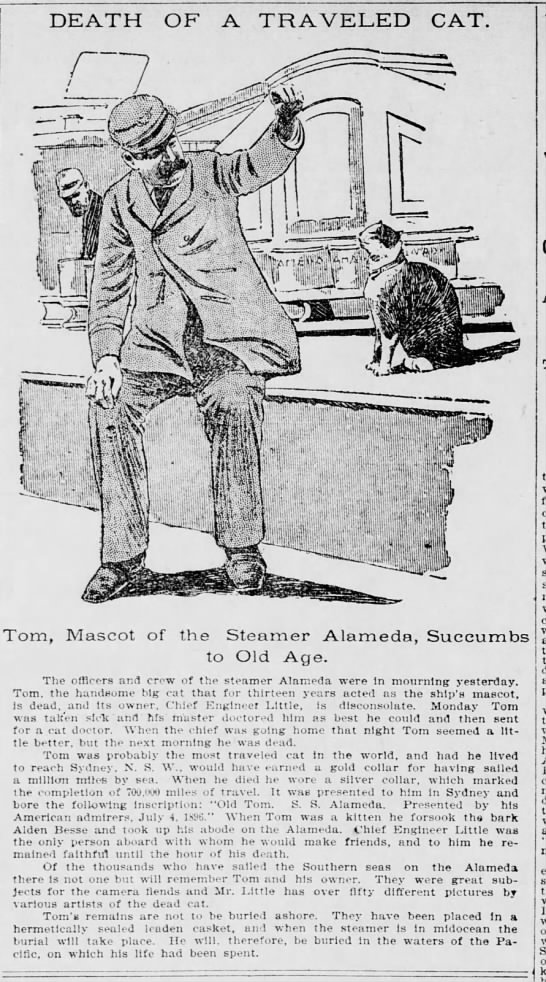
Sadly, Tom never reached his goal. The “Honolulu Adviser” for July 22, 1898 reported that this great Sailor Cat had made his last journey:
Chief Engineer Little's handsome big cat Tom, for thirteen years the mascot of the Alameda, died at San Francisco when the ship was last in that port. Tom was buried at sea.

Tom was probably the most traveled cat in the world, and had he lived to reach Sydney, N.S.W., would have earned a gold collar for having sailed a million miles by sea. When he died he wore a silver collar, which marked the completion of 700,000 miles of travel. It was presented to him in Sydney and bore the following inscription: "Old Tom. S.S. Alameda. Presented by his American admirers, July 4, 1896."

When Tom was a kitten he forsook the bark Alden Bessie and took up his abode on the Alameda. Chief Engineer Little was the only person aboard with whom he would make friends, and to him he remained faithful until the hour of his death. Of the thousands who have sailed the Southern seas on the Alameda there is not one but will remember Tom and his owner. They were great subjects for the camera fiends and Mr. Little has over fifty different pictures by various artists of the dead cat.
RIP, Tom. You had a great run.

San Francisco Call, July 13, 1898

Monday, July 20, 2020

Little Peyton Place on the Prairie: The McElheny Murder

The Western Spirit, October 11, 1912, via Newspapers.com


When you think of bleak, mysterious murders with a Gothic hue, a small town in early 20th century Kansas is not the first thing that springs to mind. Neither is a postmaster, for that matter.

Well, think again.

We do not know very much about the life of George McElheny of Louisburg, Kansas (population 500,) because there wasn’t very much to say. He was the town’s postmaster, which suggests he was a man of some local standing and respectability. He gave the impression of being a classic “ordinary citizen”; someone who quietly lives their life without distinguishing themselves in either a positive or negative fashion.

On the evening of October 5, 1912, the 32-year-old McElheny, along with his wife Maude and their two young children, Victor and Winifred, attended a band concert. After they returned home, George went to the kitchen of their little cottage to adjust an oil lamp, while his wife went to another room to take off her wraps. All was quiet. Then, around 10 p.m., someone silently walked up to the screen door of the kitchen and shot McElheny through the screen, killing him almost instantly. The assassin then vanished into the night. Although the screams of McElheny’s wife and children sent neighbors instantly rushing to the scene, no one saw any sign of the murderer.

This was one of those murders that left authorities in an instant state of befuddlement. Literally no one had any idea why anyone would murder McElheny in such a cold, execution-style fashion. Robbery was clearly not the motive, and the dead man was a churchgoing, friendly sort with no enemies. His marriage of twelve years was believed to have been a happy one.

The first thing police did was to bring in bloodhounds, in the hope they could find the killer’s trail. Three hundred men, virtually the entire male population of Louisburg, was summoned. They all stood in line to be inspected by the dogs. The hounds took little notice of any of them. The dogs followed a trail which led to a circuitous route for a half-mile to the train depot. The dogs refused to go any further.

Lacking any workable clues, the press then did what it usually does in such situations: bring on the usual suspects. The first to be named was a laborer for the Missouri Pacific named Harvey McCoy, on the grounds that it was said McCoy had quarreled with McElheny over the laborer’s desire to sell bootleg whisky at the Louisburg fair. (McElheny was the fair’s treasurer.) It was alleged that McCoy had recently bought a box of gun shells similar to the shell found at the murder scene. Newspapers soon reported that McCoy had been arrested and charged with the slaying.

And then, the newspapers had one of those “Oopsie!” moments which make libel lawyers throw their hats in the air and emit three cheers:
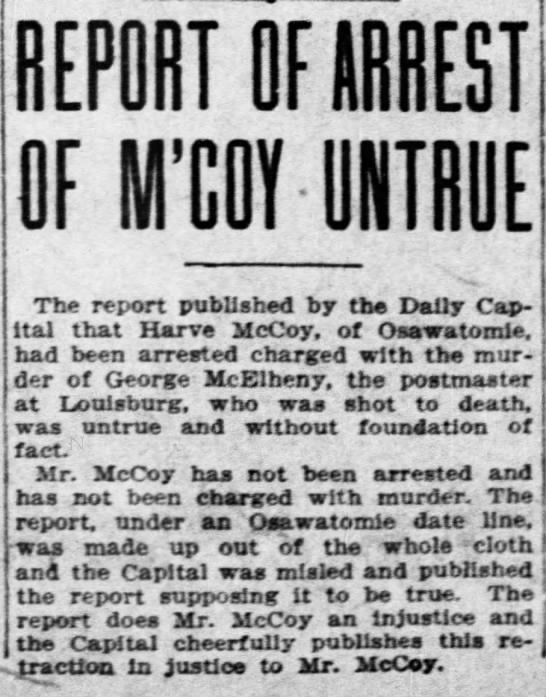
Topeka Daily Capital, October 13, 1912


Exit Mr. McCoy from our little story. (And, yes, he sued several different newspapers and one Keith Clevenger for defamation.)

A local “citizens committee” offered a reward of $1,000 for any information leading to the arrest and conviction of this peculiarly mysterious murderer. No one came forward.

Lacking any sort of clues to follow, the story quickly died in the newspapers. On October 31, it was reported that one William Henson had bought the late McElheny’s bird dog, “considered by sportsmen as one of the best ones in this part of the country,” for $15.

It was looking as if this sporting dog would be the last word on the murder. Then, in late December, the inquest into McElheny’s death was held, and things quickly got interesting. This hearing had been held in secret, with the jury hearing from a variety of witnesses behind closed doors. This testimony apparently consisted entirely of gossip and innuendo, but it was enough to have one Charles H. Crosley accused of the murder.

The 60-year-old Crosley had been considered one of Louisburg’s most respected citizens. From what was reported, the case against him was laughably feeble. Several days after the murder, one person told another that Crosley had said he would “kill someone.” This alleged statement circulated through the town until, inevitably, McElheny’s name was inserted as the “someone.” Shortly after the murder, it was rumored that Crosley had a pair of shoes in no need of repair, but he had taken them to be “half-soled,” anyway. Was this to prevent the shoes being fitted into the tracks left by the murderer? (Sadly for the gossips, testimony from Crosley’s shoemaker established the innocence of Crosley’s act.)

Crosley himself issued a signed statement. It made a convincing case for his innocence:
I did not kill George V. McElheny. I had no reason to do so. He was one of my best friends. If I had sufficient reason to kill him or any other man I would have done so in daylight and there would have been no need for any detectives. I welcome arrest because I have sufficient evidence to show that I could not possibly have committed the crime. George was killed at about 9:45 o'clock in the evening. I can prove that I reached my home at 9:30 o'clock and was playing solitaire when the shot was fired. A relative of the dead man was at my house at the time and another relative talked with me over the telephone ten minutes before the murder. My house is nearly a mile from the McElheny home. Another thing, I have not owned a shotgun for more than twenty five years and I have not fired one in five years. I never have borrowed one. I have obtained denials from two persons whose statements are said to have led to this slander and gossip and I am more than willing to face any man who has anything upon which to connect me with this murder.
McElheny’s relatives, including his widow, asserted their belief that Crosley had nothing to do with the murder.

The secret inquest went on. And on. And on. It was now alleged that for weeks, McElheny had lived in fear of being attacked, but by whom? And why? Nobody knew. Investigation into his professional and private life revealed no reason for anyone to want him dead.

On January 7, the inquest finally adjourned, without hearing anything the least bit useful. The jury gave the standard verdict of murder by person or persons unknown. President Wilson appointed Mrs. McElheny to succeed her late husband as postmaster. And life went on.

It looked as if the investigation into the murder was as dead as McElheny himself. Then, in April 1915, came a development absolutely no one had predicted: Maude McElheny went to the Miami county prosecutor and told a tale outdoing the most lurid dime novels of the period.

Mrs. McElheny claimed that before her husband’s death, one Roscoe Hornbaker had written to George suggesting they indulge in a spot of wife-swapping. When McElheny declined, Hornbaker “forced his attentions” on her. She was never a willing partner in the affair, but she continued to sleep with him because he threatened to tell her husband about their relations if she refused him. He also tormented her with allegations of George’s infidelity. Hornbaker told her that George was having an affair with Charles Crosley’s daughter Zelda (who worked in McElheny’s post office) and was planning to elope with her, taking George’s son Victor with them. (Maude explained that Zelda liked their son, but not their daughter.)

Hornbaker subsequently urged her to kill George by putting ground glass in his food. Once George was dead, Roscoe would murder his own spouse, and then the two of them could be together. When she refused, Hornbaker took matters into his own hands by hiring a hit man to shoot his rival. (She learned of Hornbaker’s guilt in a dream, in which her husband appeared at her bedside and named Roscoe as the man who had him killed.) She explained her long silence about all these fascinating details by saying Hornbaker had threatened to kill her as well if she told anyone.

Hornbaker, a 39-year-old mail carrier from the office where George McElheny had been postmaster, was immediately arrested. He vigorously denied every word of Maude’s story. “It is a frame-up!” he declared. He had never been intimate with Mrs. McElheny, he knew nothing about the murder, and he had no idea whatsoever why the widow would accuse an entirely innocent man. He added that he could prove he was at home with his family at the time of the murder.  (As a side note, many people commented that it seemed unlikely that in a nosy and gossipy community like Louisburg, such a liaison could go unnoticed.)

The statement of Hornbaker’s wife Belle took the mystery’s weirdness quotient up by quite a few notches:
Mrs. McElheny never was in any room of my house alone with my husband. I do not think she ever was alone with him anywhere. I am sure there was no love affair between them. My husband has always been good to me, much better than most husbands and we had a perfectly happy married life. He never had an affair with that woman, of that I am sure.

Why she is accusing him I don't know. But she has some motive. She came to my house on the 19th day of last March and talked with me in a friendly manner for a few minutes. Then she said, “Are you alone?” I said I was. “I want my letters,'' she cried.

She was sitting behind me and as I turned my head, astonished at her words, she had a revolver pointing at my head. I jumped up and caught it and threw it up. See where I bent my thimble in the scuffle. I feel sure she was going to kill me. Never did I see such a look In a human being's eyes as was in hers. I knew I was fighting for life. I tried to get her out of the door but was not strong enough and at last I got near the entrance myself and slipped out and hanged the door. I ran for my life to my neighbor, Mrs. John Rice's, and told her what had happened. Mrs. McElheny followed me out of my house and Mrs. Rico saw her.
Hornbaker was a liked and well-respected member of the community, so his arrest came as a general shock. What was even more startling was that there was at least some corroboration for Mrs. McElheny’s scandalous story. At Hornbaker’s trial, Dr. F.J.V. Ferrel, coroner of Miami county at the time of the murder, testified that the defendant had repeatedly urged him to call off the investigation into McElheny’s death. After first denying that he had letters from Mrs. McElheny, he finally admitted that he did, and reluctantly agreed to give them to Ferrel. He then continued to pester the coroner, asking if “Maude had told anything,” and if she would “keep still.”

These letters were introduced into the court record. They were described as “tangled and incoherent missives,” indicating that Maude hated and feared Hornbaker, and she repeatedly begged him to leave her alone.

Maude’s testimony was a repetition of her initial confession. The “unusually attractive” young woman was obviously extremely nervous on the stand, telling her story in a halting manner, with her eyes continually downcast.

Topeka Daily Capital, April 3, 1915


Hornbaker’s attorney opened the defense by asking Mrs. McElheny point-blank if it wasn’t true that she herself shot her husband. He pointed out that she testified that she had been in the front yard to collect a milk delivery just seconds before the shooting. “Did you take George’s shotgun with you when you went out after that milk,” he thundered. “Did you go around to the kitchen door to shoot him, then run back and come in by the front way?”

The shaking, white-faced woman stammered out a denial.

Evidence exonerating Hornbaker for the murder was given by a Louisburg telephone operator, Edgar Hand. He testified that on the night of the murder, Mrs. McElheny phoned to tell him of the tragedy. He then called Hornbaker, who instantly answered the phone. Hand noted that Hornbaker’s home was a considerable distance from McElheny’s.

The defense continued to suggest that Maude was the real murderer. Hornbaker took the stand, still denying Maude’s story in its entirety. He stated that his reason for talking about Mrs. McElheny after the murder was that in 1912, George had given him several notes he had found hidden in his home. They were love letters Maude had written to a fellow postal service employee named Alf Moody. These letters naturally concerned George, and he asked his good friend Roscoe to put them in safe-keeping for him.  (Hornbaker added that he himself had once caught Maude and Moody getting frisky in a back room of the post office.)  Hornbaker claimed that following the murder, Maude learned he had the letters. When he refused her demands to give them to her, she threatened to implicate him in George’s death. As for his alibi, his wife and children testified that he was at home all the night of the murder.

After all the testimony had been heard, the judge told the jury they had two choices: return a verdict of first-degree murder, or acquit the prisoner. He advised them that circumstantial evidence was not enough for a conviction, and warned them against believing implicitly all the witnesses. As nearly the entire case against Hornbaker was circumstantial, this was believed to be very good news for the defendant.

And so it was. On June 24, 1915, after two and a half hours of deliberation, the jury delivered an acquittal. After the verdict was read, Hornbaker told the reporters that although as a result of the trial, he had lost his job and was forced to mortgage his home, he fully intended to return to Louisburg and start over. That appears to have been exactly what he did.  He remained in Louisburg until his death in 1945.  Maude McElheny remained Louisburg's postmaster until at least 1923. Chance encounters around town between those two must have been...awkward.  Maude married two more times before she died in California in 1960.

So. If Maude McElheny was telling the truth, Roscoe Hornbaker, our humble little small-town mail carrier, was a villain who could have taught the worst of the Borgias a thing or two. If Hornbaker was telling an honest tale, Mrs. McElheny was a psycho straight out of “Fatal Attraction.” Or were there elements of truth and falsehood in both their stories?

In any case, it’s quite startling to browse the old newspapers and stumble across a small Kansas town which would be right at home on “Midsomer Murders.”

[Note: In January 1916, John Bush, a farmer living eight miles northwest of Salina, Kansas, was murdered under circumstances eerily similar to McElheny’s. One evening, as he sat at his kitchen table reading a newspaper, a gun blast fired through a window killed him instantly. Nine months later, a farmer named William Patterson, who lived about three miles from Louisburg, was slain in an identical fashion. Reading newspaper at kitchen table.  Gunshot through the window.  Dead.  Neither killing was ever solved.

Could there be a connection between these three odd--and oddly alike--murders?  Unfortunately, that question is fated to remain forever unanswered.
]