"...we should pass over all biographies of 'the good and the great,' while we search carefully the slight records of wretches who died in prison, in Bedlam, or upon the gallows."
~Edgar Allan Poe

Friday, June 10, 2016

Weekend Link Dump


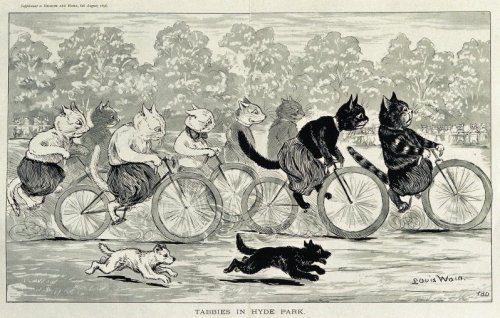
This week's Link Dump is happy to be sponsored by the Cat Cycling Club of America!


What the hell is Baltinglass Hill?

What the hell is the Windsor Hum?

How the hell did King Ludwig II die?

Watch out for the Funeral Men!

Watch out for those Ukrainian Monsters!

Watch out for the Fairy of Argouges!

Artistic Georgian era women.

Mew Britannia: the illustrious British Bureaucats.

Life lessons:  Pretending to be dead rarely ends well.  For you, at least.

13 billion year old star music.

Here's your chance to buy a mysterious London mansion.

Some ghosts never know when to just go away.

Fishing with the Dead.

Catching a cold in the Early Modern era.

An eerie tale about a sociopathic murderer's multiple lives.

A Captain who slept on the job.

Because your week just wouldn't be complete without stories of brain matter on pillows.

Putting ghosts on the couch.

We saw what you did in this headline, Executed Today.

The Lady's Magazine looks at marriage.  Isn't too thrilled.

What to do at a 19th century fair.

Oh, just another story about headless bears and the Devil rolling people like a hoop.

An unusually well-preserved French noblewoman.

Sam Patch, professional waterfall jumper.

The truth and fiction about post-mortem photography.

Some 18th century inquests.

18th century actors hit the road.

The wild world of Biblical Typos.

What to do with "stale and nauseous water."

The notorious murder of Stanford White.

The power of Neanderthal DNA.

An unusual German polymath.

Medieval book spam.

The sailor and the astral projection.

The deadly Maria Theresa Phipoe.

The heroic Philis de La Tour.

That time St. Francis met the Sultan.

That time it was a fad to keep monkeys as pets.

That time zombie Zombies went on tour.

How Gore Vidal created Aaron Burr.

The price of fame for 18th century actresses.

The adventures of two 19th century British archaeologists in Southern Arabia.

"Less in his mind than there was in his pistol."

Lobsters make excellent archaeologists.

The medieval tragedy surrounding Little St. Hugh.

The eyeballing of Gottlieb Williams.

And, finally, this week in Russian Weird:  Yeah, it's those damned Siberian craters again.

And so yet another Link Dump draws to an end. See you on Monday, when we'll be looking at a classic English haunted house. In the meantime, just to get your weekend off to the right start, how about a drunken wedding march?

Wednesday, June 8, 2016

Newspaper Clipping of the Day


This account of an alleged encounter with a malevolent UFO was reported in the "Canberra [Australia] Times" on January 21, 1988:
A Perth family say they were terrorised by a UFO which plucked their car from the road on the Nullarbor Plain.

Police said yesterday that they were taking the report seriously after investigating damage to the car, which was covered in an ash-type substance.

A truck driver and a car driver also witnessed the bizarre event after being chased by the UFO along the Eyre Highway just inside the Western Australia border.

Mrs. Faye Knowles and her three sons, Patrick, 24, Sean, 21, and Wayne, 18, were about 40km west of Mundrabilla driving toward South Australia when they first saw the glowing object about 2.45am yesterday.

They told police they had watched as it chased the truck and car, which were travelling in the opposite direction, before turning and landing on their own vehicle.

"It apparently picked the car up off the road, shook it quite violently and forced the car back down on the road with such pressure that one of the tyres was blown," a police spokesman said.

"While this was happening the family said their voices were distorted and it was as if they were talking in slow motion."

Mrs. Knowles told police the UFO turned the car around and placed it back on the road facing in the opposite direction.

Once they were back on the road they had jumped out and fled into the bush where they hid for some time before going back and changing the wheel.

They drove to Ceduna in the far west of South Australia and reported the incident to local police.

By chance, crime scene investigators from Port Lincoln were in Ceduna and examined the car.

"We have to take it seriously, there's no reason why we shouldn't," Sergeant Fred Longley, of Ceduna police, said. "There were too many witnesses for us not to.

"The car was damaged and was covered in ash from the object and they were clearly shaken up."

Sergeant Longley said the Knowles drew a diagram of the UFO which looked like an egg in an egg cup.

Another account of the Knowles' experience appeared in "The Age," the following day:
A Perth woman who claims an unidentified flying object landed on top of her car said last night that she and her three sons believed the object had been "after" them.

Mrs. Faye Knowles, speaking on Channel 7, said she had initially mistaken the object, which emitted a "horrible humming noise" for a truck.

She said the encounter, on the Nullarbor Plain in Western Australia on Wednesday night, had lasted about 90 minutes.

Mr. Sean Knowles, who was driving the family car at the time, said on Adelaide radio yesterday that after sighting the UFO at 5:30 a.m. on Wednesday, "I was doing about 200 kilometres (an hour) to try and get away from it.

"Somehow, I got a blow-out," he said. "I don't know how. Once I got the blow-out, it (the UFO) was on the car. All of us had this real weird feeling going through us."

Mrs. Knowles said she and her sons believed they were dying when the object grew in size and landed on the top of their car with a clunk.

"I was screaming, I was in hystericals," she said. After the object lifted the Knowles' car off the ground and dropped it heavily, Mrs. Knowles wound down her window and started screaming. Soot then filled the car and covered it.

"We thought we were dying, then we got out of the car and we hid behind a little tree in the bushes and it couldn't find us," she said. "It was up the road a bit further from us. It was after us."

The object then took off and the family, after changing the tyre quickly, drove away but they said the object followed them again. The family had tried to wave down other cars but none stopped.

The Victorian UFO Research Society said it was not an unusual phenomenon to have remnants of ash after an alleged UFO visit.

The group said that an incident in northern Tasmania, near Launceston, on 14 December bore striking similarities to the Nullarbor Plain event. In that incident, a car was dragged towards an unidentified object on the road and its motor cut out, the society said.

The single occupant had been scared and left the car to take cover in some bushes. When the object, described as a conglomeration of bright lights, had moved away, the car had been covered in grey ash. The society's spokesman, Mr. Pat Gildea, said the incident was still being investigated.

Port Lincoln police confirmed yesterday that the crew of the tuna boat Monica claimed to have seen moving lights in the sky in the Great Australian Bight on Wednesday night.

The crew of another vessel, the Empress Lady, had also reported seeing an object a week before the Nullarbor incident.

A truck driver, Mr. John de Jong, also said on Channel 7 last night that he had seen the lights that terrified Mrs. Knowles and her three adult sons.
Skeptics suggested that what the witnesses had actually experienced was a meteor shower.

Monday, June 6, 2016

The Contentious Death of Sir Edmund Berry Godfrey


A Justice of the Peace named Sir Edmund Berry Godfrey came to a violent end. Three men were eventually executed for his murder. What makes Godfrey's death somewhat unique is the universal agreement that these men were not responsible for the crime, leading to an unusually large crop of alternative theories naming the "real" killer or killers.

Some even argue there was no murder at all.

Godfrey was born in 1621 into a family who was part of the English gentry. Most of his life was unremarkable: He attended Oxford, toured the Continent to complete his education, and studied law, although illness forced him to abandon his legal studies before graduation. He took up a career as a merchant instead. It has been speculated that poor health accounted for his odd and rather unlikable personality: Godfrey was considered cold, unsociable (he never married and may have been asexual,) and arrogant.

In 1660, he became a magistrate, where he gained a reputation for being severe, but also hard-working, brave, and just. In 1666 he received a knighthood for his exemplary public service during the Great Plague of the previous year. He was also--rarely for a public official at that time--seen as being very lenient towards Catholics. He had many "dissenting" friends, and it was believed that this usually stern man was willing to bend or overlook laws in order to protect them. Despite his religious tolerance, he also became increasingly opposed to the government of King Charles II and its pro-French policy. According to at least one contemporary report, Godfrey was a member of the "Peyton Gang," a secret organization dedicated to overthrowing the king and making England a republic. With his ties to the Catholics on the one hand, and his alleged membership in the anti-Catholic, anti-monarchical Peyton Gang on the other, Godfrey had his fingers in many contradictory and potentially very dangerous pies.

The story of Godfrey's death may be said to have started in 1678, when two men, Titus Oates and Israel Tonge, came before him to give depositions describing an alleged "Popish Plot," spearheaded by the king's brother the Duke of York, to kill Charles and conduct a mass slaughter of Protestants. Although the whole affair remains somewhat mysterious, we know that Godfrey was remarkably reluctant to become entangled with the story, particularly when Oates named Edward Coleman, the Duke of York's secretary, as a main actor in the plot. Godfrey and Coleman were close associates. Godfrey knew that if any formal inquiry of Oates' fable was made, his known connection to Coleman would mean that he himself would be implicated in this so-called "plot." However, if it could be shown that he had tried to bury the story, that would not only also implicate him, but leave himself open to being charged with misprision of treason. Godfrey dithered about what to do with this testimony, and seemed to want to ignore the whole mess in the hopes that it would just go away. He told a friend that he would get "little thanks" for his involvement with Oates' tale and "would fain have [had] it done by others." He became a seriously worried, even frightened man. And he had every reason to be fearful.

On October 12, 1678, Godfrey left his home at about 3 p.m. to go for a walk. He never returned. He suddenly and inexplicably vanished.

Godfrey's disappearance caused an immediate public uproar, with everyone immediately assuming the missing magistrate had been the victim of foul play. Godfrey's brothers, Michael and Benjamin, went to the privy council arguing that their sibling had been murdered by "the Papists"--a sentiment that was widely held.

Godfrey's whereabouts remained a mystery until October 17, when his body was discovered near an area known as Primrose Hill. The corpse was lying in a ditch, run through with his own sword. The body was badly bruised, and marks of strangulation were found around his neck. According to some accounts, his neck had been broken. He had evidently been stabbed only after his death.

The inquest into his death became more of a political tribunal than an objective search for the truth. Rumor had it that witnesses were intimidated and evidence suppressed in order to foster the belief that Godfrey had been murdered by the Catholics. Titus Oates' wild stories about treasonous Papists and their evil conspiracies appeared to have been confirmed by Godfrey's murder, although it never was plausibly explained why the Catholics would wish to kill someone who had been one of their few prominent friends.

It was one of history's many curious ironies that a man who, in life, had strong Catholic sympathies, should have been elevated in death as a Protestant martyr. Parties hostile to the government used highly fictionalized accounts of Godfrey's life and character for propagandistic pamphlets, plays, and poems illustrating the dangers of Catholicism. Even his funeral became an exercise in depicting the dead man as someone who had heroically died for the Protestant cause. Catholics were persecuted, even (like Edward Coleman,) executed, in Godfrey's name--something that undoubtedly would have appalled him.

Lost in all this, of course, was the issue of who really did kill the magistrate. Any serious investigation into Godfrey's murder was stalled until November, when an informer named William Bedloe went to the authorities claiming that Godfrey had been taken to the queen's palace, Somerset House, and murdered there. Bedloe named Miles Prance, a servant of Queen Catherine's, as one of the killers. When Prance was arrested, he saved his own skin by turning King's evidence. He claimed the murderers were three of Somerset House's servants, Robert Green, Henry Berry, and Lawrence Hill. Although there was absolutely no evidence against these men other than Prance's story, the trio were quickly tried and convicted for the killing. (With what was seen as a fitting sense of justice, the three condemned men were hanged near Primrose Hill.) To most of the public, these executions were seen as confirmation that Godfrey had indeed been murdered as part of a widespread Catholic plot.

Contemporary woodcut depicting Godfrey's alleged murder


However, once the general atmosphere of anti-Catholic paranoia and hysteria began to cool, doubts began to arise about the justice of the verdict. Prance's story was easily discredited, and he wound up being convicted of perjury. Green, Berry, and Hill were eventually completely exonerated of the murder--although that was obviously little comfort to them by that point.

These second thoughts were first publicized in 1682, when three men named Nathaniel Thomson, William Pain, and John Farwell were put on trial for libel. They had suggested that the magistrate had really killed himself, and the coroner's jury was pressured into bringing a false verdict of murder. By the mid-1680s, England had a new king, a new government, and a consequent willingness to take a second look at Godfrey's puzzling death. The first serious investigation into the mystery was taken by Sir Roger L'Estrange. His 1687 book, "A Brief History of the Times" argued that Godfrey had killed himself, and that his brothers subsequently covered up the truth about his death in order to save his estate from being forfeited to the Crown. L'Estrange's book is not very trustworthy--he was known to have manipulated evidence in order to make it fit his thesis--but it deserves some credit for keeping the case alive, even if his conclusion is not generally accepted today.

The next major analysis of the Godfrey mystery came from a legal officer named Roger North. North contended that the magistrate had been murdered, but was uncertain who did the deed, and why. The most he could suggest was that Titus Oates or Oates' political supporters had murdered Godfrey because the magistrate knew Oates was a rank perjurer.

Philosopher David Hume offered a more contrarian view of the case. Although he did not offer a possible suspect in the crime, he scoffed at the notion that the Catholics had any motive to kill Godfrey. His analysis of the available evidence led him to propose that the murder was the result of some personal quarrel against the magistrate, and had nothing to do with politics at all.

Hume's theory was endorsed in 1924 by J.G. Muddiman, who proposed perhaps the most plausible theory of the murder. He suggested that Godfrey's killer was Philip Herbert, Earl of Pembroke.

Pembroke was unquestionably one of the nastier figures of his era. The earl had only a passing acquaintance with sanity and decent behavior. He was a drunken, sadistic, horrifyingly violent man with a penchant for inflicting physical attacks on his many enemies. He was quite definitely capable of the crime.

And he had reason to harbor a grudge against Godfrey. In 1678, the magistrate was the foreman on a jury that convicted Pembroke of murder. Regrettably, the earl successfully appealed this conviction in the House of Lords, and he was released from custody. After this miscarriage of justice, Godfrey prudently left the country for a short time, but upon his return, Muddiman believed the psychopathic aristocrat finally got his revenge against him. Unfortunately, although Pembroke had the classic "means, motive, and opportunity" for the murder, there is no contemporary direct evidence linking him to the crime.

In recent years, historian J.P. Kenyon suggested keeping things simple: Perhaps Godfrey was just a random victim of some anonymous highwayman or footpad? Alas for this prosaic theory, it fails to explain the curious fear and depression Godfrey exhibited before his death. And if he was just another robbery victim, why was jewelry and money left on his body? On the other end of the spectrum, Stephen Knight--he of the infamous "Jack the Ripper Royal Freemason Conspiracy" fame--saw Pembroke as a "hit man" hired by the Peyton Gang to kill Godfrey, thus ensuring that the magistrate would not reveal their secrets.

So, how did Edmund Berry Godfrey die? Was it suicide, a political assassination, a vendetta by groups eager to shut Godfrey's mouth, a revenge killing, an ordinary street crime, a high-level conspiracy?

Take your pick.

[Note: It is often related as a "startling coincidence" that Green, Berry, and Hill were hanged at a place called "Greenberry Hill." However, the historical record is surprisingly confused about whether the site was originally known by that name, or if it acquired that designation later, as a result of the notorious executions.]

Friday, June 3, 2016

Weekend Link Dump


This week's Link Dump is sponsored by the spirit of Manson, unofficial patron saint for cats everywhere.

Photo via Kcet.org

What the hell happened to Don Wiley?

What the hell was the Ape Canyon Incident?

Watch out for Deadshot Mary!

Watch out for the Ghost of Louise Island!

A 17th century murder is finally solved.  Sort of.

Various "animal fads" through history.

The discovery of a little girl who died about 150 years ago.

That time Edgar Allan Poe did not pull a practical joke.

Ancient Sudanese paintings.

How to make a "love sorbet."

A castaway's message in a bottle.

The fairies of Lancashire.

The odd disappearance of Lorraine Chance.

Maybe Heaven really can wait.

An 18th century look at death as family planning.

Human history keeps getting pushed back...back...back...

A handy guide to getting an easy, pleasant discharge from the army.

A 19th century case of one of the oldest stories there is: love, murder, and suicide.

19th century doctors and the law.

19th century mermaids.

The capture of USS Chesapeake.

A premonition of the assassination of a Prime Minister.

Hey, homely men!  Want to be pretty?  Follow this link!

England's oldest handwritten document.

The world's oldest stone bracelet.

When cutting your hair meant stealing your soul.

No.  Next question?

Why Nevers is one really hot town.

Some very taxing shoes.

The popular Circassian Bloom.

The kingdom of Africa Town.

The infanticide case that inspired a George Eliot novel.

Robert Clive in India.

Kaiser, survivor cat.

The journalist and the squirrel.

Pig boys and boar bites.

I'm only going to tell you this one more time:  a goose throat is not a toy.

The volatile life of Margaret Pole.

Wilkie Collins' terrier.

Well, all righty.

Line of the Week:  "As the fairies could not be produced the case ended."

Aaaand...we're done! See you on Monday, when we'll be looking at a puzzling death that spawned endless conspiracy theories. In the meantime, here's The King:

Wednesday, June 1, 2016

Newspaper Clipping of the Day


In 1920-21, the "Boston Post" ran a delightful series of columns titled "Famous Cats of New England." Some of these cats were genuinely well-known, while others were simply fortunate enough to have proud and loving owners eager to show them off to the world. From time to time, I plan to share excerpts from this series, so those of you who do not share my fondness for felines (yes, I'm looking right at you, Dr. Beachcombing) may consider yourselves warned.

The first of the "Famous Cats" was the illustrious Von Hindenburg, pride of the "Boston Post" itself:
In a series of Famous Cats of New England, it is eminently fitting that Von Hindenburg's name should lead all the rest. "Hindy" is undoubtedly the best-known cat in New England today, because of the immense amount of publicity he has received during the past two years or more in the columns of the Post. He is known by name to millions, while hundreds every week recognize him on the street as the famous Post cat. He receives mail regularly from admirers and detractors. Von Hindenburg is a New England institution.

Were he human, "Hindy" would probably nearly own the Post today, through the medium of judgments rendered in libel suits. He has been slandered something awful in these columns. Unscrupulous reporters have written the most maligning and damaging articles about him, and careful editors have allowed the libels to pass. His escutcheon has been smirched by those whom he regards as his best friends. He has been pictured as a rowdy, and worse--a bully who is always looking for trouble and as a generally undesirable citizen. Apologies are due "Hindy" for them cruel words of the past. In this article we shall endeavor to tell the truth about him for a change.

"Hindy" is a magnificent, big, yellow cat who makes the Post his headquarters. He isn't very regular about coming home nights in the summer time, but when the weather becomes cook he can be depended upon to be somewhere about the building. He sleeps any place his fancy dictates. sometimes his couch is the managing editor's desk, sometimes the composing room attracts him, and often he peacefully slumbers close to one of the gigantic presses down cellar. He is likely to be around any time during the day or night, but he has no fixed hours. He comes swaggering in, waves his tail at his friends, submits to some petting and then gracefully retires to a favorite nook and goes to sleep. He will wait a little while to pass through some of the entrances to the Post building, but not too long, as he has his own entrance, which consists of climbing up to the composing room floor at the rear and tapping on a window to attract attention. This window is three stories up from the street. He gets out by the doors--at least he has never been seen leaving via a window.

"Hindy" doesn't eat in the Post building. He scorns the food that is offered him here. He picks his restaurants. Childs', underneath the Post editorial room, is a favorite place, while Wyman's, across Washington street in Spring lane, is another. His late dinners are often taken at Young's Hotel, while it is suspected that the Parker House is often visited by him. Now and then he will cross Tremont street and call at the Press Club in the Houghton & Dutton building. He is always sure of a meal at any of these places, where he is as highly regarded as he is at the Post.

He is at home in the entire district. He loafs around shoe shining establishments a lot, where a lazy wave of the tail is his answer to scores of greetings. He roams City Hall at will, and is no more awed by his Honor the Mayor than he is by the Post office boy. He is always sleek and well fed and, for one of his habits, a remarkably well-groomed cat.

"Hindy" is as independent as the famous Declaration itself. He is absolutely without fear. He walks majestically through the busy thoroughfares with his tail straight up. There is no slinking close to buildings for "Hindy"; the middle of the sidewalk for him; and when he crosses the street he does it in a calm, deliberate way that should shame Boston's frenzied jay-walkers. No dog can make "Hindy" retreat; nor any cat, either. He isn't looking for trouble, but he never dodges it. If it comes his way he is ready.

"Hindy" is a real gentleman cat. His only weakness is a fondness for catnip, which is one of the failings of his kind. He will become quite gloriously illuminated on catnip, and while under the influence his native dignity is lost as he tries to become kittenish. However, he soon goes to sleep when on one of these carouses, and when he awakes is the real, old, genuine, courtly Hindenburg again. He is some cat.
~December 7, 1920
Tragically, in May 1923 the valiant cat-about-town was seriously attacked by a dog. Although everything possible was done to save Hindy, his wounds developed a fatal infection. He was buried in the cat cemetery of Methuen, Massachusetts.

However, his memory lived on. As a result of the "Post's" many whimsical columns about their mascot, readers demanded photographic portraits of the cat. The newspaper wound up sending out over 100,000 photos of "Hindy." In January 1945, "Popular Photography" magazine noted:
Recently new tenants in a home at Bartlett, N.H., prowling in the attic, came across the protruding corner of a rustic black walnut picture frame. Under the dusty glass was a photo portrait of that utterly calm, confident and world-famous feline champion of Pi Alley.

Remembrance of Hindy turned up again a few weeks ago in a letter from a "Post" reader in Norfolk, Mass--a collector of cat stories and pictures who rates Hindy's photo and clipping as "priceless treasures" which occupy two full pages in her mammoth scrapbook. Says her letter: "I am told Hindy had many honors such as appeals in his name for the Children's Hospital and special charities. I should be pleased to possess one of his signed stories...I should like to have had the honor of knowing Hindy..."

Thus does evidence continue to mount that Hindy's immortal reputation, with one photograph for the build-up, still is on the prowl although the last of his battle-scarred nine lives ended more than a score of years ago.

[Note: Photos of Hindy still turn up on Ebay.]

Monday, May 30, 2016

Lady, the Wonder Horse

Lady Wonder and Claudia Fonda, 1928


A horse is a horse, of course, of course, and no one can talk to a horse, of course, that is, of course, unless the horse is the famous Mr. Ed...

...or an almost equally famous psychic mare.

Our story opens in 1924, when a Richmond, Virginia woman named Claudia Fonda bought a two-week-old filly she called Lady Wonder. Mrs. Fonda bottle-fed the filly, and, before long, came to think of the animal almost as her own child. Nothing unusual was noted about Lady Wonder until one day, it struck Mrs. Fonda that the horse did not wait to be called before running to her--the owner merely had to think of beckoning her over. From that time on, Mrs. Fonda studied the filly more closely, and became convinced Lady possessed unusual mental powers. In short, she credited Lady not only with human intelligence, but psychic abilities as well.

By the time Lady was two, Mrs. Fonda had worked out a system where the horse used large lettered children's blocks as a sort of simple typewriter. Fonda later designed a piano-sized device that used a double row of keys. When Lady would nudge a key with her nose, a tin card popped up bearing a number or letter, enabling the horse to solve math problems and spell out words. Even, we are told, predict the future. On one occasion, Lady spelled out the word, "engine." A minute or so later, a tractor passed by the farm. It was reported that Lady could tell married women their maiden names and correctly guess the sex of unborn babies. While she was not infallible, she picked the winners of ball games, handed out personal advice, and revealed hidden details of people's lives with often unnerving accuracy.


The fame of this unusual horse spread, particularly after she picked the winner of the Jack Dempsey/Jack Sharkey fight in 1927. Crowds of people flocked every day to the Fonda farm to quiz the "Wonder Horse"--at a price of three questions for a dollar. It is estimated that, in total, Lady drew over 150,000 visitors. (As a bonus, visitors were also greeted by the sight of Claudia's piano-playing Pomeranian, Pudgy. We are told he did a killer rendition of "The Bells of St. Mary's.") Mrs. Fonda even hired a press agent to deal with the media attention. (Before engaging the man, she first asked Lady, "Is this man honest?" When the horse answered in the affirmative, the deal was struck.)


The most famous episode in Lady's career of equine savant came in 1952. A little boy from Massachusetts, Danny Matson, had been missing for months. The investigation into his disappearance was stymied. Figuring there was nothing to lose by the effort, someone asked Lady if she knew where the child could be found. The horse spelled out the words, "Pittsfield Water Wheel." A policeman who heard of this response wondered if it could have referred to an abandoned quarry that was known as "Field and Wilde Water Pit." A search was made, and, yes, that was where Matson's body was found. A tragic ending to the story, but at least the boy's parents no longer had to live with the agony of an unsolved mystery. Unfortunately, Lady was less accurate in the case Gary Hayman, a nine-year-old who vanished from his school in Providence, Rhode Island. When the boy's mother asked the horse about her son, Lady communicated that the boy was in Kansas, "hurt," but still alive. However, some months later a skull later assumed to be Gary's was found in the woods near his home. His death was ruled accidental. [Note: Some students of the Hayman disappearance have questioned whether the skull was of the missing boy.]

Among Lady Wonder's more successful predictions were the presidential elections of Roosevelt, Truman, and Eisenhower, as well as the entry of America into World War Two. (And, yes, she did pick winners of horse races.)

In 1928, pioneering parapsychologists William McDougall, Dr. Joseph Banks Rhine, and Dr. Lousia E. Rhine of Duke University spent a week conducting various examinations on the now world-famous horse. For instance, J.B. Rhine wrote "Mesopotamia, Hindustan, and Carolina" on a piece of paper. While keeping the words hidden, he asked the horse what he had written. Using her "typewriter," Lady immediately picked out the correct words. By the time their testing came to an end, McDougall and the Rhines had concluded that the Lady was indeed a Wonder. The following year, the Rhines wrote a paper describing their tests for the journal "Abnormal and Social Psychology." They concluded that "There is left only the telepathic explanation, the transference of mental influence by an unknown process. Nothing was discovered that failed to accord with it, and no other hypothesis seems tenable in view of the results." Another psychologist, Thomas L. Garrett, made his own study of the horse and concluded that there was "no trickery involved."

There were, of course, many who disagreed with this analysis. They saw Lady Wonder and her owner as simply a fraudulent sideshow act. A New Jersey professor named John Scarne made his own visit to the Lady, which left him convinced that the horse was merely following subtle cues given by her owner.

He wrote, "Mrs Fonda carried a small whip in her right hand, and she cued the horse by waving it. I detected Mrs. Fonda doing it every time the horse moved the lettered blocks with the nose. This method of doing the trick might have puzzled me if I hadn't known that the placement of horse's eyes on either side of the head gave them wide backward range of peripheral vision. Therefore it offered no problem for me to detect....The shaking of the whip first time was the signal for Lady to bend her head within a couple of inches to the blocks. A second shake of the whip was the cue for Lady to continuously move her head in a bent position back and forth over the blocks. When Lady Wonder's head was just above the desired block Mrs. Fonda made the horse touch the block with her nose by shaking the whip a third time. It was as simple as that." Others responded to this debunking by pointing out that Lady often answered questions accurately when her owner did not know the correct response, or when Mrs. Fonda was not even present. Yet another researcher, a Dr. Gayle, simply conceded that he was baffled by the horse. In 1927 he told the "Richmond Times-Dispatch," "I am perfectly willing to admit that I have no idea how she arrives at the correct answers to our questions. There is no conscious trickery here, I am convinced. But I am not converted to the mind-reading theory. What's the solution of the puzzle? I don't know!"

Mrs. Fonda never wavered from her genuine belief in Lady's wild talents. She asserted that every horse would show the same abilities, if their owners would only bother to teach them the alphabet. Lady, Mrs. Fonda explained, was merely an "educated horse."

Lady Wonder at age 27


When the "educated horse" herself was asked "how she did it," she simply spelled out "Mind." She continued her placid existence as America's "psychic horse" until her death from a heart attack on March 19, 1957. It is said that Claudia Fonda never quite recovered from the loss. She followed her beloved horse into the grave two years later.

Photo credit: Paul Koudounaris

Friday, May 27, 2016

Weekend Link Dump


This week's Link Dump is sponsored by Strange Company HQ staffer Potter.  If you wish to hire security for your next big party, his size and temperament make him an excellent bouncer.


What the hell was the Harlech Meteor?

What the hell was the Flying Black Giant of Boston?

What the hell were these Neanderthal stone circles?

Watch out for those voices in your chimney!

Watch out for those snowball bombs!

Watch out for Morgawr!

The world's oldest cave paintings.

A Roman villa has been found under an English barn.

An early 19th century racetrack that's still in business.

The first broomstick witches.

How DNA can implicate the innocent.

A Georgian merman.

Good Walkers battle the witches over wine.

Aristotle's tomb may have been found.

The Macclesfield Pedestrian.

The Etruscan underworld.

The ghosts of war.

The strange death of a Hollywood screenwriter.

A brief history of relics, religious and secular.

An 1801 public subscription ball.

An Israeli mermaid.

Louis Slotin and the Demon Core.

A secret club of rooftop climbers.

Childbirth in the Regency period.

The Victorian poor tell their own story.

A gruesome small-town murder mystery.

The Gordon Riots of 1780.

You can buy a cannibal's castle.

So, there's such a thing as "tree law."

America's first cremation.

The comet scare of 1773.

How a printer crippled the Confederacy.

The story behind "Grand Hotel."

How to buy food, 1950s style.

The baby farmers of Brixton.

19th century sporting cats.

Napoleon's "beautiful moon."

The tricky issue of 19th century "marital coercion."

An ancient Egyptian spell book.

The vampiric Countess Elga.

A cursed village.

Still more Bohemian Cats!

Beauty tips for bluestockings.

Sleeping with the Devil.

Mary Anning, who sold seashells on the seashore.

The astronomer nuns.

Shakespeare in India.

A smelly ghost.

A Mediterranean garden in Northumberland.

Some of the most influential criminal trials in history.

The ungrateful Tully McQuate.

That time fighter jets were sent to intercept a UFO.

That time when sugar was good for your teeth.

A tale of the Sjo-Troll.

The case of the wandering musket ball.

A particularly odd case of grave-robbing.

The Flying Goliath of Boston.

A hired boy's ghost.

The kind of thing that happens when they dissect you before you're dead.

And we're done!  See you on Monday, when we'll have a look at a Wonder of a horse.  In the meantime, here's a bit of Pleyel: