"...we should pass over all biographies of 'the good and the great,' while we search carefully the slight records of wretches who died in prison, in Bedlam, or upon the gallows."
~Edgar Allan Poe

Wednesday, June 15, 2022

Newspaper Clipping of the Day

Via Newspapers.com


This creepy little account of a malevolent spirit appeared in the “Sandusky Register,” February 15, 1895:

A Hancock street woman is suffering from a strange hallucination. She imagines that her deceased husband makes daily and nightly visits to her. Her departed spouse, who died a year or so ago, was not one of the kindest men to his wife during his earthly career, and as may be expected is not a spirit every one would care to have as a visitor, even at midday. 

The woman, who is nigh onto three score years and ten of age, showed great joy on the death of her husband, but her happiness was of short duration, as the third night after his death he paid the wife of his bosom a midnight visit. His wife was not at all pleased to see him, and as the visits became of nightly occurrence she became greatly worried and asked advice of her neighbors. They did all in their power to rid her of her strange imaginations but she continues to fret and worry over the spiritual visitations and great fear is felt for her reason, as she already shows signs of mental derangement. 

She says that at first the spirit of her too devoted spouse would awaken her nights by stroking her forehead, as one who was troubled with headache would do. He also talks to her, upbraiding her for feeling so relieved when he died and promises that he will not leave her as she wished but would visit her nightly.

The spirit comes to the home every afternoon at 4 o'clock. He enters the house through a pantry window and then through a door into a side room. Now, every afternoon, iust before 4 o'clock, the room is darkened in expectation of the arrival of the eternal husband. He immediately goes to that room and remains there until night. It is a curious fact but the woman affirms that in the past few months the spirit has taken the form of a large serpent and nights when she goes to bed she has to draw the covers over her head to prevent her serpentine other half from putting his fangs in her face. 

Just before the spirit's departure every night it breaks up dishes, making noises plainly audible to the only occupant of the house. Mornings this poor deluded woman finds broken dishes scattered about. Cans of fruit have been thrown to the floor, the contents being spilled about everywhere. Chairs are moved about from one place to another and eatables are taken. One peculiar trait shown by the spirit is that it is very fond of coffee, as the coffee pot is always emptied of its contents. The deceased, to whom this article alludes, was a veritable coffee fiend during his existence on earth and was always doing everything in his power to make life miserable for his wife, and he is evidently following the same course since his death. 

Some of the neighbors who have visited the house say that they have felt the presence of the spirit. One woman affirms that some fancy work at which she was engaged was torn from her hands and destroyed before her eyes by some invisible power, and that she has heard the spirit cursing and jumping around in an adjoining room, as the master of the house was wont to do. The neighborhood is and has been really worried over the affair and the house is already becoming known as the “haunted" house.

I couldn't find any further reports, but I'm guessing this is one of those ghost stories which did not end well.

Monday, June 13, 2022

The Playwright's Murdered Mistress: A Mystery From Tsarist Russia

If you want true crime that reads like something out of a Tolstoy novel, you can do no better than look at a murder case from Tolstoy-era Russia.

Alexander Sukhovo-Kobylin (1817-1903) was a wealthy, handsome Moscow aristocrat.  He was highly intelligent, well-educated, sophisticated, witty, and an author and philosopher of some renown.  Unfortunately, he balanced out all these admirable qualities by also being a double-barreled bastard.  He treated his servants with a brutality which left them in terror of him.  He was a serial womanizer.  He had a violent temper he either wouldn’t or couldn’t control.  (Suffice to say this was a man who would smash dishes at the dinner table if the food did not please him, which you have to admit would be enough for anyone to start singing “The Worker's Marseillaise.”)  His arrogant personality and fondness for spreading particularly waspish gossip ensured that even among his peers, there were few people who wished him well.
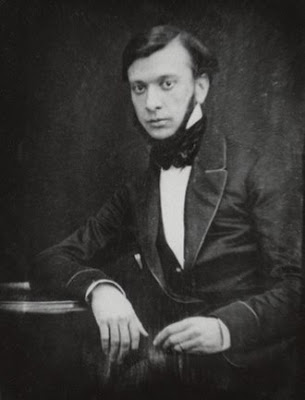
Sukhovo-Kobylin, 1850


Since 1842, Sukhovo-Kobylin had kept a mistress, a beautiful Frenchwoman named Louise-Simone Dimanche.  He had met her on one of his frequent visits to Paris, and so liked what he saw that he invited her to live in Moscow under what was in those days quaintly called his “protection.”  Dimanche saw no reason to refuse, so before long she was ensconced in a luxurious five-room apartment Sukhovo-Koblyin bought for her.  He assigned four of his serfs to staff the household.  Louise got along well with her lover's family, particularly his domineering, cigar-smoking mother.

Portrait allegedly of Louise Dimanche


Although Sukhovo-Kobylin continued his relationship with Louise, by 1850 he was having another liaison, with a married high-society woman named Natalya Naryshkina.  Naryshkina was not considered a beauty, but she was a vibrant, assertive woman who was an excellent conversationalist.  Her social skills won her many admirers.  It was said that these two women in Sukhovo-Kobylin’s life resented each other, which would hardly be surprising.  It was said that Dimanche told friends that she was planning to return to France, where she would live on the pension Sukhovo-Kobylin promised her.

Natalya Naryshkina


November 7, 1850, was, as far as we know, a busy, but unremarkable day for Dimanche.  At 9 a.m., her coachman drove her to pick up a friend, Ernestine Liandert, after which the two women did some shopping.  Afterwards, Dimanche spent about an hour at Liandert’s apartment.  Dimanche then returned to her own home.  An hour later, she again went out in her sleigh, visiting a bookstore, a business office, and her dressmaker.  After returning home to change clothes, she had dinner at Liandert’s apartment, along with Ernestine’s lover Lieutenant Sushkov and another man whom Dimanche’s coachman did not recognize.  After dinner, the four friends went out for a ride along the boulevard, stopping to eat ices at a confectioner’s shop.  Dimanche returned home at 9 p.m.  At 10 p.m. her cook, Efim Egorov, asked her what food he should prepare on the following day.  Before he left, Dimanche gave him a note to deliver to Sukhovo-Kobylin.  As Sukhovo-Kobylin was out, Egorov left the note with Alexander’s valet.  (The valet, a man named Lukyanov, later said that the note asked Sukhovo-Kobylin if he planned to dine with her on the following evening.)
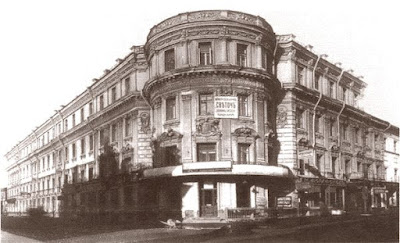
Louise's apartment building


Dimanche’s housemaid, Pelageya Alekseeva, later stated that her mistress waited a half hour for a response to her note.  Then Dimanche left the apartment.  She did not tell her servants where she was going, only that she would return soon.

She never came back.  At around 8 a.m. on the following morning, a man came to Dimanche’s apartment.  When the maids told him that Louise had not come home, the stranger said, “That’s a bad business,” and left.  Soon afterward, Sukhovo-Kobylin arrived, and was also told of Dimanche’s disappearance.

Late that evening, Sukhovo-Kobylin approached the Moscow police chief, a man named Luzhin, who was relaxing in his club.  The aristocrat had a curious question for him:  Had he heard anything about a “traffic mishap involving a woman in a blue cloak?”  

Luzhin was one of the innumerable people who wished to chat with Sukhovo-Kobylin as little as possible.  Instead of asking any of the obvious follow-up questions, he simply said “No,” and went back to his cigar and brandy.

The following morning, Sukhovo-Kobylin again visited the police chief.  He said that Louise Dimanche had not been seen for two days, and demanded that an official search be made.  He suggested two areas in particular should be examined: the Petersburg Chaussee, northwest of Moscow, and the road which led to the village of Choroshevo.

The search for the missing woman was fruitless until the evening of November 9, when a woman’s corpse was found near a cemetery in the western area of Moscow, near the Choroshevo road. She was young, beautiful, expensively dressed, with gold earrings and rings on both hands.  She was--very unusually for that period--not wearing a corset and her drawers were pulled up to her knees.  A closer look showed a large wound across her throat.  There was very little blood on the ground around her, suggesting that she had been murdered elsewhere.  The tracks of a sleigh and hoofprints of horses were nearby, which seemed to confirm that the corpse had been carried to this remote spot.  When the dead woman was brought to Moscow, Sukhovo-Kobylin’s servants quickly identified her as Louise Dimanche.

The autopsy found other damage to the body.  A groove was noticeable around the upper portion of her neck.  There was a large bruise around the left eye.  The entire left side of her body was bloody, and the left arm was heavily bruised.  Four ribs were broken.  In short, the doctors found that she had been quite brutally injured aside from the “unquestionably mortal wound” to her throat.

There is nothing like a scandalous murder in high places to grab people’s attention.  Dimanche’s violent and mysterious end quickly became the talk of Moscow.  And few people had any trouble coming up with a chief suspect.  The popular theory was that in the early hours of November 8, Dimanche went to Sukhovo-Kobylin’s house, where she caught him in flagrante delicto with Natalya Naryshkina.  The infuriated Sukhovo-Kobylin impulsively beat Dimanche with a candlestick and slit her throat.  He then ordered two of his servants to bring the body to the cemetery where it was eventually found.

The police, however, turned their initial interest to the serfs Sukhovo-Kobylin had assigned to be Dimanche’s servants:  the maids Pelageya Alekseeva and Agrafena Kashkina, the cook Egorov, and the coachman, Glalktion Kozmin.  This interest heightened when police found 100 rubles in the lining of Egorov’s vest.  When Dimanche’s gold watch was found in Sukhovo-Kobylin’s attic, where Egorov slept after performing his duties, her servants were all arrested.  Sukhovo-Kobylin insisted that the discovery of the rubles and the watch proved that robbery was the motive for Dimanche’s murder.  However, if such was the case, why was Louise’s expensive jewelry still on her body?

Although the common opinion was that Sukhovo-Kobylin was the guilty party, Muscovites were still shocked when, on November 16, the police arrested him as well, citing “inconsistencies” in his statements.  They claimed to have other evidence against him:  in the wing of the Sukhovo-Kobylin family home which he occupied, they found a letter to Dimanche which they claimed proved he had premeditated the murder, a pair of daggers, and a number of tiny bloodstains.

However, this evidence proved to be far, far weaker than initially seemed the case.  The letter, which had been written at a time when Dimanche was away from Moscow, was a clearly amorous note playfully telling her to return where she would be “within reach of my Castilian dagger.”  (Moscow police clearly were unfamiliar with double entendres.)  Sukhovo-Kobylin had a ready explanation for the bloodstains: he said that poultry and game were often brought up the back stairs and in the hallway.  As for any stains found on the wall, well, one of his servants was prone to nosebleeds.  (Doctors confirmed that the stains were of blood, but they were unable to say if it was animal or human.)  Sukhovo-Kobylin insisted that on the night Dimanche vanished, he was having a late dinner with Natalya Naryshkina and her husband.  (Some of Natalya’s servants confirmed this, although, for whatever reason, police did not interview Natalya and her husband.)

On November 20, the case took another wild turn when the cook Egorov, after what was probably less-than-gentle questioning by police, suddenly confessed that he and Dimanche’s three other servants had committed the murder.  The motive, he said, was not mere robbery, but revenge for Louise’s cruel treatment of them.  Egorov explained that Dimanche had never become fluent in Russian, with the result that the serfs often misunderstood her spoken instructions.  When they failed to perform tasks to her satisfaction, she would beat them, or worse, turn them over to Sukhovo-Kobylin for punishment.  Feeling they couldn’t take any more of such an existence, on November 7 the servants resolved to kill their mistress.  Early on the morning of November 8, the murder squad creeped into Dimanche’s bedroom, where they beat and smothered her.  When they believed she was dead, the maids dressed her.  Then, the two men harnessed her sleigh and put the body inside.  When they arrived at the site where the corpse was later found, Egorov thought he heard Dimanche groan.  In a panic, he cut her throat with a folding knife and tossed the weapon somewhere nearby.  After Egorov’s confession, Sukhovo-Kobylin was released, but the police still held him under suspicion.

On December 8, Natalya Naryshkina, who was by then pregnant with Sukhovo-Kobylin’s child, obtained permission to leave for France.  She eventually gave birth to a daughter, whom she and Sukhovo-Kobylin named after Louise Dimanche.  (A rather peculiar act, no matter what their guilt or innocence may have been.  To give Alexander his due, he became a doting father to his only child.). As a little literary side note, Naryshkina later married Alexandre Dumas fils.

Not everyone felt it was a good idea to leave Naryshkina as free as a bird.  On December 7, Leo Tolstoy wrote to a relative:  

“Since you are keen on tragic stories, I'll tell you one which has created a stir in Moscow. A certain Mr. Kobylin was keeping a certain Madame Simon, and he supplied her the services of two men and a maidservant. Now, Mr. Kobylin, before keeping this Madame Simon, formed a liaison with Madame Naryshkina, nee Knorring, a lady from the best Moscow society and a lady very much in vogue, and he had not stopped corresponding with her, although he was keeping Madame Simon.

“On top of all this, one fine morning Simon is found murdered, and certain evidence indicates that she was killed by her own servants. This might not have amounted to anything much, were it not for the fact that the police, when arresting Kobylin, found among his papers some letters from Madame Naryshkina, in which she reproaches him for abandoning her and threatens Madame Simon, which only adds to the many other reasons for concluding that the murderers were but the instruments of Madame Naryshkina.”

On September 13, 1851, the Moscow Aulic Court convicted the four servants and acquitted Sukhovo-Kobylin.  The serfs were sentenced to public flogging (the men were branded as well,) and long terms of prison with hard labor.  However, in the spring of 1852, the servants recanted their confessions, claiming that their interrogators had invented their accounts of the murder.  They stated that they had been shown letters from Sukhovo-Kobylin promising the servants and their families financial rewards and freedom from serfdom if they cooperated.  Egorov added that he had been tortured in prison until he confessed.

In December 1852, the Senate held a hearing about the matter.  Three members of the panel voted to affirm the convictions, but one Senator disagreed, arguing that Sukhovo-Kobylin was likely guilty.  He did not believe the maids would have had time to dress the corpse so elaborately, and he thought the neck wound must have been made by a larger weapon than a mere folding knife.

The case went to the general assembly of the Moscow departments of the Senate.  When they failed to come to a consensus, the matter was passed on to the Minister of Justice, V.N. Panin.  He concluded that thanks to the “obvious incompleteness and evident shortcomings of the investigation,” the confessions of the servants were legally invalid.  Also, as none of the other residents of the apartment building heard any cries or other unusual noises on the night of the murder, Panin believed she had been killed elsewhere.  The minister noted the sinister fact that on the morning after the murder, Sukhovo-Kobylin--who had never shown much concern over Dimanche’s comings and goings--visited her apartment no less than six times, and that when he returned home that night, he remarked to his valet that “Dimanche must surely have been murdered.”

Panin recommended that a new investigation into the case was necessary.  In February 1854, a commission was put together to look into the mystery.  Sukhovo-Kobylin was again arrested and jailed from May to November 1854.  As was probably inevitable after such a long period of time, this commission was unable to come to any solid conclusions.  As a result, the Moscow Criminal Tribunal reconfirmed the original verdicts.  In June 1855, the Moscow military governor general approved this judgment and referred the case to the senate.  

The senators were not happy about the Tribunal’s decision.  To be blunt, a good many of them were convinced Sukhovo-Kobylin was guilty as hell.  This dissension resulted in one of the odder verdicts in true-crime history.  The Senate announced that Sukhovo-Kobylin would be left “under suspicion for participation in the murder.”  The servants were absolved of the crime, but they were to be exiled to Siberia for perjury and obstruction of justice!

Sukhovo-Kobylin’s mother successfully petitioned the Empress to use her influence to clear Alexander’s name.  In May 1856, Panin informed Sukhovo-Kobylin that the investigation into the mystery was officially over.  However, it was not until October 1857 that the State Council issued a judgment absolving the servants and Sukhovo-Kobylin from the murder charges.  (Although they added that because of Sukhovo-Kobylin’s “illicit love affair,” he was to “submit himself to ecclesiastical penance for the cleansing of his conscience.”)  The Tsar approved this decree on December 3, 1857.  Over seven years after Dimanche died, her case, while still unsolved, was finally well and truly closed.

Sukhovo-Kobylin expressed his bitterness at his long legal ordeal through his writings.  He wrote a series of tragi-comic plays satirizing aristocratic corruption and the Russian judicial system, which he depicted as a hopelessly corrupt nightmare.  (He referred to these plays as “my revenge.”)  Although he often ran afoul of the government censors, his plays were wildly popular, and are still considered among the greatest works of 19th century Russian theater.  In his later years, he abandoned the theater in favor of writing Hegelian philosophical works.  Shortly before his death in 1903, Sukhovo-Kobylin was elected to the Russian Academy of Sciences.  His works enjoyed a revival during the Soviet period, where his savage indictments of Tsarist Russia were understandably welcomed.

Sukhovo-Kobylin always maintained that he had been accused of Dimanche’s murder solely because, as a very wealthy man, officials could wring enormous bribes out of him to ensure his acquittal.  (His family was nearly bankrupted by the efforts to clear his name.)  Of course, it is equally possible that these officials blackmailed him because they knew he was guilty.  (For what it's worth, Sukhovo-Kobylin's diary entries expressed his conviction that the serfs had indeed murdered Louise, although there is the strong suggestion that he somehow felt morally responsible for her death.)

To the end of his days, Sukhovo-Kobylin kept a large portrait of Louise in his home, which he would often point out to visitors.  Was this the act of an innocent man showing the sense of grief and regret he depicted in his diary?  Or could it have been a murderer’s private penance?

[Note:  It is hard for me to make up my mind about this strange case.  Despite the serious injuries on Louise's body, her clothes were undamaged.  That, plus the fact that she wasn't wearing a corset and had small velvet shoes on her feet--hardly the footwear for a Russian winter--corroborates the serf's confession.  It has also been suggested that the wound on her neck was made after her death.  On the other hand, Sukhovo-Kobylin's odd behavior after Louise vanished seems to indicate that he already knew she was dead, and where her body would be discovered.  Despite that, I find it hard to believe he was the murderer.  He may have been an unpleasant man in many ways, but he was not a small one.  I can picture him killing someone while in a rage.  However, what I can't picture is him lying about it to himself in his diary.

Then there is the version of events related by Tolstoy--that Natalya Naryshkina arranged her rival's murder.  That would explain why she left Russia for good soon afterwards.  That would explain Sukhovo-Kobylin's sense of guilt about Louise's death.  That might even explain why he insisted on naming his daughter after his murdered mistress.

Perhaps that was his way of punishing Natalya.]

Friday, June 10, 2022

Weekend Link Dump


"The Witches' Cove," Follower of Jan Mandijn

This week's Link Dump is enough to send the Strange Company staff into a great deal of merriment.


Why the hell do giraffes have such long necks?

Meet Henry, the cat with an unbeatable bedside manner.

The physicists who sat around for 14 years watching a clock tick.

How to pack for 18th century traveling.

Librarians get asked some of the damnedest things.

Neptune, the neglected planet.

The outlaw nuns of Bruges.

Battle strategies from the Old Testament.

Why you really, really, don't want to have toilet trouble on a submarine.

The discovery of a shipwrecked 17th century warship.

Margaret Thatcher's "secret phone."

The mystery of the lost wonder plant.

Accounts of indirect poisonings.

The first Juneteenth celebration.

The curse of Cleopatra's Needle.

An ancient grave marker that comes complete with a curse.

The last D-Day ration pack.

A visit to an animatronic model workshop.

The Amarillo Zoo had a nighttime visitor, and people have questions.

Submarine heroics during WWI.  Thankfully, no toilets were involved.

The short life of "Harlem's Coney Island."

A famed Colombian rescue mission.

The Birmingham, England lock-up.

A boy of the Shoeblack Society.

Two WWI tragedies at sea.

East Germany's "Red Woodstock."

Victorian urban legends were stuffed full of incognito aristocrats.

How crossword puzzles nearly derailed D-Day.

This may be the oldest tree in the world.

Some trade cards of 18th century book sellers.

How cowards came to be called "chicken."

The con artist who sold the Eiffel Tower.

The Lake Nyos tragedy.

A notorious French serial killer.

Two failed spies.

A golden life of Christ.

A family's murder plot.

Treasure hunting in medieval England.

The dying art of making Eastern Himalayan cheese.

The pioneering Doctors Blackwell.

The lives of Indian street dogs.

The 18th century "London Monster."

Murder on Thirtieth Street.

An ancient woman was buried on a "mermaid bed."

How to eat like a 19th century gold miner.  Assuming, of course, that you want to.

That's it for this week!  See you on Monday, when we'll look at one of 19th century Russia's most scandalous murder mysteries.  This one really is a doozy.  In the meantime, here's a Gordon Lightfoot cover.

Wednesday, June 8, 2022

Newspaper Clipping of the Day

Via Newspapers.com


A ghost resembling a cartwheel who dislikes accordions.  Works for me.  The “Taunton Courier,” February 6, 1895:

The little Wiltshire village of Ham has a ghost—an up-to-date nineteenth-century ghost—which discards tradition, and instead of appearing as respectable ghosts should, at the witching hour of midnight, erratically selects any opportunity for appearing. This is what a correspondent who visited the ghostly hunting-ground writes :—The information gathered was to the effect that on Thursday, in last week, the occupants of the haunted house—a cottage occupied by a married man—were suddenly alarmed by an unexpected movement of the chairs. The wife was naturally greatly agitated, and sought the aid of her neighbours, who, however, were unable to restore her composure or allay her apprehension. The report of this remarkable occurrence spread, and as the result a council of war was held, and a representative body undertook to verify the extraordinary statements that were made. Accordingly the man's employer, the village publican, the village policeman, and an ex-prize fighter known as " Jack," proceeded to the cottage in question with a view of clearing up the mystery. The policeman had his lamp alight, and the party also took with them two cats. It is alleged that soon after they had established themselves a distant rumbling sound was heard, and one of the number, "Jack," it is alleged, sought to make his exit, but the door was blocked by the entrance of the ghost, who bade “Jack” resume his seat. This, however, was impossible, because the chairs, without any visible sign of interference, were tumbling over each other in delightful confusion. While this was proceeding the watchers are said to have departed in great fright. Though able to escape from the scene of these unaccountable manifestations, the policeman, publican, farmer, and ex-prize-fighter were not free from the shock sustained; and that their affright was not simulated or mere sentiment is shown by the fact that two of the number have since severely suffered mentally and physically, and have required medical treatment. 

In the meantime the occupants of the cottage had removed to another house, and on Sunday they were alleged to have received another visit, and to have suffered from similar occult manifestations. It is also reported that on Sunday a boy was playing an accordion in the house, when he suddenly found the chair mysteriously go from under him. His shrieks and cries were so alarming that they aroused the whole village. Some people, determining to get at the truth of the business, began to watch, and they declare that the apparition appeared having a face resembling a cartwheel and a frightful tail, the extremity being bifurcated, and in appearance like an inverted V, with eight pair of fins and scales like a fish. They also allege that the chairs turned over,the pictures also acted in a similar manner, and that so alarmed were the poor cats that one jumped into the fire, and the other was apparently forced across the room. Nor were these the whole of the manifestations, for the top of the boiler flew off, and eight pairs of boots were seen flying in all directions about the room, as well as from out of the oven. One villager in declaring his experiences remarked to the writer " Why, sir, it was enough to make your hair stand up." Another said "Me and my wife and nine children be afeared to chop wood." When asked what was his reason, he replied “We're afeared of angering the spirit." 

By Monday the feeling had increased, and the news of these supernatural experiences having got abroad, a number of people visited the village. One "Posty" Challis, an authority on most matters, declared his intention to find out the mystery. In company with others he proceeded at 10 o'clock to the "haunted house," and they declare that they heard unearthly noises; sometimes it appeared as the wailing of an infant, sometimes like the cry of a sailor in distress; at other times the cry for help, succour, and relief. All day long people were going to the village, not that they could see anything, but they usually ended by adjourning to the village inn, where the extraordinary stories of what had been seen and heard were told over a glass and a pipe. It was here that I met a hardy son of the soil, who had, perhaps, reached his fourscore years. With his half-pint of fourpenny and a screw of tobacco, which he leisurely discussed, he told me that years ago a "spirit" came to Ham in much the same fashion. He recollected his father saying that a man who was prone to use bad language went to the haunted house, and whilst standing outside the door the step suddenly opened, and he fell in the cavity above his knees, and the step closing quickly his legs were snapped clean off. For years afterwards the villagers declared they saw him going home at night with the aid of two bean-sticks. The mystery thickens and refuses to be solved, and as a result the whole village is scared.

Monday, June 6, 2022

The Rougham Mirage

“Undine,” you say, “I’m bored with stories about houses inhabited by ghosts.  Show us one more haunted house, and you’ll probably lose the vast majority of your three or four readers.  Give us something new.”

Fair enough.  How about a story where the house is the ghost?

Our tale is set in Suffolk, England, in an area between Rougham Green and Bradfield St. George.  One evening in June 1860, a farmer named Robert Palfrey was working in his fields, when he suddenly felt an inexplicable chill.  When he looked up, he was startled to see a large red brick house in the Georgian style, complete with gardens and iron gates, where just a moment earlier there had been nothing but empty land.  After a short time, the house vanished.

As far as is recorded, the house was not seen again until 1912.  One James Cobbold (who was, coincidentally enough, Palfrey’s grandson,) was riding in a pony trap alongside the local butcher, George Waylett.  As had been the case with Palfrey, both men were suddenly hit with a cold breeze and steep drop in the temperature.  They also heard a strange swishing noise.  The panicked pony reared up, throwing Waylett to the ground.  At that moment, Cobbold saw a three-story Georgian mansion identical in description to the one his grandfather had seen.  Before Waylett could see the house, it was enveloped in mist and vanished.  (Waylett later told Cobbold that he had previously seen the house several times.)

One autumn day in 1926, a schoolteacher, Ruth Wynne, was walking through the countryside with one of her pupils.  In 1934, Wynne wrote ghost-researcher Edward Bennett of what they had seen during their stroll:

I came to live at Rougham, four miles from Bury St. Edmunds, in 1926. The district was then entirely new to me, and I and my pupil, a girl of 10, spent our afternoon walks exploring it. 

One dull, damp afternoon, I think in October 1926, we walked off through the fields to look at the church of the neighbouring village, Bradfield St. George. In order to reach the church, which we could see plainly ahead of us to the right, we had to pass through a farmyard, whence we came out on to a road.

We had never previously taken this particular walk, nor did we know anything about the topography of the hamlet of Bradfield St. George. Exactly opposite us on the further side of the road and flanking it, we saw a high wall of greenish-yellow bricks. The road ran past us for a few yards, then curved away from us to the left. We walked along the road, following the brick wall round the bend, where we came upon tall, wrought-iron gates set in the wall. I think the gates were shut, or one side may have been open.

The wall continued on from the gates and disappeared round the curve. Behind the wall, and towering above it, was a cluster of tall trees. From the gates a drive led away among these trees to what was evidently a large house. We could just see a corner of the roof above a stucco front, in which I remember noticing some windows of Georgian design. The rest of the house was hidden by the branches of the trees. We stood by the gates for a moment, speculating as to who lived in this large house, and I was rather surprised that I had not already heard of the owner amongst the many people who had called on my mother since our arrival in the district....

My pupil and I did not take the same walk again until the following spring. It was, as far as I can remember, a dull afternoon, with good visibility, in February or March. We walked up through the farmyard as before, and out on to the road, where, suddenly, we both stopped dead of one accord and gasped. "Where's the wall" we queried simultaneously. It was not there. The road was flanked by nothing but a ditch, and beyond the ditch lay a wilderness of tumbled earth, weeds, mounds, all overgrown with the trees which we had seen on our first visit. We followed the road on round the bend, but there were no gates, no drive, no corner of a house to be seen. We were both very puzzled.

At first we thought that our house and wall had been pulled down since our last visit, but closer inspection showed a pond and other small pools amongst the mounds where the house had been visible. It was obvious that they had been there a long time.

The “Rougham Mirage” (as it is usually called) has continued to make appearances over the years.  As far as I know, the most recent reported sighting was in 2007.  Jean Bartram and her husband were driving on Rougham’s Kingshall Street when they noticed a beautiful Georgian mansion.  When they drove on that same road later in the day, the house and its gardens were no longer there.

Kingshall Street


Old maps suggest that there may once have been some large property in the area where the “mirage” has been seen.  However, even if it could be established that a Georgian mansion once graced that part of Rougham, it fails to explain why the house refuses to rest in peace.

Friday, June 3, 2022

Weekend Link Dump


"The Witches' Cove," Follower of Jan Mandijn

The Strange Company team has been hard at work getting this week's Link Dump ready!


What the hell happened to Michael Rockefeller?

Turning your child into a living advertisement.

Slavery in medieval and Renaissance Europe.

The Nose Duel: one of the odder Victorian urban legends.

In which we learn that Tabasco sauce was served at the Last Supper.

In which we learn that mice are terrified of bananas.

The jubilee tour of James VI and I.

It turns out that we've all misinterpreted Ben Jonson.

The cats of a Greek monastery. 

A Habsburg jubilee.

The study of astral projection can get really weird.

An ancient city has emerged from the Tigris River.

Some NSFW ancient Roman graffiti.

A German spy buried in a London cemetery.

When women had to get official permission to wear pants.

T.S. Eliot and the Holy Grail.

A look at the coronation of Elizabeth II.

The mysterious author of "Gawain and the Green Knight."

The ancients were more technologically advanced than you might think.

The largest bell ever made.

How ancient Egyptians made olive oil.

The American Memorial Day of 1885.

The American Civil War's largest POW escape attempt.

The history of a miniature portrait.

A remarkable medieval map.

The churches of Antarctica.

An 18th century Scottish woman's life in the Moroccan court.

William Butterfield and the fairies.

Depressed coffin makers go on strike.

The demons of ancient Egypt.

Recreating Cleopatra's favorite perfume.

We've lost a whole lot of our literature.

The "ugliest woman in history."

An odd superstition involving crocodiles.

The woman who tried to ban kissing.

I really wish scientists would stop messing around with things we don't really understand.  I've become convinced that if the human race ever becomes extinct, odds are it'll be thanks to some idiot in a lab coat.

Europe's oldest book.

Just what 2022 needs: 1,369 Draculas.

The Neosho murder.

The lost mansions of Stepney.

Sylvester, the Mummy of the West.

The husband of Lady Jane Grey.

The DNA of two Pompeii victims.

That's all for this week!  See you on Monday, when we'll look at a ghostly house.  In the meantime, here's what the world looked like in the 1890s.


Wednesday, June 1, 2022

Newspaper Clipping of the Day

Via Newspapers.com


Yes, another gruesome one, but you have to admit that's one eye-catching headline.  The “Arizona Silver Belt,” March 31, 1910:

With an eastbound Santa Fe passenger train running at full speed out of Needles yesterday the express agent and baggageman were so badly scared by the movements of a corpse in the baggage car that they would have deserted the car had it not been what is known as a blind baggage, according to the statement of a passenger who arrived here last night, says the Prescott Courier. 

The corpse was being shipped from California to Ohio for interment. The body was that of a man who died four months ago. Soon after the train pulled out of Needles the occupants of the baggage car saw the lid of the box encasing the remains move, although it was sealed in the usual way. Aware that the man had been dead four months they were surprised at seeing such remarkable signs of life. 

After recovering from the first shock they approached closer to the coffin casing and were further surprised to see the lid slowly rising from the box as if being pushed up by the strength of the body in the coffin. With the lid open the corpse continued to rise until almost in a standing position before the next station was reached, when with the aid of the trainmen the body was pushed back into its place and unloaded at the depot to be further prepared for shipment to its last resting place. 

Passengers who saw the body claim that it was not scientifically prepared for shipment, judging from the odor, and that the box containing the coffin was not hermetically sealed strong enough to comply with the rules governing the shipment of corpses. The queer action of the corpse is believed to have been provoked by the warm weather prevailing in Needles and vicinity.

When everyone left the train, I hope there was a bar nearby.  I’m sure they needed it.